
Use Code: ND30 And Get 30% OFF | Get Free Delivery With No Minimum Order
-1744229570.gif "Almujtama Pharmacy logo")




Frequently bought together

Vitamins & Supplements > Omega-3 Supplements
Vitamins & Supplements > Sleeping aid supplements

Vitamins & Supplements > Sleeping aid supplements

Vitamins & Supplements > Sleeping aid supplements
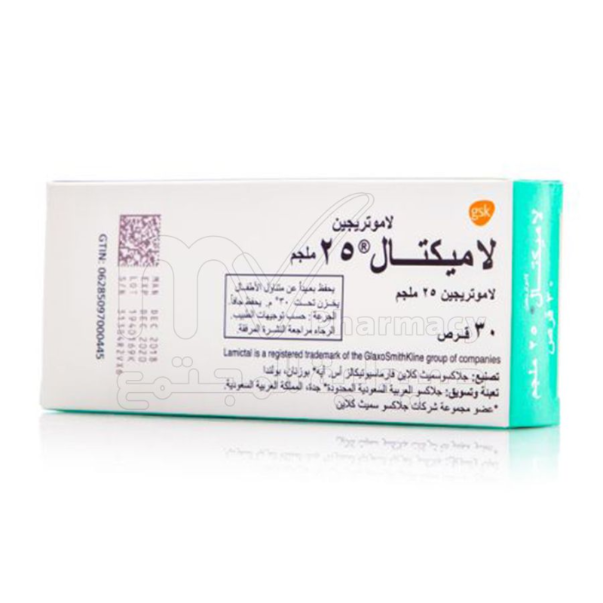
LAMICTAL 25MG TAB NEW
- Sku : I-012310
Key features
Lamictal Tablet 25mg is a prescription tablet containing lamotrigine 25 mg, supplied in a pack of 30 tablets. It works by inhibiting voltage-sensitive sodium channels, helping stabilize neuronal membranes and reduce the release of excitatory neurotransmitters. It is used for epilepsy, including partial seizures, generalized tonic-clonic seizures, and seizures associated with Lennox-Gastaut syndrome, as well as maintenance treatment of bipolar I disorder to help delay mood episodes. This product is available as tablets in a 30-tablet pack.- Brand: LAMICTAL
- Active Ingredient: LAMOTRIGINE 25mg
- Strength: 25mg
- Dosage Form: Tablet
- Pack Size: 30 Tablets
- Route: Oral use
- Prescription Status: Prescription
- Therapeutic Class: Anticonvulsant
- Pharmacological Group: Antiepileptics
- Drug Class: Phenyltriazine anticonvulsant (antiepileptic); also classified clinically as a mood stabilizer for bipolar disorder maintenance.
- Manufacturer: DELPHARM POZNAN SPOLKA AKCYJNA
- Country of Origin: Poland
- SFDA Registration No.: 2101256696
- Shelf Life: 24 months
- Storage: store below 30°c
- Psych Class: Mood Stabilizer
- Controlled Substance: No
Frequently bought together
Vitamins & Supplements > Omega-3 Supplements
Vitamins & Supplements > Sleeping aid supplements
Vitamins & Supplements > Sleeping aid supplements
Vitamins & Supplements > Sleeping aid supplements
Indications
Approved Uses
Epilepsy (adjunctive and monotherapy for partial seizures, generalized tonic-clonic seizures, seizures associated with Lennox-Gastaut syndrome), maintenance treatment of bipolar I disorder to delay mood episodes
Off-Label Uses
Common off-label uses include neuropathic pain and trigeminal neuralgia; other off-label psychiatric uses (e.g., PTSD or borderline personality disorder) have limited/variable evidence and are not standard.
Dosage & Administration
Dosing by Condition
Adults-Epilepsy (adjunct): With valproate: 25 mg every other day x2 weeks, then 25 mg daily x2 weeks, then increase by 25-50 mg every 1-2 weeks; typical maintenance 100-200 mg/day. With enzyme inducers (carbamazepine/phenytoin/phenobarbital/primidone) and no valproate: 50 mg daily x2 weeks, then 100 mg/day in 2 divided doses x2 weeks, then increase by 100 mg every 1-2 weeks; typical maintenance 200-400 mg/day. Adults-Bipolar I (maintenance): No valproate/inducers: 25 mg daily x2 weeks, 50 mg daily x2 weeks, 100 mg daily x1 week, then 200 mg daily maintenance; with valproate: 25 mg every other day x2 weeks, 25 mg daily x2 weeks, 50 mg daily x1 week, then 100 mg daily maintenance; with enzyme inducers (no valproate): 50 mg daily x2 weeks, 100 mg/day x2 weeks, 200 mg/day x1 week, 300 mg/day x1 week, then 400 mg/day maintenance.
Initial Dose
25 mg once daily for 2 weeks (monotherapy, without valproate or enzyme inducers); 25 mg every other day for 2 weeks then 25 mg once daily for 2 weeks (with valproate); 50 mg once daily for 2 weeks (with enzyme-inducing AEDs without valproate
Maintenance Dose
Epilepsy (typical maintenance): 100-200 mg/day (monotherapy); 200-400 mg/day with enzyme-inducing AEDs (without valproate); 100-200 mg/day with valproate. Bipolar disorder (maintenance): 200 mg/day (100 mg/day with valproate; up to 400 mg/day with enzyme inducers).
Maximum Dose
700mg/day (with enzyme-inducing AEDs in epilepsy); 400mg/day (bipolar disorder with enzyme inducers)
Children's Dosage
Epilepsy (2-12 years, adjunct with valproate): Initial 0.15mg/kg/day for 2 weeks, then 0.3mg/kg/day for 2 weeks, maintenance 1-5mg/kg/day (max 200mg/day). Epilepsy (2-12 years, with enzyme inducers without valproate): Initial 0.6mg/kg/day for 2 weeks, then 1.2mg/kg/day for 2 weeks, maintenance 5-15mg/kg/day (max 400mg/day). Not approved for bipolar disorder under 18 years. Not recommended under 2 years
Dose Adjustment Notes
Slow titration is required to reduce serious rash risk; adjust dosing when used with valproate (lower doses) or enzyme inducers (higher doses); use reduced doses in hepatic impairment and consider lower maintenance/slow titration in significant renal impairment (especially end-stage renal disease).
How to Take
Oral use: swallow the tablet with water (with or without food) at the same time each day; do not crush/chew unless specifically instructed for a dispersible/chewable formulation (this SFDA product is a standard tablet).
Side Effects
Common Side Effects
Dizziness, headache, diplopia, blurred vision, nausea/vomiting, somnolence or insomnia, ataxia (lack of coordination), tremor, fatigue, and rash.
Side Effect Frequency
Very common (≥10%): dizziness, headache, diplopia/blurred vision, nausea, ataxia, somnolence; rash is common overall but can be ≥10% in some datasets. Common (1-10%): vomiting, insomnia, tremor, fatigue, back pain, diarrhea. Rare/very rare: serious cutaneous adverse reactions (SJS/TEN), DRESS, aseptic meningitis, suicidal ideation/behavior, hemophagocytic lymphohistiocytosis.
Safety & Warnings
Contraindications
Contraindication: hypersensitivity to lamotrigine or any component/excipient of the formulation.
Warnings & Precautions
Key warnings/precautions: strict slow titration to reduce serious rash risk (highest in first 2-8 weeks; increased with valproate or rapid escalation); discontinue for rash unless clearly non-drug-related; monitor for hypersensitivity/DRESS, HLH, aseptic meningitis, and suicidal thoughts/behavior; avoid abrupt withdrawal (taper ≥2 weeks when feasible); consider cardiac risk (conduction disorders/structural heart disease) and monitor/avoid in high-risk patients; estrogen-containing contraceptives can lower lamotrigine levels-dose adjustments/monitoring may be needed.
Age Restriction
Epilepsy: approved for patients ≥2 years (as adjunctive therapy for certain seizure types; monotherapy indications vary by jurisdiction). Bipolar I maintenance: approved for adults; not approved <18 years.
Driving Warning
May Cause Drowsiness
Drug Interactions
Drug Interactions
Major interactions: valproate increases lamotrigine concentrations (requires lower lamotrigine dosing); enzyme inducers (carbamazepine, phenytoin, phenobarbital, primidone, rifampin) decrease lamotrigine concentrations; estrogen-containing hormonal contraceptives decrease lamotrigine concentrations (and levels rise during pill-free week); some HIV protease inhibitor regimens (e.g., lopinavir/ritonavir, atazanavir/ritonavir) can decrease lamotrigine concentrations-monitor and adjust. Sertraline is not a consistent clinically significant interaction.
Interaction Severity
MAJOR: Valproate/divalproex (markedly increases lamotrigine concentrations and rash risk-requires much lower lamotrigine dosing/titration). MAJOR: Enzyme-inducing AEDs (carbamazepine, phenytoin, phenobarbital, primidone) and rifampin (reduce lamotrigine concentrations-often requires higher doses). MAJOR/MODERATE (clinically significant): Estrogen-containing hormonal contraceptives (can reduce lamotrigine levels ~50% and levels rise during pill-free week-dose adjustments/monitoring needed). MODERATE: Certain HIV protease inhibitor regimens (e.g., lopinavir/ritonavir, atazanavir/ritonavir) can lower lamotrigine exposure. MINOR: Antacids-no clinically meaningful interaction.
Food Interaction
No restriction.
Special Populations
Pregnancy
Category C (Risk cannot be ruled out
Breastfeeding
Caution
Children
Epilepsy (2-12 years, adjunct with valproate): Initial 0.15mg/kg/day for 2 weeks, then 0.3mg/kg/day for 2 weeks, maintenance 1-5mg/kg/day (max 200mg/day). Epilepsy (2-12 years, with enzyme inducers without valproate): Initial 0.6mg/kg/day for 2 weeks, then 1.2mg/kg/day for 2 weeks, maintenance 5-15mg/kg/day (max 400mg/day). Not approved for bipolar disorder under 18 years. Not recommended under 2 years
Elderly
Start at lower dose, titrate slowly. Mean effective doses are often lower (e.g., 50-150 mg/day) than in younger adults.
Kidney Impairment
No specific initial dose change is usually required, but use caution in significant renal impairment and consider reduced maintenance doses (including in end-stage renal disease) because metabolites may accumulate; titrate to clinical response/tolerability.
Liver Impairment
Mild hepatic impairment (Child-Pugh A): no adjustment needed. Moderate hepatic impairment (Child-Pugh B): reduce initial, escalation, and maintenance doses by approximately 50%. Severe hepatic impairment (Child-Pugh C): reduce initial, escalation, and maintenance doses by approximately 75%
Storage & Patient Advice
Missed Dose
Take the missed dose as soon as remembered unless it is close to the next dose; do not double doses. If lamotrigine has been missed for >5 half-lives (about 3-5 days, longer if on valproate), contact the prescriber because re-titration may be needed.
Stopping the Medicine
Do not stop abruptly; taper over at least 2 weeks when possible, but discontinue rapidly if serious safety concerns occur (e.g., rash, hypersensitivity).
Overdose
Overdose may cause ataxia, nystagmus, dizziness, seizures, decreased consciousness/coma, and cardiac conduction abnormalities (e.g., QRS widening); management is supportive with airway/ventilation as needed, activated charcoal if appropriate, and ECG/cardiac monitoring-seek emergency care immediately.
Patient Counseling
Take exactly as prescribed and do not stop abruptly; titrate slowly and do not change doses without advice. Seek urgent care for any rash (especially with fever, mouth sores, facial swelling, or swollen glands). Report mood changes or suicidal thoughts. Use caution with driving/alcohol until effects are known. Tell clinicians about all medicines-valproate, enzyme-inducing seizure medicines, and estrogen-containing contraceptives can require dose changes; if therapy is interrupted for several days, contact the prescriber as re-titration may be needed.
Monitoring Requirements
Monitor closely for rash and hypersensitivity (especially during the first 2-8 weeks and after dose increases), suicidal ideation/behavior and mood changes, and clinical seizure/mood control; consider baseline and periodic hepatic/renal assessment in at-risk patients; serum levels are not routine but may be useful in select situations (adherence, pregnancy, interactions, toxicity).
Pharmacology
Mechanism of Action
Inhibits voltage-sensitive sodium channels, stabilizing neuronal membranes and reducing presynaptic release of excitatory neurotransmitters (notably glutamate and aspartate).
Onset of Action
Clinical benefit is gradual due to mandatory titration: seizure control may improve over days to weeks as target doses are reached; bipolar maintenance/antidepressant benefit typically emerges over several weeks (sometimes longer).
Duration of Effect
Supports once- or twice-daily dosing; effective duration is driven by a long half-life (~25-33 hours in monotherapy, shorter with enzyme inducers and longer with valproate).
Half-Life
Approximately 25-33 hours in adults on lamotrigine monotherapy; ~14 hours with enzyme-inducing antiepileptics (e.g., carbamazepine, phenytoin, phenobarbital, primidone); ~48-70 hours with valproate co-therapy.
Bioavailability
Approximately 98% (high oral bioavailability).
Metabolism
Hepatic metabolism primarily via glucuronidation (mainly UGT1A4; also UGT2B7), with minimal CYP450 involvement.
Excretion
Primarily renal excretion of metabolites (mainly glucuronide conjugates), with a small fraction excreted unchanged in urine.
Protein Binding
Approximately 55% protein bound.
Product Information
Available Dosage Forms
Tablet, Chewable/dispersible tablet, Orally disintegrating tablet, Extended-release tablet.
Composition per Dose
Each tablet: 25mg lamotrigine
Generic Availability
Yes
OTC Alternatives
No OTC alternative
Psych Class
Mood Stabilizer
Controlled Substance
No
Reviewed by Al Mujtama Pharmacy Medical Review Team. Last reviewed 07-07-2026
Similar Products
Medications > Diabetes Medications
Medications > Dermatology Medications
Medications > Gastrointestinal Medications
Medications > Psychiatric Medications

Medications > Cold, Cough, and Allergy Medications
Medications > Urology Medications
Medications > Painkillers and Antipyretics
Medications > Other Medicines

Medications > Dermatology Medications
Medications > Gastrointestinal Medications
