
Use Code: ND30 And Get 30% OFF | Get Free Delivery With No Minimum Order
-1744229570.gif "Almujtama Pharmacy logo")




Frequently bought together
Vitamins & Supplements > Natural Supplements
Vitamins & Supplements > Probiotecs
Vitamins & Supplements > Probiotecs

Vitamins & Supplements > Natural Supplements
Vitamins & Supplements > Probiotecs
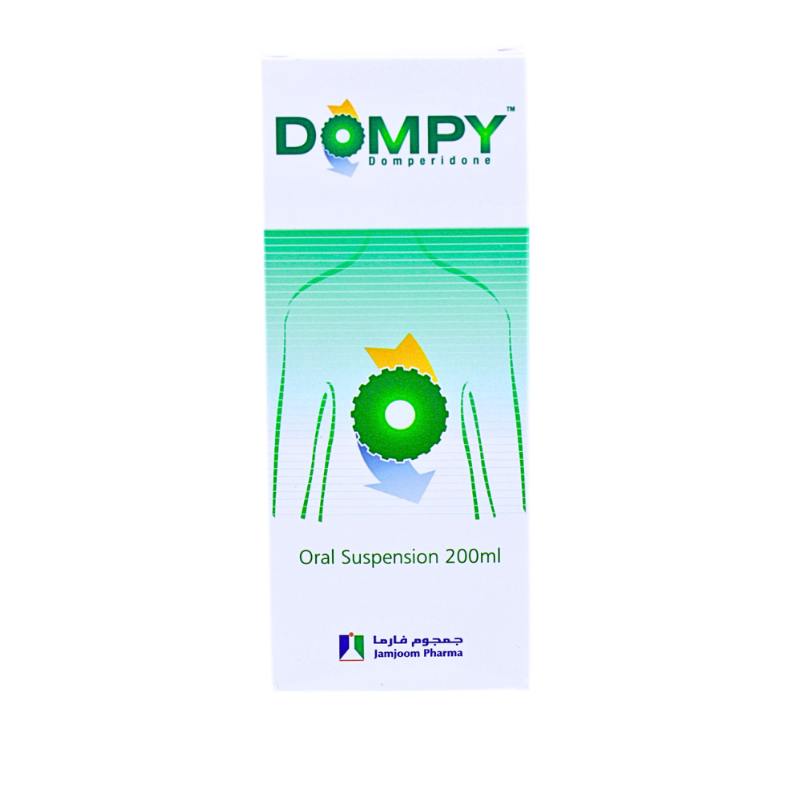
DOMPY SUSP 200ML
- Sku : I-001709
Key features
DOMPY SUSP 200ML is a DOMPY-brand oral suspension containing domperidone 0.1 mg/ml as the active ingredient. It functions as a peripherally selective dopamine D2 (and to a lesser extent D3) receptor antagonist at the chemoreceptor trigger zone and gastrointestinal tract, producing antiemetic effects and enhancing gastric motility with limited blood-brain barrier penetration. It is indicated for the short-term symptomatic treatment of nausea and vomiting. Available as a prescription suspension in a 200 ml pack.- Brand: DOMPY
- Active Ingredient: DOMPERIDONE 0.1mg/ml
- Strength: 0.1mg/ml
- Dosage Form: Suspension
- Pack Size: 200 ml
- Route: Oral use
- Prescription Status: Prescription
- Therapeutic Class: Gastrointestinal
- Pharmacological Group: Antispasmodics
- Drug Class: Peripherally selective dopamine D2-receptor antagonist with prokinetic and antiemetic activity.
- Manufacturer: Jamjoom Pharmaceuticals Factory Company
- Country of Origin: Saudi Arabia
- SFDA Registration No.: 1109234167
- Shelf Life: 36 months
- Storage: store below 30°c
- Gi Condition: Nausea/Vomiting
Frequently bought together
Vitamins & Supplements > Natural Supplements
Vitamins & Supplements > Probiotecs
Vitamins & Supplements > Probiotecs
Vitamins & Supplements > Natural Supplements
Vitamins & Supplements > Probiotecs
Indications
Approved Uses
Short-term symptomatic treatment of nausea and vomiting.
Off-Label Uses
Gastroparesis (specialist-directed where alternatives are limited) and lactation augmentation (galactagogue) are commonly cited off-label uses; use is constrained by cardiac safety concerns.
Dosage & Administration
Dosing by Condition
Nausea/Vomiting: Adults and adolescents ≥12 years and ≥35 kg: 10 mg up to three times daily, 15-30 minutes before meals; maximum 30 mg/day; typically short-term (often ≤7 days). Pediatric dosing should be specialist-directed and is generally not recommended for <12 years/<35 kg in many guidelines due to cardiac risk.
Initial Dose
10mg (10ml of 0.1% suspension) three times daily, 15-30 minutes before meals
Maintenance Dose
10mg (10ml) up to three times daily as needed.
Maximum Dose
Maximum 30 mg/day (adults and adolescents ≥12 years and ≥35 kg): 10 mg up to 3 times daily. Pediatric dosing: 0.25 mg/kg per dose up to 3 times daily (maximum 0.75 mg/kg/day; do not exceed 30 mg/day).
Children's Dosage
0.25mg/kg per dose (2.5ml/10kg), up to 3 times daily, 15-30 minutes before meals; maximum 0.75mg/kg/day; not recommended in neonates due to immature metabolic function
Dose Adjustment Notes
Use the lowest effective dose for the shortest duration (often ≤7 days for acute N/V); in renal impairment consider reducing frequency (e.g., 1-2 times daily) and monitor; avoid in moderate-to-severe hepatic impairment; avoid doses >30 mg/day due to increased QT/arrhythmia risk.
How to Take
Shake well before each dose; measure with an oral syringe/measuring device; take orally 15-30 minutes before meals (preferably before food); avoid taking with grapefruit juice; follow prescribed dose and duration.
How to Prepare
Ready-to-use oral suspension (no reconstitution required). Shake well before each dose; measure with an oral syringe/cup.
Side Effects
Common Side Effects
Dry mouth, headache, abdominal cramps, diarrhea; hyperprolactinemia-related effects (e.g., galactorrhea, menstrual irregularities, gynecomastia) can occur.
Side Effect Frequency
Common: dry mouth; Uncommon/Rare: headache, GI effects (e.g., diarrhea/abdominal cramps), hyperprolactinemia-related effects (galactorrhea, gynecomastia, amenorrhea, breast tenderness), rash/urticaria; Rare/very rare but clinically serious: QT prolongation, ventricular arrhythmias/sudden cardiac death; Extrapyramidal effects are rare (more in children)
Safety & Warnings
Contraindications
Contraindicated in: hypersensitivity; prolactinoma; GI hemorrhage/obstruction/perforation or when increased motility is dangerous; known QT prolongation or significant cardiac disease (e.g., CHF); significant electrolyte disturbances; concomitant QT-prolonging drugs and/or potent CYP3A4 inhibitors; moderate-to-severe hepatic impairment.
Warnings & Precautions
Key precautions: increased risk of QT prolongation/serious ventricular arrhythmias and sudden death-use lowest effective dose for shortest duration; avoid in patients with QT prolongation, significant cardiac disease, or electrolyte disturbances; avoid QT-prolonging drugs and potent CYP3A4 inhibitors; use caution and reduce frequency in severe renal impairment; contraindicated in moderate-to-severe hepatic impairment; may increase prolactin (galactorrhea/gynecomastia).
Age Restriction
Not recommended in children <12 years or <35 kg unless specialist-directed; avoid in neonates/infants unless clearly indicated and monitored.
Drug Interactions
Drug Interactions
Major interactions: (1) QT-prolonging drugs (e.g., amiodarone, sotalol, many antipsychotics, macrolides/fluoroquinolones) increase arrhythmia risk; (2) potent CYP3A4 inhibitors (e.g., ketoconazole/itraconazole, clarithromycin/erythromycin, ritonavir) increase domperidone exposure and QT risk; (3) antacids/antisecretory agents can reduce absorption if taken together (separate dosing); (4) anticholinergics may reduce prokinetic effect.
Interaction Severity
MAJOR: Potent CYP3A4 inhibitors (e.g., ketoconazole/itraconazole, clarithromycin/erythromycin, ritonavir) and other QT-prolonging drugs (e.g., amiodarone, sotalol, haloperidol) due to increased QT prolongation/arrhythmia risk; MODERATE: Antacids/antisecretory agents can reduce bioavailability if taken together (separate dosing); MODERATE: Anticholinergics may reduce prokinetic effect.
Food Interaction
Take 15-30 minutes before meals (on an empty stomach) because food can reduce/delay absorption and may reduce effectiveness.
Special Populations
Children
0.25mg/kg per dose (2.5ml/10kg), up to 3 times daily, 15-30 minutes before meals; maximum 0.75mg/kg/day; not recommended in neonates due to immature metabolic function
Kidney Impairment
In severe renal impairment, reduce dosing frequency to once or twice daily and use the lowest effective dose; mild impairment usually needs no adjustment.
Storage & Patient Advice
Storage Conditions
Store below 30°C. Keep away from light and moisture. Keep out of reach of children. No reconstitution required - ready-to-use suspension.
Preparation Instructions
Ready-to-use oral suspension (no reconstitution required). Shake well before each dose; measure with an oral syringe/cup.
Missed Dose
Take as soon as remembered; skip if it is almost time for the next dose; do not double the dose
Stopping the Medicine
Can be stopped without tapering; use the lowest effective dose for the shortest duration and seek medical advice if symptoms persist or if use is needed beyond about 7 days.
Overdose
Symptoms may include drowsiness, confusion, agitation, and extrapyramidal reactions (especially in children); management is supportive with consideration of activated charcoal if recent ingestion and ECG monitoring for QT prolongation/arrhythmias; treat extrapyramidal symptoms with anticholinergic/antiparkinson agents as needed and seek urgent care.
Patient Counseling
Shake well and measure doses accurately; take 15-30 minutes before meals; do not exceed prescribed dose (max 30 mg/day) or use longer than advised (often ≤7 days for acute N/V) due to heart rhythm risk; seek urgent care for palpitations, fainting, or severe dizziness; avoid/consult before using macrolide antibiotics, azole antifungals, HIV protease inhibitors, or other QT-prolonging medicines; report breast changes/milk production or menstrual changes; store below 30°C.
Monitoring Requirements
Assess cardiac risk before use; consider baseline and follow-up ECG in patients with risk factors (history of QT prolongation, cardiac disease, electrolyte abnormalities) or when co-administered with interacting drugs; monitor/correct K+/Mg2+ in at-risk patients; monitor for symptoms of arrhythmia; consider prolactin-related adverse effects if symptomatic.
Pharmacology
Mechanism of Action
Peripherally selective dopamine D2 (and to a lesser extent D3) receptor antagonist acting at the chemoreceptor trigger zone and GI tract to provide antiemetic effects and enhance gastric motility/emptying, with limited blood-brain barrier penetration.
Onset of Action
30-60 minutes.
Duration of Effect
Approximately 4-6 hours (clinical effect), hence dosing up to three times daily.
Half-Life
7-9 hours.
Bioavailability
Approximately 13-17% oral bioavailability
Metabolism
Extensive first-pass metabolism in the gut wall and liver, primarily via CYP3A4
Protein Binding
91-93%.
Product Information
Available Dosage Forms
For this SFDA-registered product: Oral suspension only (DOMPY 0.1% oral suspension, 200 mL bottle).
Composition per Dose
Each 10ml: 1mg domperidone (as 0.1mg/ml suspension)
Generic Availability
Yes
OTC Alternatives
No OTC alternative
Gi Condition
Nausea/Vomiting
Reviewed by Al Mujtama Pharmacy Medical Review Team. Last reviewed 29-06-2026
Similar Products
Medications > Gastrointestinal Medications
Medications > Eye and Ear Medications
Medications > Urology Medications
Medications > Painkillers and Antipyretics
Medications > Gastrointestinal Medications
Medications > Dermatology Medications
Medications > Sexual Health
Medications > Dermatology Medications
Medications > Dermatology Medications
Medications > Cold, Cough, and Allergy Medications
