
Use Code: ND30 And Get 30% OFF | Get Free Delivery With No Minimum Order
-1744229570.gif "Almujtama Pharmacy logo")




Frequently bought together
Health Care & Wellness > Diabetes Care
Health Care & Wellness > Diabetes Care
Health Care & Wellness > Diabetes Care
Skin And Body Care > Moisturizers
Skin And Body Care > Moisturizers
Skin And Body Care > Moisturizers
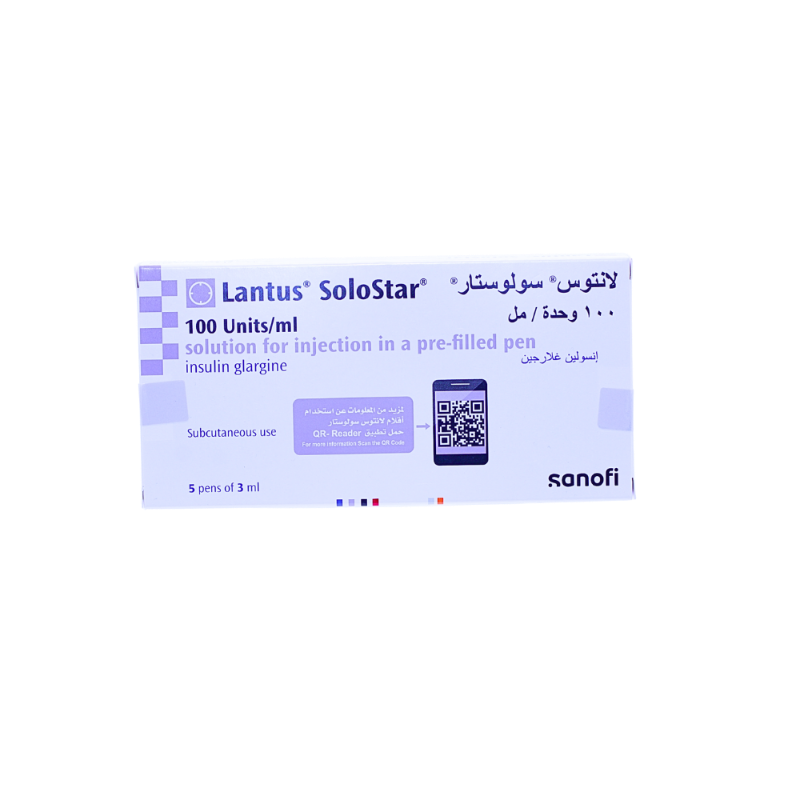
LANTUS SOLOSTAR 100/UNITS/ML 5×3ML/PENFILL @
- Sku : I-003479
Key features
LANTUS SOLOSTAR 100 IU/mL is a solution containing insulin glargine 100 IU/mL. Insulin glargine is a long-acting insulin analog that binds insulin receptors to increase peripheral glucose uptake and decrease hepatic glucose output, with prolonged, steady action resulting from slow, continuous absorption after subcutaneous injection due to precipitation in the tissue. It is indicated to improve glycemic control in adults and pediatric patients aged 6 years and older with type 1 diabetes mellitus, and in adults with type 2 diabetes mellitus. Supplied as 3 mL prefilled penfills, packaged as a pack of five.- Brand: LANTUS
- Active Ingredient: INSULIN GLARGINE 100IU/ml
- Strength: 100IU/ml
- Dosage Form: Solution
- Pack Size: 3 ml
- Route: Subcutaneous use
- Prescription Status: Prescription
- Therapeutic Class: Antidiabetic
- Pharmacological Group: Insulins
- Drug Class: Long-acting Insulin Analog (Basal Insulin)
- Manufacturer: sanofi-aventis
- Country of Origin: Germany
- SFDA Registration No.: 2705257464
- Shelf Life: 36 months
- Storage: store in a refrigerator (2°c - 8°c)
- Diabetes Type: Both
- Insulin Type: Long-acting
Frequently bought together
Health Care & Wellness > Diabetes Care
Health Care & Wellness > Diabetes Care
Health Care & Wellness > Diabetes Care
Skin And Body Care > Moisturizers
Skin And Body Care > Moisturizers
Skin And Body Care > Moisturizers
Indications
Approved Uses
To improve glycemic control in adults and pediatric patients ≥6 years with type 1 diabetes mellitus, and in adults with type 2 diabetes mellitus.
Dosage & Administration
Dosing by Condition
Type 1 DM (≥6 years): use as basal insulin once daily as part of a basal-bolus regimen; basal typically ~1/3 to 1/2 of total daily insulin requirement, then titrate to fasting targets. Type 2 DM (adults): start 10 units once daily or 0.1-0.2 units/kg once daily, then titrate (e.g., by 2 units every 3 days or 1-2 units once/twice weekly) to fasting glucose goal while avoiding hypoglycemia.
Initial Dose
Type 2 DM: 10 IU (or 0.2 IU/kg) subcutaneously once daily at the same time each day. Type 1 DM: Approximately 0.2 IU/kg/day as part of a basal-bolus regimen.
Maintenance Dose
Individualized based on metabolic needs, blood glucose monitoring, glycemic control, type of diabetes, and prior insulin use; titrate to glycemic control goals.
Maximum Dose
No specific maximum dose; individualize and titrate to glycemic targets and clinical response.
Children's Dosage
Safety and effectiveness in pediatric patients under 6 years of age have not been established.
Dose Adjustment Notes
Individualize and titrate based on fasting SMBG/CGM and hypoglycemia; adjust with changes in diet, activity, illness, or interacting drugs, and consider lower requirements in renal/hepatic impairment. When switching from twice-daily NPH to once-daily insulin glargine, start at ~80% of the total daily NPH dose (≈20% reduction) and titrate.
How to Take
Subcutaneous injection only (abdomen, thigh, or upper arm) once daily at the same time each day; rotate injection sites. Do NOT administer IV or IM and do NOT use in an insulin pump. For SoloStar: use a new needle each injection, prime per pen instructions, inject and hold the needle in the skin ~10 seconds, then remove; do not mix or dilute with other insulins/solutions.
How to Prepare
Ready-to-use prefilled pen: visually inspect-solution must be clear, colorless, particle-free. Attach a new needle for each injection. Prime/safety test per manufacturer IFU (commonly 2 units) before each injection to ensure flow. Do not mix or dilute. Use only subcutaneously.
Side Effects
Common Side Effects
Hypoglycemia; injection-site reactions (pain, erythema, pruritus, swelling); lipodystrophy; weight gain; peripheral edema; rash (less common).
Safety & Warnings
Contraindications
Contraindicated during episodes of hypoglycemia and in patients with hypersensitivity to insulin glargine or any excipients.
Warnings & Precautions
Major warnings/precautions: hypoglycemia (most common; monitor and educate), never share pens/needles, SC use only (do not give IV/IM), do not mix/dilute with other insulins/solutions, adjust dose with illness/stress/diet/exercise changes, monitor/avoid hypokalemia, TZD + insulin may cause fluid retention/heart failure, rotate injection sites to prevent lipodystrophy/cutaneous amyloidosis, and prevent medication errors by verifying insulin type/strength.
Age Restriction
Approved for use in adults and pediatric patients ≥6 years (not recommended/approved for children <6 years).
Driving Warning
Avoid Driving
Drug Interactions
Drug Interactions
Key interactions: (1) Thiazolidinediones (pioglitazone/rosiglitazone) + insulin → fluid retention/heart failure risk; (2) agents that increase hypoglycemia risk (other antidiabetics, ACE inhibitors, salicylates, MAOIs, some antidepressants) and agents that raise glucose (corticosteroids, thiazides/loop diuretics, sympathomimetics, thyroid hormones, some antipsychotics); (3) beta-blockers/clonidine may mask hypoglycemia; alcohol may increase hypoglycemia; octreotide/lanreotide may increase or decrease insulin needs.
Interaction Severity
MAJOR: Thiazolidinediones (pioglitazone/rosiglitazone) with insulin-risk of fluid retention/heart failure. MODERATE: Other glucose-lowering drugs (↑ hypoglycemia), ACE inhibitors/salicylates/MAOIs (may ↑ hypoglycemia), corticosteroids/thiazides/sympathomimetics/atypical antipsychotics (may ↑ glucose), beta-blockers (mask hypoglycemia symptoms). MINOR/variable: Alcohol (can ↑ hypoglycemia and impair awareness; effect may be unpredictable).
Food Interaction
No specific food-timing requirement for glargine itself; counsel consistent carbohydrate intake and caution with alcohol due to increased risk of hypoglycemia.
Special Populations
Pregnancy
Category C: Animal reproduction studies have not shown a fetal risk but there are no controlled studies in pregnant women, or animal reproduction studies have shown an adverse effect (other than a decrease in fertility) that was not confirmed in controlled studies in women in the first trimester.
Breastfeeding
It is unknown whether LANTUS is excreted in human milk. Caution should be exercised when LANTUS is administered to a nursing woman.
Children
Safety and effectiveness in pediatric patients under 6 years of age have not been established.
Elderly
Use with caution; hypoglycemia may be more difficult to recognize and more severe. Start at lower doses, titrate slowly, and monitor blood glucose frequently. Renal function decline in elderly may reduce insulin clearance and increase hypoglycemia risk.
Kidney Impairment
No fixed adjustment; dose may need reduction in renal impairment-monitor glucose closely and individualize.
Liver Impairment
No fixed adjustment; dose may need reduction in hepatic impairment-monitor glucose closely and individualize.
Storage & Patient Advice
Storage Conditions
store in a refrigerator (2°c - 8°c)
Preparation Instructions
Ready-to-use prefilled pen: visually inspect-solution must be clear, colorless, particle-free. Attach a new needle for each injection. Prime/safety test per manufacturer IFU (commonly 2 units) before each injection to ensure flow. Do not mix or dilute. Use only subcutaneously.
Stopping the Medicine
Do not stop or change dose abruptly without medical supervision; interruption/inadequate dosing can cause severe hyperglycemia and diabetic ketoacidosis.
Overdose
Overdose primarily causes hypoglycemia (may be prolonged) and can cause hypokalemia; treat mild/moderate with oral fast-acting carbohydrate, and severe with IV dextrose and/or glucagon, followed by ongoing carbohydrate intake and close monitoring for recurrence.
Patient Counseling
Inject subcutaneously once daily at the same time each day; never IV/IM. Rotate injection sites (abdomen, thigh, upper arm) to reduce lipodystrophy/amyloidosis. Use a new needle each time and never share the pen/needles. Do not mix or dilute insulin glargine with other insulins. Check the solution is clear/colorless and use correct pen technique (prime per IFU). Monitor glucose as directed; recognize and treat hypoglycemia (carry fast-acting carbohydrate) and know when to seek help. Keep follow-up for dose titration; do not stop insulin abruptly without medical advice. Storage: unopened pens refrigerated 2-8°C; in-use pen kept <30°C, protected from heat/light, and discarded after 28 days (per product labeling).
Monitoring Requirements
Monitor blood glucose regularly (SMBG/CGM) and assess for hypoglycemia; check HbA1c about every 3 months until stable then at least twice yearly. Monitor potassium in at-risk patients (e.g., high-dose insulin, renal impairment) and monitor weight/edema and injection sites; renal/hepatic function monitoring is clinically appropriate when impairment is present or suspected.
Pharmacology
Mechanism of Action
Insulin glargine is a long-acting insulin analog that binds insulin receptors to increase peripheral glucose uptake and decrease hepatic glucose output; its prolonged action is due to precipitation in subcutaneous tissue after injection (acidic solution neutralizes), causing slow, continuous absorption.
Onset of Action
Onset is gradual, typically about 1-2 hours after subcutaneous injection.
Duration of Effect
Approximately 24 hours (may be shorter in some patients), with a relatively flat/peakless profile compared with NPH.
Half-Life
A conventional plasma half-life is not clinically meaningful for insulin glargine after subcutaneous injection; its clinical effect is governed by slow, continuous absorption from the subcutaneous depot with a duration of action up to ~24 hours (sometimes longer).
Metabolism
After subcutaneous injection, insulin glargine is proteolytically converted mainly to active metabolite M1 (and to a lesser extent M2) in the subcutaneous tissue and systemically; M1 predominates in circulation.
Product Information
Available Dosage Forms
Injection, solution (insulin glargine U-100) supplied as: prefilled disposable pen (SoloStar), 10 mL vial, and 3 mL cartridge (for compatible reusable pens) depending on market.
Composition per Dose
Each 1 mL: Insulin glargine 100 IU (equivalent to 3.6378 mg); Each 3 mL pen: Insulin glargine 300 IU total. Excipients: zinc chloride, m-cresol, glycerol 85%, polysorbate 20, hydrochloric acid, sodium hydroxide, water for injections
Generic Availability
No; brand insulin glargine (Lantus) has authorized generics but original is reference-listed
OTC Alternatives
No OTC alternative - insulin glargine requires a prescription; no OTC insulin equivalent is available for basal insulin replacement
Diabetes Type
Both
Insulin Type
Long-acting
Reviewed by Al Mujtama Pharmacy Medical Review Team. Last reviewed 29-05-2026
Similar Products
Medications > Dermatology Medications
Medications > Hemorrhoid Medications
Medications > Gastrointestinal Medications
Medications > Eye and Ear Medications
Medications > Urology Medications
Medications > Cold, Cough, and Allergy Medications
Medications > Diabetes Medications
Medications > Psychiatric Medications
Medications > Cold, Cough, and Allergy Medications
Medications > Dermatology Medications
