
Use Code: ND30 And Get 30% OFF | Get Free Delivery With No Minimum Order
-1744229570.gif "Almujtama Pharmacy logo")




Frequently bought together
Vitamins & Supplements > Vitamins and Minerals
Vitamins & Supplements > Vitamins and Minerals
Vitamins & Supplements > Vitamins and Minerals
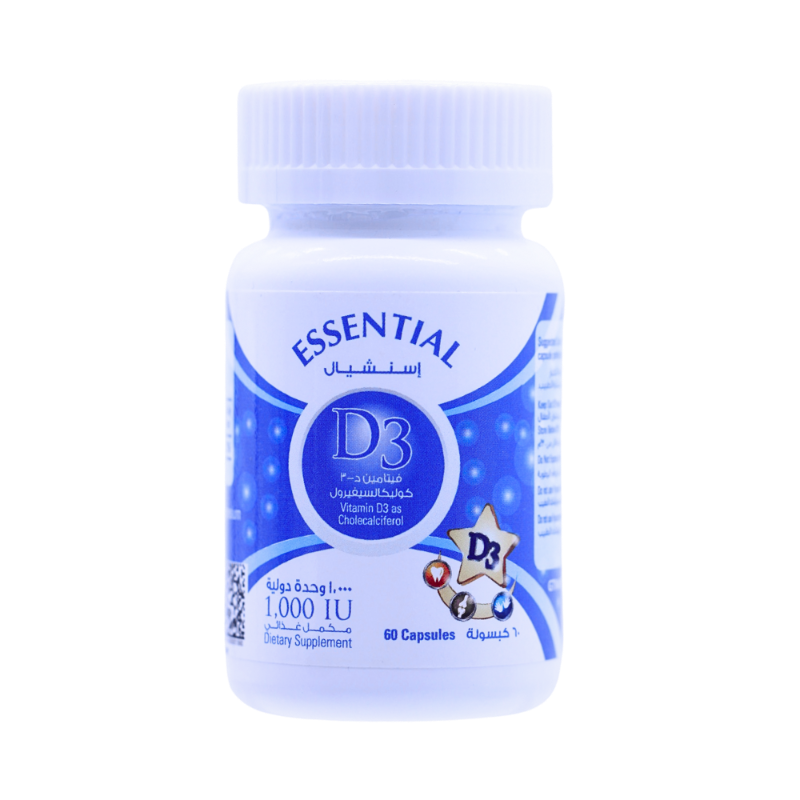
ESSENTIAL D3 1000/IU CAP 60/CAP
- Sku : I-022594
Key features
ESSENTIAL D3 1000 IU capsules contain cholecalciferol (Vitamin D3) 1000 IU (25 mcg) per capsule in an easy-to-swallow capsule form. They support bone health, calcium absorption, and immune function, making them suitable for adults seeking to maintain adequate vitamin D levels. The formula uses Vitamin D3 (cholecalciferol), the most bioavailable form-approximately 87% more effective than D2 (ergocalciferol) at raising and sustaining serum 25-hydroxyvitamin D levels-promoting efficient absorption. Serving size is one capsule; available in a 60-capsule pack.- Brand: ESSENTIAL
- Supplement Type: Vitamin
- Active Compounds: Cholecalciferol (Vitamin D3) 1000 IU (25 mcg)
- Supplement Form: Capsule
- Serving Size: 1 capsule
- Servings Per Container: 60
- Pack Size: 60 Capsules
- Primary Benefit: Supports bone health, calcium absorption, and immune function by maintaining adequate vitamin D levels
- Bioavailability Form: Vitamin D3 (cholecalciferol) - the most bioavailable form, approximately 87% more effective than D2 (ergocalciferol) at raising and sustaining serum 25-hydroxyvitamin D levels
- Prescription Status: OTC
- Manufacturer: ARNET PHARMACEUTICAL CORP
- Country of Origin: United States
- SFDA Registration No.: 3003210652
- Shelf Life: 24 months
- Vitamin D Form: D3
- Calcium Included: No
- Vitamin K Included: No
Frequently bought together
Vitamins & Supplements > Vitamins and Minerals
Vitamins & Supplements > Vitamins and Minerals
Vitamins & Supplements > Vitamins and Minerals
Benefits & Uses
Primary Benefit
Supports bone health, calcium absorption, and immune function by maintaining adequate vitamin D levels
Health Claims
Contributes to normal absorption and utilization of calcium and phosphorus; supports maintenance of normal bones and teeth; supports normal muscle function; contributes to normal immune system function; helps reduce the risk of osteoporosis
Common Deficiency Symptoms
Fatigue, bone pain, muscle weakness, frequent infections, depression, hair loss, impaired wound healing, rickets in children, osteomalacia in adults
Target Population
Adults with limited sun exposure, elderly individuals (65+), dark-skinned individuals, people living in northern latitudes or indoor-confined settings, pregnant and breastfeeding women, individuals with malabsorption conditions, obese individuals
Scientific Evidence Level
Strong
Onset Timeline
Serum 25-hydroxyvitamin D levels begin rising within 1-2 weeks; optimal blood levels achieved in 2-3 months with consistent daily use; bone density improvements observed after 6-12 months
Usage & Dosage
Serving Size
1 capsule
Servings Per Container
60
Best Time to Take
With meals (preferably the largest meal of the day containing dietary fat)
Recommended Daily Intake
Adults: 600-800 IU/day (15-20 mcg); many health authorities support 1000-2000 IU/day for deficiency prevention
Upper Tolerable Limit
4000 IU/day (100 mcg) for adults (Institute of Medicine); some clinical guidelines allow up to 10,000 IU/day under medical supervision
Absorption Enhancers
Dietary fat (increases micellar solubilization and lymphatic absorption); magnesium (required for vitamin D metabolism and activation); bile acids
Absorption Inhibitors
Orlistat (blocks fat absorption, reducing vitamin D uptake); cholestyramine and colestipol (bile acid sequestrants impair absorption); high-dose calcium supplements taken simultaneously may compete; mineral oil laxatives reduce fat-soluble vitamin absorption
Side Effects
Possible Side Effects
Generally well-tolerated at 1000 IU/day; excessive doses may cause hypercalcemia, nausea, vomiting, constipation, weakness, polyuria, and kidney stones
Toxicity Risk
Low
Upper Tolerable Limit
4000 IU/day (100 mcg) for adults (Institute of Medicine); some clinical guidelines allow up to 10,000 IU/day under medical supervision
Safety & Warnings
Contraindications
Hypercalcemia; hypervitaminosis D; hypersensitivity to vitamin D; and conditions predisposing to hypercalcemia (e.g., primary hyperparathyroidism, granulomatous diseases such as sarcoidosis, and some malignancies including lymphoma); use caution/avoid in severe renal impairment and in patients with nephrolithiasis
Children Suitability
The safe upper limit for children 1-10 years is 2000 IU/day; 1000 IU daily is generally safe but consult a doctor for appropriate pediatric dosing.
Interactions
Medication Interactions
Orlistat reduces absorption; thiazide diuretics increase hypercalcemia risk when combined with high-dose vitamin D; corticosteroids impair vitamin D metabolism; anticonvulsants (phenytoin, phenobarbital) accelerate vitamin D catabolism; rifampin and isoniazid reduce vitamin D levels
Supplement Interactions
High-dose calcium supplements combined with vitamin D may increase hypercalcemia risk; vitamin A at very high doses may antagonize vitamin D activity
Special Populations
Target Population
Adults with limited sun exposure, elderly individuals (65+), dark-skinned individuals, people living in northern latitudes or indoor-confined settings, pregnant and breastfeeding women, individuals with malabsorption conditions, obese individuals
Children Suitability
The safe upper limit for children 1-10 years is 2000 IU/day; 1000 IU daily is generally safe but consult a doctor for appropriate pediatric dosing.
Storage & Patient Advice
SFDA Storage Conditions
store below 30°c
Patient Counseling
Take 1 capsule (vitamin D3 1000 IU) orally once daily, preferably with a meal (fat-containing meal may improve absorption). Do not exceed the labeled dose unless advised by a clinician; avoid chronic intakes >4000 IU/day without medical supervision. Consult a clinician before use if you have hypercalcemia, a history of kidney stones/severe renal impairment, or granulomatous disease (e.g., sarcoidosis). Vitamin D (25‑OH) and calcium monitoring may be considered in at‑risk patients or if using higher doses/long-term therapy.
Science & Evidence
Bioavailability Form
Vitamin D3 (cholecalciferol) - the most bioavailable form, approximately 87% more effective than D2 (ergocalciferol) at raising and sustaining serum 25-hydroxyvitamin D levels
Water or Fat Soluble
Fat-soluble
Scientific Evidence Level
Strong
Onset Timeline
Serum 25-hydroxyvitamin D levels begin rising within 1-2 weeks; optimal blood levels achieved in 2-3 months with consistent daily use; bone density improvements observed after 6-12 months
Food Sources
Fatty fish (salmon, mackerel, sardines, tuna), cod liver oil, egg yolks, beef liver, UV-exposed mushrooms, fortified milk and dairy products, fortified cereals
Product Information
Supplement Type
Vitamin
Suitable for Vegetarians
Yes
Suitable for Vegans
No
Vitamin D Form
D3
Calcium Included
No
Vitamin K Included
No
Reviewed by Al Mujtama Pharmacy Medical Review Team. Last reviewed 27-05-2026
Similar Products
Vitamins & Supplements > Probiotecs
Vitamins & Supplements > Vitamins and Minerals
Vitamins & Supplements > Vitamin_D & Bone Health

Vitamins & Supplements > Sleeping aid supplements
Vitamins & Supplements > Natural Supplements

Vitamins & Supplements > Natural Supplements
Vitamins & Supplements > Vitamins and Minerals
Vitamins & Supplements > Natural Supplements

Vitamins & Supplements > Skin and Hair Supplements
Vitamins & Supplements > Vitamin_D & Bone Health
