Use Code: ND30 And Get 30% OFF | Get Free Delivery With No Minimum Order
-1744229570.gif "Almujtama Pharmacy logo")




Frequently bought together
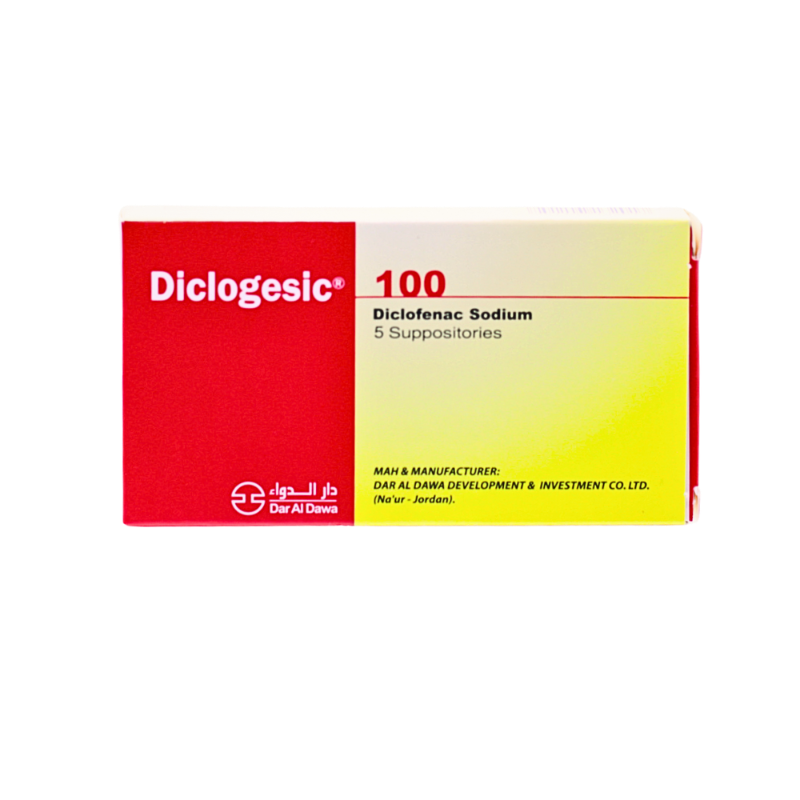
DICLOGESIC 100/MG SUPP 5/SUPP
- Sku : I-001661
Key features
DICLOGESIC 100 mg suppositories contain diclofenac sodium as the active ingredient. It inhibits cyclooxygenase-1 and cyclooxygenase-2 (COX-1 and COX-2), reducing prostaglandin synthesis to alleviate inflammation, pain and fever. Indicated for symptomatic treatment of pain and inflammation in rheumatic conditions (including rheumatoid arthritis, osteoarthritis and ankylosing spondylitis) and for acute pain such as dysmenorrhea, acute migraine attacks, and post-operative or post-traumatic pain. Supplied as a pack of 5 suppositories and available by prescription.- Brand: DICLOGESIC
- Active Ingredient: DICLOFENAC SODIUM
- Strength: 100mg
- Dosage Form: Suppository
- Pack Size: 5 Suppositories
- Route: Rectal use
- Prescription Status: Prescription
- Therapeutic Class: Analgesic
- Pharmacological Group: Acetic Acid Derivatives (NSAIDs)
- Drug Class: Nonsteroidal anti-inflammatory drug (NSAID); non-selective cyclooxygenase (COX-1/COX-2) inhibitor; acetic acid (phenylacetic acid) derivative.
- Manufacturer: DAR ALDAWA
- Country of Origin: Jordan
- SFDA Registration No.: 27-124-89
- Shelf Life: 36 months
- Storage: store below 30°c
- Pain Type: General/Muscular/Joint
- Nsaid: Yes
- Opioid: No
Frequently bought together
Indications
Approved Uses
Symptomatic treatment of pain and inflammation in rheumatic conditions (e.g., rheumatoid arthritis, osteoarthritis, ankylosing spondylitis) and acute pain conditions such as dysmenorrhea, acute migraine attacks, and post-operative/post-traumatic pain and inflammation.
Off-Label Uses
Off-label examples include acute gout flares and acute pericarditis (as an NSAID option); other pain indications (e.g., dental pain) may be used off-label depending on local practice.
Dosage & Administration
Dosing by Condition
Adults (rectal): typical total diclofenac dose 75-150 mg/day; for suppositories, 100 mg once daily (often at bedtime) is common, and some patients may require up to 150 mg/day total from all diclofenac formulations as directed; do not exceed 150 mg/day total without prescriber direction.
Initial Dose
100mg rectally as a single dose
Maintenance Dose
For rectal suppositories, 100 mg once daily.
Dose Adjustment Notes
Use the lowest effective dose for the shortest duration; use caution in older adults and those with renal/hepatic impairment or cardiovascular risk, and avoid use in severe renal or severe hepatic impairment unless specialist-directed.
How to Take
For rectal use only: remove the suppository from the foil/blister, insert into the rectum (preferably pointed end first) while lying on your side, remain lying for a few minutes to reduce expulsion, and wash hands before and after use.
Side Effects
Common Side Effects
Common: GI upset (abdominal pain, dyspepsia, nausea, diarrhea/constipation), headache, dizziness; with rectal use: local rectal irritation/discomfort/tenesmus; rash can occur.
Side Effect Frequency
Common (1-10%): GI symptoms (e.g., nausea, abdominal pain, dyspepsia, diarrhea/constipation, flatulence) and CNS symptoms (e.g., headache, dizziness). Uncommon (0.1-1%): transaminase elevations and local rectal irritation (for suppositories). Rare/very rare (<0.1%): GI ulceration/bleeding, severe hypersensitivity (including anaphylaxis), severe cutaneous adverse reactions, clinically significant hepatotoxicity/jaundice, renal impairment, and serious cardiovascular events (e.g., heart failure).
Safety & Warnings
Contraindications
Hypersensitivity to diclofenac/other NSAIDs; history of asthma/urticaria/allergic-type reaction after aspirin/NSAIDs; use in the setting of CABG surgery; active GI ulceration or bleeding; severe hepatic impairment; severe renal impairment/advanced renal disease; severe heart failure; third trimester of pregnancy; and (for suppositories) proctitis or recent rectal bleeding.
Warnings & Precautions
Use the lowest effective dose for the shortest duration; monitor/avoid in patients with cardiovascular disease or risk factors; high risk of GI bleeding/ulceration (higher in elderly, prior ulcer/GI bleed, concomitant anticoagulants/antiplatelets/SSRIs/corticosteroids); monitor BP, edema/heart failure, and renal function in at-risk patients; monitor liver enzymes with prolonged use; avoid use with other NSAIDs; and avoid in rectal inflammation/bleeding (suppository).
Age Restriction
Not generally recommended for children; 100 mg suppository strength is typically for adults/adolescents and is usually not used under 14 years unless specifically prescribed by a specialist.
Driving Warning
Safe
Drug Interactions
Drug Interactions
Clinically important interactions include: anticoagulants (e.g., warfarin) and antiplatelets (e.g., aspirin, clopidogrel) and SSRIs/SNRIs (↑ bleeding); other NSAIDs/corticosteroids (↑ GI toxicity); ACEi/ARBs/diuretics (↓ antihypertensive effect, ↑ AKI risk-'triple whammy'); lithium (↑ levels); methotrexate (↑ toxicity); cyclosporine/tacrolimus (↑ nephrotoxicity); digoxin (↑ levels); and quinolones (rare ↑ seizure risk).
Interaction Severity
MAJOR/clinically significant: anticoagulants/antiplatelets (e.g., warfarin, DOACs, aspirin/clopidogrel) and SSRIs/SNRIs (↑ bleeding), other NSAIDs (↑ GI/renal risk), lithium (↑ levels), methotrexate (↑ toxicity, especially high-dose), cyclosporine/tacrolimus (↑ nephrotoxicity). MODERATE: ACE inhibitors/ARBs and diuretics (↓ antihypertensive/diuretic effect, ↑ AKI risk), digoxin (↑ levels), systemic corticosteroids and alcohol (↑ GI bleeding).
Food Interaction
Not applicable for this product (rectal suppository); for oral diclofenac, taking with food may reduce GI upset but can delay absorption.
Alcohol Interaction
Avoid
Special Populations
Pregnancy
Avoid in third trimester; use in first and second trimesters only if benefit outweighs risk (FDA Pregnancy Category D in third trimester, C earlier).
Breastfeeding
Caution
Elderly
Start at the lowest effective dose and use for the shortest duration possible due to increased risk of side effects, particularly GI bleeding and renal toxicity.
Kidney Impairment
Mild-moderate renal impairment: no formal dose adjustment but use with caution and monitor renal function; severe renal impairment (e.g., CrCl <30 mL/min) or advanced renal disease: avoid/not recommended.
Liver Impairment
Mild-moderate hepatic impairment: use with caution at the lowest effective dose and monitor LFTs; severe hepatic impairment: avoid/contraindicated.
Storage & Patient Advice
Missed Dose
Take as soon as remembered; skip if near the time of the next dose. Do not double the dose
Stopping the Medicine
No taper is required; it can be stopped at any time, but if used chronically or for inflammatory disease, reassess with a clinician to avoid symptom rebound and to manage underlying condition.
Overdose
Overdose may cause nausea/vomiting, epigastric pain, GI bleeding, dizziness/drowsiness, headache; severe cases can cause hypotension, acute renal failure, metabolic acidosis, seizures, respiratory depression/coma; management is supportive (airway/breathing/circulation, fluids, labs/renal-hepatic monitoring) and urgent medical evaluation-no specific antidote.
Patient Counseling
Rectal use only; insert one suppository as directed (do not exceed prescribed total daily dose). Use the lowest effective dose for the shortest time. Avoid combining with other NSAIDs and limit alcohol. Seek urgent care for signs of GI bleeding (black stools/vomiting blood), severe abdominal pain, allergic reaction, or chest pain/shortness of breath/one-sided weakness. Use caution with blood thinners and in heart, kidney, or liver disease. Avoid use in the 3rd trimester of pregnancy. Store below 30°C in original packaging.
Monitoring Requirements
If used beyond short-term: monitor blood pressure, renal function (SCr/eGFR), hepatic function (LFTs), and CBC periodically; monitor for GI bleeding and cardiovascular symptoms throughout therapy.
Pharmacology
Mechanism of Action
Inhibits cyclooxygenase-1 (COX-1) and cyclooxygenase-2 (COX-2) enzymes, which results in decreased synthesis of prostaglandins, thereby reducing inflammation, pain, and fever.
Onset of Action
30-60 minutes.
Half-Life
1.2-2 hours.
Bioavailability
Rectal diclofenac has variable systemic bioavailability and is generally lower than 100% due to first-pass metabolism; typical relative bioavailability is roughly ~50-70% versus IM, with substantial interpatient variability.
Metabolism
Extensive hepatic metabolism primarily via CYP2C9, with minor contribution from other CYPs (e.g., CYP3A4) and subsequent glucuronidation/sulfation.
Excretion
Primarily renal excretion as metabolites (~60-65%) with the remainder excreted via bile/feces (~35-40%).
Protein Binding
>99%.
Product Information
Available Dosage Forms
Diclofenac is available in multiple dosage forms depending on country/brand, commonly including oral tablets/capsules (immediate-, enteric/delayed-, and modified/extended-release), rectal suppositories, injectable forms, and topical formulations (gel/solution); ophthalmic forms also exist for diclofenac in some markets.
Composition per Dose
Each suppository: 100mg diclofenac sodium
Generic Availability
Yes
OTC Alternatives
OTC alternatives for mild pain (where available) include ibuprofen and naproxen; topical diclofenac may be OTC in some countries but is not a direct substitute for a prescription 100 mg rectal suppository.
Pain Type
General/Muscular/Joint
Nsaid
Yes
Opioid
No
Reviewed by Al Mujtama Pharmacy Medical Review Team. Last reviewed 05-08-2026
Similar Products