
Use Code: ND30 And Get 30% OFF | Get Free Delivery With No Minimum Order
-1744229570.gif "Almujtama Pharmacy logo")




Frequently bought together
Skin And Body Care > Eye Care
Skin And Body Care > Eye Care
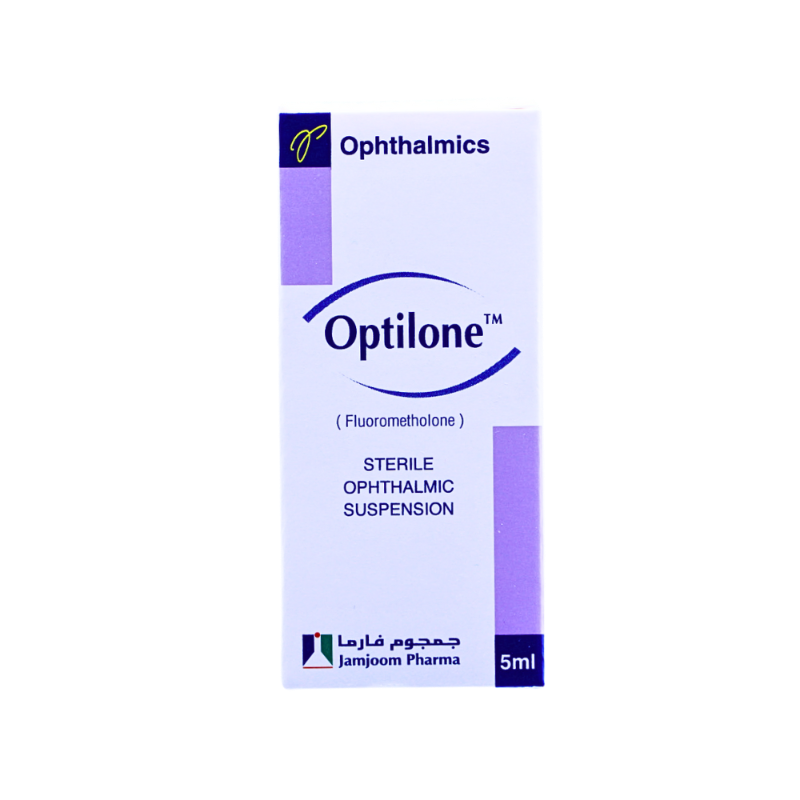
OPTILONE EYE DROPS 5ML
- Sku : I-004653
Key features
OPTILONE Eye Drops are an ophthalmic suspension containing the active ingredient fluorometholone 0.1%. It is a synthetic corticosteroid that suppresses ocular inflammation by inducing lipocortins to inhibit phospholipase A2, thereby reducing prostaglandin and leukotriene-mediated inflammatory signaling. It is indicated for steroid‑responsive inflammatory conditions of the palpebral and bulbar conjunctiva, cornea, and anterior segment of the eye. Available as a 5 ml ophthalmic suspension and supplied on prescription.- Brand: OPTILONE
- Active Ingredient: FLUOROMETHOLONE
- Strength: 0.1%
- Dosage Form: Eye drops, suspension
- Pack Size: 5 ml
- Route: Ophthalmic use
- Prescription Status: Prescription
- Therapeutic Class: Ophthalmic
- Pharmacological Group: Anti-inflammatory (Eye)
- Drug Class: Ophthalmic Corticosteroid (Synthetic Glucocorticoid)
- Manufacturer: Jamjoom Pharmaceuticals Factory Company
- Country of Origin: Saudi Arabia
- SFDA Registration No.: 2012211487
- Shelf Life: 24 months
- Storage: do not store above 30°c
- Target Organ: Eye
- Preservative Free: No
Frequently bought together
Skin And Body Care > Eye Care
Skin And Body Care > Eye Care
Indications
Approved Uses
Steroid-responsive inflammatory conditions of the palpebral and bulbar conjunctiva, cornea, and anterior segment of the eye.
Off-Label Uses
May be used off-label for other steroid-responsive ocular surface inflammatory conditions (e.g., vernal/allergic keratoconjunctivitis or contact lens-related inflammatory keratitis) under ophthalmologist supervision.
Dosage & Administration
Dosing by Condition
Steroid-responsive ocular inflammation: Instill 1-2 drops into the conjunctival sac 2-4 times daily; in the first 24-48 hours, frequency may be increased (commonly up to every 2 hours) based on severity, then reduce as improvement occurs.
Initial Dose
1-2 drops in the affected eye(s) 2-4 times daily. May be increased to every 4 hours for the first 24-48 hours.
Maintenance Dose
1 drop in the affected eye(s) 2-4 times daily, gradually tapered as inflammation subsides.
Children's Dosage
Children 2 years and older: same as adult dosing (1-2 drops 2-4 times daily). Not recommended in children under 2 years of age
Dose Adjustment Notes
Taper by gradually reducing dosing frequency as clinical improvement occurs; avoid abrupt discontinuation after prolonged/frequent use. If used for ≥10 days, monitor intraocular pressure (IOP) and reassess need for continuation.
How to Take
Shake well before each use (suspension). Wash hands. Instill 1-2 drops into the conjunctival sac of the affected eye(s) as prescribed. Avoid touching the dropper tip to the eye/eyelids/any surface. Close the eye gently and perform nasolacrimal occlusion (press inner corner) for ~1 minute to reduce systemic absorption. If using other eye medicines, separate by 5-10 minutes (ointments last). Remove contact lenses before use and wait at least 15 minutes before reinserting (or avoid lenses during active inflammation unless prescriber advises).
How to Prepare
Shake well before each use (ophthalmic suspension).
Side Effects
Common Side Effects
Increased intraocular pressure, temporary blurred vision, mild stinging or burning, eye irritation, feeling of a foreign body in the eye.
Side Effect Frequency
Common: transient ocular burning/stinging/irritation, blurred vision, and increased intraocular pressure; Less common/with prolonged use: posterior subcapsular cataract, delayed wound healing, secondary ocular infection, and corneal/scleral thinning/perforation risk.
Safety & Warnings
Contraindications
Hypersensitivity to fluorometholone/components; active viral disease of cornea/conjunctiva (including epithelial herpes simplex keratitis, vaccinia, varicella); mycobacterial ocular infection; fungal disease of ocular structures.
Warnings & Precautions
Monitor intraocular pressure if used for ≥10 days or if high-frequency/prolonged therapy; prolonged use may cause glaucoma/optic nerve damage and posterior subcapsular cataract; avoid use in active viral/fungal/mycobacterial ocular infection; may mask or worsen infection (use appropriate anti-infective therapy if bacterial infection present); use caution with history of herpes simplex and in corneal thinning disorders (perforation risk); shake well; avoid contaminating dropper tip.
Age Restriction
Safety and efficacy in children <2 years have not been established; use only if clearly needed under specialist supervision.
Driving Warning
Avoid Driving
Drug Interactions
Drug Interactions
Clinically significant interactions are mainly additive ocular effects with other IOP-raising agents (e.g., other ophthalmic corticosteroids) and increased risk of infection/delayed healing with concurrent immunosuppressants; CYP3A-inhibitor interaction is generally not clinically relevant for routine ophthalmic fluorometholone but may be a theoretical concern with strong inhibitors and prolonged/high-frequency use.
Interaction Severity
Clinically significant drug interactions are uncommon; use caution with strong CYP3A inhibitors (e.g., ritonavir/cobicistat) as they may increase systemic corticosteroid effects even with topical routes, and additive ocular adverse effects may occur with other topical steroids.
Food Interaction
No clinically relevant food interactions (not applicable for ophthalmic administration).
Special Populations
Pregnancy
Consult Doctor
Breastfeeding
Consult Doctor
Children
Children 2 years and older: same as adult dosing (1-2 drops 2-4 times daily). Not recommended in children under 2 years of age
Elderly
Standard adult dosing; monitor intraocular pressure closely as elderly patients may be more susceptible to steroid-induced IOP elevation
Kidney Impairment
No adjustment needed.
Liver Impairment
No adjustment needed.
Storage & Patient Advice
Preparation Instructions
Shake well before each use (ophthalmic suspension).
Missed Dose
Use the missed dose as soon as remembered; if it is close to the next scheduled dose, skip the missed dose and resume the regular schedule-do not double doses.
Stopping the Medicine
Do not stop abruptly after prolonged/frequent use; taper frequency gradually under medical supervision.
Overdose
Ocular overdose: rinse/flush the eye(s) with lukewarm water/saline; ingestion of small amounts is unlikely to cause serious toxicity-provide supportive care and seek medical advice/poison center if a large amount is swallowed or symptoms occur.
Patient Counseling
Shake well; wash hands; instill as directed without touching the tip; expect brief blurred vision-avoid driving until clear; remove contact lenses and wait ≥15 minutes before reinsertion (or avoid during active inflammation unless advised); space other eye drops by 5-10 minutes; do not use longer than prescribed and do not stop abruptly if used frequently/prolonged-taper per prescriber; seek care urgently for worsening pain, redness, discharge, photophobia, or vision changes; do not share the bottle. Discard after the in-use period per local labeling/pharmacy policy (commonly 28 days after opening if not otherwise specified).
Monitoring Requirements
Check intraocular pressure if treatment continues for ~10 days or longer; with prolonged/repeated courses, perform slit-lamp examination to monitor for cataract formation, corneal thinning/ulceration, and superinfection (including fungal/HSV) if symptoms worsen.
Pharmacology
Mechanism of Action
A synthetic corticosteroid that suppresses ocular inflammation by inducing lipocortins (phospholipase A2 inhibitory proteins), reducing arachidonic-acid-derived mediators (prostaglandins, leukotrienes) and other inflammatory signaling.
Onset of Action
Relief may begin within hours; noticeable improvement often within 24-48 hours in steroid-responsive inflammation.
Half-Life
Unknown/Not established for ophthalmic fluorometholone (systemic half-life after ocular dosing not reliably reported).
Bioavailability
Systemic absorption is minimal after ophthalmic administration; most effect is local in ocular tissues, and systemic bioavailability is low (further reduced by nasolacrimal occlusion).
Excretion
Unknown/Not well characterized for ophthalmic fluorometholone; any systemically absorbed fraction is expected to be eliminated mainly as metabolites via renal excretion with some biliary/fecal contribution (class effect of corticosteroids).
Protein Binding
Unknown/Not established for fluorometholone ophthalmic suspension.
Product Information
Available Dosage Forms
Ophthalmic suspension.
Composition per Dose
Each 1 mL of ophthalmic suspension: fluorometholone 1 mg (0.1%)
Generic Availability
Yes
OTC Alternatives
No OTC equivalent corticosteroid eye drop alternative; symptomatic OTC options (e.g., lubricants/antihistamine-mast cell stabilizer drops) are not therapeutic equivalents for steroid-responsive inflammation.
Target Organ
Eye
Preservative Free
No
Reviewed by Al Mujtama Pharmacy Medical Review Team. Last reviewed 13-08-2026
Similar Products
Medications > Painkillers and Antipyretics
Medications > Psychiatric Medications
Medications > Diabetes Medications
Medications > Cholesterol Medications
Medications > Cholesterol Medications
Medications > Painkillers and Antipyretics
Medications > Gastrointestinal Medications
Medications > Dermatology Medications
Medications > Painkillers and Antipyretics
Medications > Other Medicines
