
Use Code: ND30 And Get 30% OFF | Get Free Delivery With No Minimum Order
-1744229570.gif "Almujtama Pharmacy logo")




Frequently bought together
Vitamins & Supplements > Natural Supplements
Vitamins & Supplements > Probiotecs
Vitamins & Supplements > Probiotecs
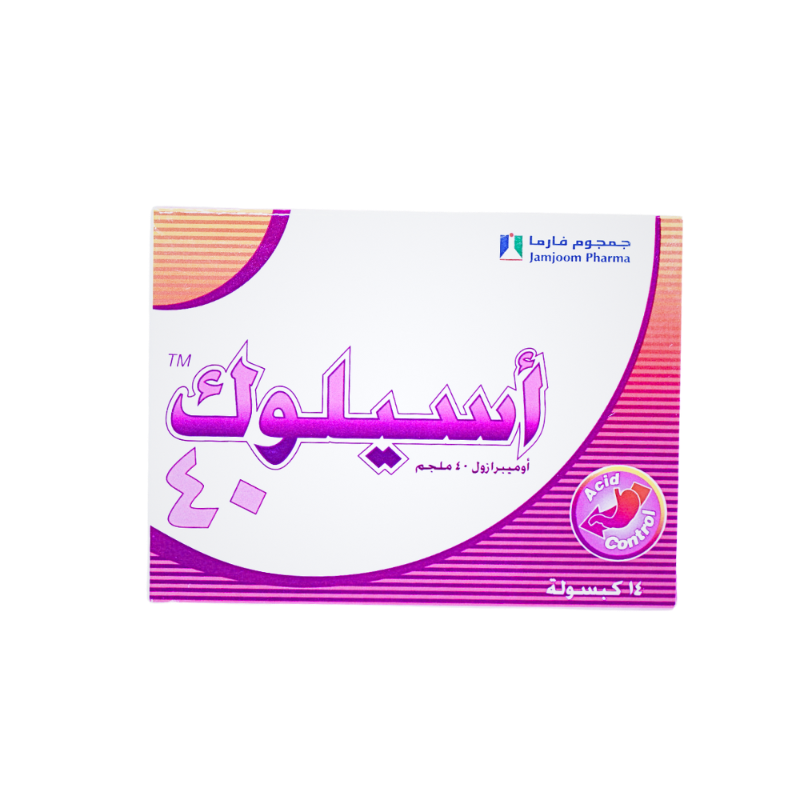
ACILOC 40/MG CAP 14/CAP
- Sku : I-000063
Key features
ACILOC 40 mg gastro-resistant hard capsules contain 40 mg of the active ingredient omeprazole. Omeprazole irreversibly inhibits the gastric parietal cell H+/K+-ATPase (proton pump), blocking the final step in acid secretion. ACILOC is indicated for acid-related conditions including gastroesophageal reflux disease (GERD), duodenal and gastric ulcers, Helicobacter pylori eradication as part of combination therapy, Zollinger-Ellison syndrome, erosive esophagitis, and treatment and prevention of NSAID-associated gastric ulcers. Available by prescription in packs of 14 gastro-resistant capsules.- Brand: ACILOC
- Active Ingredient: OMEPRAZOLE 40mg
- Strength: 40mg
- Dosage Form: Gastro-resistant capsule, hard
- Pack Size: 14 Capsules
- Route: Oral use
- Prescription Status: Prescription
- Therapeutic Class: Gastrointestinal
- Pharmacological Group: Proton Pump Inhibitors
- Drug Class: Proton Pump Inhibitor (PPI)
- Manufacturer: Jamjoom Pharmaceuticals Factory Company
- Country of Origin: Saudi Arabia
- SFDA Registration No.: 63-368-04
- Shelf Life: 24 months
- Storage: do not store above 30°c
- Gi Condition: Acid Reflux/GERD, Ulcer
Frequently bought together
Vitamins & Supplements > Natural Supplements
Vitamins & Supplements > Probiotecs
Vitamins & Supplements > Probiotecs
Indications
Approved Uses
Gastroesophageal reflux disease (GERD), duodenal ulcer, gastric ulcer, Helicobacter pylori eradication (in combination therapy), Zollinger-Ellison syndrome, erosive esophagitis, NSAID-associated gastric ulcer treatment and prevention
Off-Label Uses
["Stress ulcer prophylaxis in critically ill patients (often institutional protocol-driven; IV/enteral depending on setting)", "Laryngopharyngeal reflux (selected patients)", "Functional dyspepsia (selected patients)"]
Dosage & Administration
Dosing by Condition
GERD (symptomatic): 20 mg once daily for 2-4 weeks; may extend to 4-8 weeks if needed.
Erosive esophagitis: 20 mg once daily for 4-8 weeks; 40 mg once daily may be used for severe disease or inadequate response.
Duodenal ulcer: 20 mg once daily for 4 weeks (may extend to 8 weeks if not healed).
Gastric ulcer: 20-40 mg once daily for 4-8 weeks.
H. pylori eradication: 20 mg twice daily for 10-14 days with appropriate antibiotics (per local regimen).
Zollinger-Ellison syndrome: Start 60 mg once daily; titrate to clinical response; doses >80 mg/day should be divided (up to ~120 mg/day or higher in selected cases).
NSAID-associated ulcer prophylaxis: 20 mg once daily while NSAID risk persists.
Initial Dose
20mg once daily for GERD or Duodenal Ulcer; 40mg once daily for Gastric Ulcer.
Maintenance Dose
20mg once daily
Maximum Dose
For Zollinger-Ellison syndrome, doses may be titrated up to 360 mg/day in divided doses; for typical GERD/ulcer indications, usual maximum is 40 mg/day (occasionally 80 mg/day for specific regimens).
Children's Dosage
Children 1-16 years: 10-20mg once daily based on weight (10mg for 10-<20kg, 20mg for ≥20kg) for GERD/EE. Use and dose must be determined by doctor for other conditions. Not recommended under 1 year of age.
Dose Adjustment Notes
Renal impairment: no dose adjustment generally required. Hepatic impairment: consider dose reduction/maximum 20 mg daily in severe hepatic impairment (or use the lowest effective dose with monitoring).
How to Take
Take orally 30-60 minutes before a meal (preferably breakfast). Swallow the gastro‑resistant capsule whole with water; do not crush or chew. If swallowing is difficult, the capsule may be opened and the enteric‑coated granules sprinkled on a small amount of soft food (e.g., applesauce/yogurt) or mixed with a slightly acidic liquid and swallowed immediately without chewing; do not store the mixture.
Side Effects
Common Side Effects
Headache, nausea, diarrhea, abdominal pain, flatulence, constipation, vomiting, dizziness
Side Effect Frequency
Common (1-10%): headache, abdominal pain, diarrhea, nausea/vomiting, flatulence, constipation. Uncommon (0.1-1%): dizziness, insomnia, rash/pruritus/urticaria, elevated liver enzymes. Rare/very rare (<0.1%): acute interstitial nephritis, severe cutaneous adverse reactions (e.g., SJS/TEN), hypomagnesemia (typically with prolonged use), subacute cutaneous lupus erythematosus; fracture and vitamin B12 deficiency are recognized risks mainly with long-term therapy rather than typical short-course frequency reporting.
Safety & Warnings
Contraindications
Hypersensitivity to omeprazole/other substituted benzimidazoles or excipients; concomitant use with rilpivirine-containing products; concomitant use with nelfinavir.
Warnings & Precautions
Key precautions: evaluate alarm features/consider malignancy before treatment (PPIs may mask symptoms); risk of C. difficile diarrhea; long-term/high-dose use-fracture risk, hypomagnesemia (consider monitoring), and vitamin B12 deficiency; acute interstitial nephritis; cutaneous/systemic lupus; and potential false-negative chromogranin A testing (hold PPI before testing when feasible).
Age Restriction
Pediatric use is condition- and formulation-specific; omeprazole is used in infants and children (including <1 year) under specialist/prescriber direction, but this 40 mg gastro‑resistant capsule is generally intended for older children/adolescents/adults who can swallow capsules-no OTC age limit applies because this product is prescription-only.
Driving Warning
Safe
Drug Interactions
Drug Interactions
Clinically important interactions include: clopidogrel (reduced activation/antiplatelet effect), warfarin (↑INR/bleeding risk), phenytoin and diazepam (↑levels via CYP2C19 inhibition), high-dose methotrexate (↑levels/toxicity), digoxin (↑exposure), tacrolimus (↑levels), rilpivirine and nelfinavir (contraindicated), atazanavir (reduced levels/avoid), azole antifungals such as ketoconazole/itraconazole (reduced absorption), and strong CYP inducers such as rifampin and St. John’s wort (reduced omeprazole exposure).
Interaction Severity
"MAJOR/Contraindicated: ["Rilpivirine (contraindicated due to reduced absorption with increased gastric pH)
Nelfinavir (contraindicated due to reduced antiviral exposure)"], "MODERATE/Clinically significant (manage/monitor or consider alternatives): ["Clopidogrel (reduced activation via CYP2C19 inhibition; consider alternative PPI such as pantoprazole when clinically appropriate)
High-dose methotrexate (may increase methotrexate levels/toxicity; consider temporary PPI interruption and monitoring)
Warfarin (possible INR increase; monitor INR)
Tacrolimus (possible increased levels; monitor troughs)
Digoxin (possible increased exposure; monitor especially in elderly/renal impairment)
Azole antifungals requiring acidity e.g., ketoconazole/itraconazole (reduced absorption; avoid or manage)
Phenytoin (possible increased levels; monitor)"], "MINOR/Long-term considerations: ["Iron salts (reduced absorption in some patients)
Vitamin B12 (reduced absorption with prolonged therapy)"]
Food Interaction
Take on an empty stomach, ideally 30-60 minutes before a meal.
Alcohol Interaction
Safe
Special Populations
Pregnancy
Caution
Breastfeeding
Caution
Children
Children 1-16 years: 10-20mg once daily based on weight (10mg for 10-<20kg, 20mg for ≥20kg) for GERD/EE. Use and dose must be determined by doctor for other conditions. Not recommended under 1 year of age.
Elderly
Standard adult dosing; no routine dose adjustment required, but monitor for hypomagnesemia and bone density with long-term use
Kidney Impairment
No adjustment needed.
Liver Impairment
Severe hepatic impairment: consider dose reduction; usual maximum recommended is 20 mg/day (10-20 mg/day often sufficient). Mild-moderate impairment: generally no adjustment.
Storage & Patient Advice
Missed Dose
Take as soon as remembered; skip if it is almost time for the next dose. Do not double the dose.
Stopping the Medicine
Short courses can be stopped when the course is complete/symptoms resolve; after prolonged or high-dose therapy, consider tapering (or step-down) to reduce rebound acid hypersecretion.
Overdose
Symptoms can include confusion, drowsiness, blurred vision, tachycardia, nausea/vomiting, flushing/diaphoresis, headache (± dry mouth); management is supportive/symptomatic and omeprazole is not meaningfully removed by dialysis-seek urgent medical care/poison center advice.
Patient Counseling
Take 30-60 minutes before a meal (usually breakfast). Swallow the capsule whole; do not crush/chew; if needed, open and swallow granules mixed with a small amount of soft food/liquid without chewing. Symptom relief may start the first day but full effect can take 1-4 days. Seek care for severe/persistent diarrhea, rash/joint pain, or signs of low magnesium (cramps, palpitations) with prolonged use; discuss long-term risks (B12 deficiency, fractures) and important interactions (especially clopidogrel and certain HIV medicines such as rilpivirine/nelfinavir).
Monitoring Requirements
Short-term: no routine labs typically required. Long-term or high-dose therapy: consider serum magnesium (especially if >3 months or with diuretics), vitamin B12 if prolonged use/risk factors, and assess fracture risk/bone health in at-risk patients; monitor renal function if symptoms suggest acute interstitial nephritis; monitor for C. difficile-associated diarrhea if severe/persistent diarrhea occurs.
Pharmacology
Mechanism of Action
Omeprazole irreversibly inhibits the gastric parietal cell H+/K+-ATPase (proton pump), blocking the final step of acid secretion.
Onset of Action
Acid suppression begins within ~1 hour of a dose; maximal effect is not immediate and typically requires 1-4 days of daily dosing to reach steady-state acid suppression.
Duration of Effect
Up to 72 hours.
Half-Life
Plasma half-life ~0.5-1 hour; duration of acid suppression is ~24 hours due to irreversible proton pump inhibition.
Bioavailability
Oral bioavailability is ~30-40% after a single dose and increases to ~60% with repeated dosing.
Metabolism
Extensive hepatic metabolism via CYP2C19 (primary) and CYP3A4 (secondary), with metabolites excreted mainly in urine.
Excretion
Eliminated mainly as metabolites in urine (~70-80%) with the remainder in feces (~20-30%).
Protein Binding
Approximately 95%.
Product Information
Available Dosage Forms
For this SFDA-registered product: gastro‑resistant capsule, hard (oral).
Composition per Dose
Each gastro-resistant hard capsule: 40mg omeprazole
Generic Availability
Yes
Gi Condition
Acid Reflux/GERD, Ulcer
Reviewed by Al Mujtama Pharmacy Medical Review Team. Last reviewed 02-08-2026
Similar Products
Medications > Urology Medications
Medications > Hemorrhoid Medications
Medications > Cold, Cough, and Allergy Medications
Medications > Diabetes Medications
Medications > Diabetes Medications
Medications > Urology Medications
Medications > Dermatology Medications
Medications > Sexual Health

Medications > Psychiatric Medications
Medications > Dermatology Medications
