
Use Code: ND30 And Get 30% OFF | Get Free Delivery With No Minimum Order
-1744229570.gif "Almujtama Pharmacy logo")




Frequently bought together
Skin And Body Care > Sun Protection And Tans
Skin And Body Care > Sun Protection And Tans
Skin And Body Care > Facial Wash And Exfoliators
Skin And Body Care > Facial Wash And Exfoliators
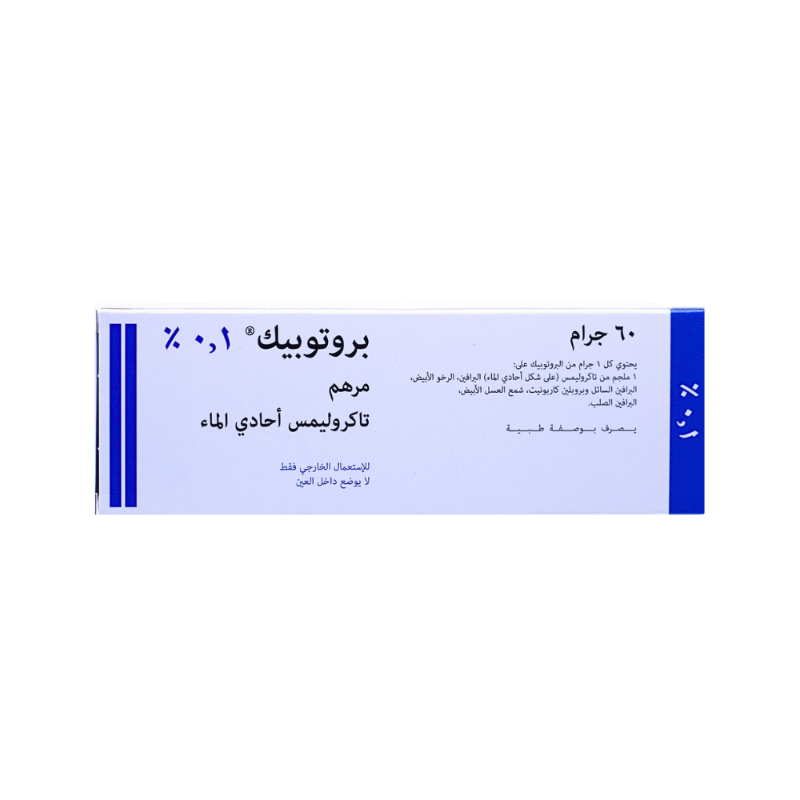
PROTOPIC 0.1% OINTMENT 60G
- Sku : I-031713
Key features
PROTOPIC 0.1% OINTMENT contains tacrolimus 0.1% as the active ingredient in a topical ointment formulation. Topical tacrolimus is a calcineurin inhibitor that binds FKBP‑12 and inhibits calcineurin phosphatase, reducing T‑cell activation and downstream pro‑inflammatory cytokine transcription to decrease cutaneous inflammation and pruritus. It is indicated as a second‑line treatment for moderate-to-severe atopic dermatitis in patients aged 16 years and older who are not adequately responsive to, or for whom conventional topical therapies are not advisable. Available by prescription as a 60 g ointment.- Brand: PROTOPIC
- Active Ingredient: TACROLIMUS
- Strength: 0.1%
- Dosage Form: Ointment
- Pack Size: 60 gm
- Route: Topical
- Prescription Status: Prescription
- Therapeutic Class: Dermatological
- Pharmacological Group: Other Dermatological
- Drug Class: Topical Calcineurin Inhibitor (TCI) / Immunomodulator
- Manufacturer: Leo Laboratories Limited
- Country of Origin: Ireland
- SFDA Registration No.: 76-19-21
- Shelf Life: 24 months
- Storage: do not store above 25°c
- Skin Condition: Eczema
- Steroid Potency: N/A - not a corticosteroid
Frequently bought together
Skin And Body Care > Sun Protection And Tans
Skin And Body Care > Sun Protection And Tans
Skin And Body Care > Facial Wash And Exfoliators
Skin And Body Care > Facial Wash And Exfoliators
Indications
Approved Uses
Second-line treatment of moderate-to-severe atopic dermatitis (eczema) in patients who are not adequately responsive to, or when use of, conventional topical therapies (e.g., topical corticosteroids) is not advisable; Protopic 0.1% is for adults and adolescents ≥16 years.
Dosage & Administration
Dosing by Condition
Atopic dermatitis flare: apply a thin layer twice daily to affected areas until lesions clear. Maintenance (proactive) therapy: after clearance, apply twice weekly (e.g., 2 non-consecutive days) to previously affected areas to reduce flares. Age/strength: 0.1% is for ≥16 years; ages 2-15 years should use 0.03% twice daily.
Initial Dose
Apply a thin layer to the affected skin twice daily (morning and evening).
Maintenance Dose
Apply a thin layer once daily, twice weekly (with 2-3 days between applications) to areas commonly affected by atopic dermatitis.
Maximum Dose
No defined maximum dose; apply a thin layer to affected areas only and avoid continuous long-term use.
Children's Dosage
Children 2-15 years: 0.03% strength only, apply thin layer twice daily to affected areas. Children 16 years and above: 0.1% strength may be used as per adult dosing. Not approved under 2 years of age
Dose Adjustment Notes
No routine dose adjustment is required for renal/hepatic impairment or in the elderly with topical use due to low systemic absorption; avoid use on significant skin barrier defects (e.g., Netherton syndrome) or very large areas where absorption may increase, and use the minimum amount for the shortest duration needed.
How to Take
Apply a thin layer to affected skin twice daily and rub in gently; use on clean, dry skin. Wash hands after application unless treating the hands. Avoid contact with eyes and mucous membranes. Do not use under occlusive dressings/bandages.
Side Effects
Common Side Effects
Application-site burning/stinging, pruritus, erythema; folliculitis/acne; skin infections (e.g., herpes simplex/impetigo) can occur; alcohol-related facial flushing may occur.
Side Effect Frequency
Very common (>10%): application-site burning and pruritus. Common (1-10%): application-site erythema/pain/tingling, folliculitis/acne, herpes simplex/other skin infections, alcohol intolerance (facial flushing).
Safety & Warnings
Contraindications
Contraindication: hypersensitivity to tacrolimus or any component of the formulation.
Warnings & Precautions
Avoid continuous long-term use; limit to affected areas; avoid use on malignant/premalignant lesions; minimize sun/UV exposure (including phototherapy/tanning beds); do not apply to active infections-treat first; avoid occlusion; avoid use in immunocompromised patients; avoid eyes/mucosa and wash hands after application.
Age Restriction
Not approved for children <2 years; Protopic 0.1% is indicated for patients ≥16 years (0.03% is used for ages 2-15).
Driving Warning
Safe
Drug Interactions
Food Interaction
No clinically relevant food interactions (not applicable for topical use).
Alcohol Interaction
Avoid
Special Populations
Pregnancy
Consult Doctor
Breastfeeding
Consult Doctor
Children
Children 2-15 years: 0.03% strength only, apply thin layer twice daily to affected areas. Children 16 years and above: 0.1% strength may be used as per adult dosing. Not approved under 2 years of age
Elderly
Standard adult dosing; no specific dose adjustment required
Kidney Impairment
No dose adjustment needed for topical use.
Storage & Patient Advice
Storage Conditions
Do not store above 25°C; do not freeze; keep the tube tightly closed (in original container).
Stopping the Medicine
Stop when signs/symptoms resolve; no taper is required; for patients with frequent relapses, proactive maintenance (e.g., twice weekly) may be used to reduce flares.
Overdose
Topical overdose is unlikely; if ingested, seek immediate medical attention-systemic tacrolimus toxicity may include tremor, headache, nausea/vomiting; management is supportive.
Patient Counseling
Apply a thin layer to affected areas twice daily (0.1% only for ≥16 years); rub in gently and wash hands after use. Expect transient burning/stinging/itching early in therapy. Avoid eyes/mucosa and do not cover with occlusive dressings. Minimize sun/UV exposure (avoid tanning beds/phototherapy on treated areas) and use sun protection. Alcohol may cause facial flushing. Use the smallest amount for the shortest time needed; seek medical advice for signs of skin infection, swollen lymph nodes, unusual/new skin lesions, or lack of improvement (reassess if not improving within ~2 weeks; reevaluate if not improved by ~6 weeks).
Monitoring Requirements
No routine laboratory monitoring is required. Clinically monitor response and tolerability; reassess if no improvement within ~2 weeks and discontinue/reevaluate if not improved by ~6 weeks. Monitor for signs of skin infection, lymphadenopathy, and new or changing skin lesions with ongoing/intermittent long-term use.
Pharmacology
Mechanism of Action
Topical tacrolimus is a calcineurin inhibitor: it binds FKBP-12, inhibiting calcineurin phosphatase, thereby reducing T-cell activation and downstream pro-inflammatory cytokine transcription (e.g., IL-2) and decreasing cutaneous inflammation and pruritus.
Onset of Action
Some improvement is often seen within about 1 week; more meaningful improvement typically occurs over 1-2 weeks, with continued gains over several weeks.
Duration of Effect
Benefit persists only with continued/proactive use; disease commonly relapses after discontinuation, with flares potentially returning within days to weeks depending on baseline severity.
Bioavailability
Very low systemic bioavailability after topical use (generally <0.5% through intact skin; absorption can increase when applied to inflamed/eroded skin or large body surface areas).
Metabolism
If absorbed systemically, tacrolimus is extensively metabolized primarily by CYP3A4 (and also CYP3A5), mainly in the liver (and intestinal wall).
Protein Binding
>98% protein binding (often cited ~98.8-99%) when systemically present, mainly to albumin and alpha-1-acid glycoprotein.
Product Information
Available Dosage Forms
Ointment
Composition per Dose
Each gram of ointment: 1 mg tacrolimus (as monohydrate) in a white petrolatum-based ointment
OTC Alternatives
No OTC calcineurin inhibitor alternative exists. OTC options for mild disease/supportive care include regular emollients/moisturizers (e.g., petrolatum, ceramide creams) and short courses of low-potency OTC hydrocortisone 0.5-1% for mild flares (if appropriate).
Skin Condition
Eczema
Steroid Potency
N/A - not a corticosteroid
Reviewed by Al Mujtama Pharmacy Medical Review Team. Last reviewed 10-07-2026
Similar Products
Medications > Painkillers and Antipyretics
Medications > Painkillers and Antipyretics
Medications > Diabetes Medications
Medications > Diabetes Medications
Medications > Cold, Cough, and Allergy Medications
Medications > Painkillers and Antipyretics
Medications > Painkillers and Antipyretics
Medications > Psychiatric Medications
Medications > Psychiatric Medications
Medications > Gastrointestinal Medications
