
Use Code: ND30 And Get 30% OFF | Get Free Delivery With No Minimum Order
-1744229570.gif "Almujtama Pharmacy logo")




Frequently bought together
Health Care & Wellness > Diabetes Care
Health Care & Wellness > Diabetes Care
Health Care & Wellness > Diabetes Care
Skin And Body Care > Moisturizers

Skin And Body Care > Moisturizers
Skin And Body Care > Moisturizers
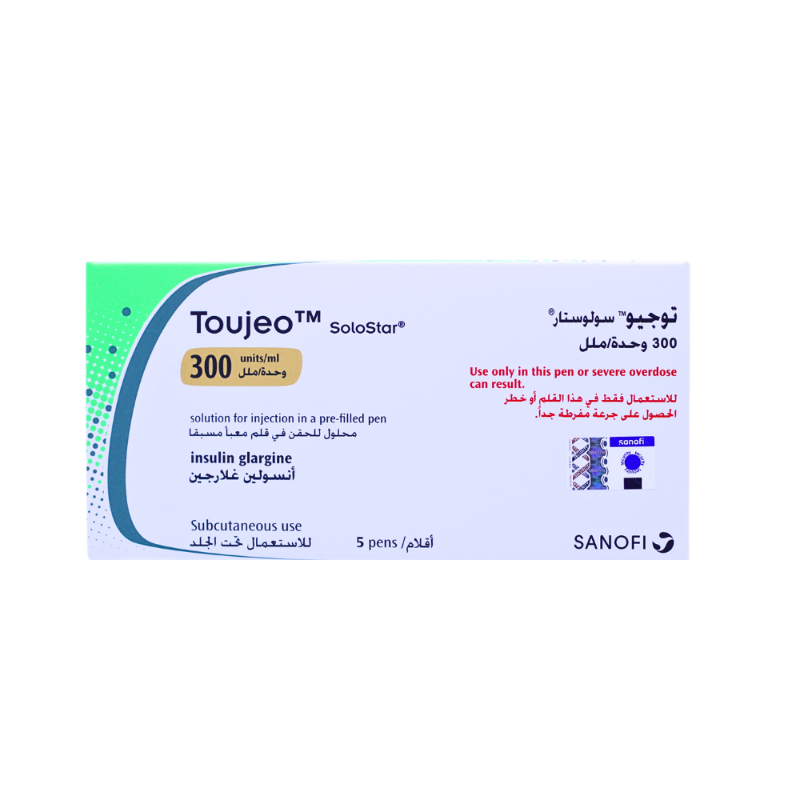
TOUJEO SOLOSTAR 300MG/ML
- Sku : I-022604
Key features
TOUJEO 300 IU/ml Solution for Injection is a solution for injection in a pre-filled pen containing the long-acting insulin glargine. Insulin glargine acts as a basal insulin analog, activating insulin receptors to increase peripheral glucose uptake and reduce hepatic glucose production; after subcutaneous injection its acidic solution forms microprecipitates that slowly release insulin for a prolonged, relatively peakless effect. It is indicated to improve glycemic control in adults and pediatric patients aged 6 years and older with type 1 and type 2 diabetes mellitus. Available by prescription as a 1.5 ml pre-filled pen.- Brand: TOUJEO
- Active Ingredient: INSULIN GLARGINE
- Strength: 300IU/ml
- Dosage Form: Solution for injection in pre-filled pen
- Pack Size: 1.5 ml
- Route: Subcutaneous use
- Prescription Status: Prescription
- Therapeutic Class: Antidiabetic
- Pharmacological Group: Insulins
- Drug Class: Long-acting (basal) insulin analog (insulin glargine).
- Manufacturer: sanofi-aventis
- Country of Origin: Germany
- SFDA Registration No.: 56-23-17
- Shelf Life: 30 months
- Storage: store in a refrigerator (2°c - 8°c)
- Diabetes Type: Type 1 and Type 2
- Insulin Type: Long-acting
Frequently bought together
Health Care & Wellness > Diabetes Care
Health Care & Wellness > Diabetes Care
Health Care & Wellness > Diabetes Care
Skin And Body Care > Moisturizers
Skin And Body Care > Moisturizers
Skin And Body Care > Moisturizers
Indications
Approved Uses
To improve glycemic control in adults and pediatric patients 6 years of age and older with diabetes mellitus (type 1 and type 2).
Off-Label Uses
No routine/standard off-label use; in pregnancy/gestational diabetes, insulin glargine may be used based on clinician judgment and local guidelines, but Toujeo (U-300) is not a standard first-line labeled option.
Dosage & Administration
Dosing by Condition
Type 1 diabetes: use once-daily Toujeo as the basal component, typically ~1/3 to 1/2 of the total daily insulin requirement, with the remainder as prandial insulin; titrate to fasting glucose targets. Type 2 diabetes (insulin-naïve): start 0.2 units/kg once daily (or per local protocol) and titrate based on fasting glucose. Switching from insulin glargine 100 units/mL to Toujeo: start unit-for-unit, recognizing some patients may require a higher Toujeo dose over time; switching from twice-daily basal: start at 80% of prior total daily basal dose.
Initial Dose
Type 2 diabetes (insulin-naive): 0.2 IU/kg/day once daily subcutaneously. Type 1 diabetes: approximately one-third to one-half of the total daily insulin dose (0.2-0.4 IU/kg/day) as part of a basal-bolus regimen
Maintenance Dose
Individualized; typically 20-60 IU/day in Type 2 diabetes; titrate every 3 days based on fasting blood glucose monitoring
Maximum Dose
No absolute maximum daily dose (individualized); device limits per injection apply-Toujeo SoloStar delivers up to 80 units/injection and Toujeo Max SoloStar up to 160 units/injection.
Children's Dosage
Approved for pediatric patients 6 years of age and older with type 1 or type 2 diabetes. Individualize dose based on type of diabetes, metabolic needs, blood glucose monitoring results and glycemic control goal.
Dose Adjustment Notes
Dose is individualized and titrated based on glucose monitoring; adjust with changes in diet, activity, intercurrent illness, or interacting drugs, and use caution in renal/hepatic impairment. When switching from twice-daily basal insulin to once-daily Toujeo, start at ~80% of the prior total daily basal dose; when switching from Toujeo to insulin glargine 100 units/mL, reduce the initial U-100 dose by ~20%.
How to Take
For subcutaneous use only. Inject once daily at the same time each day into the abdomen, thigh, or upper arm. Rotate injection sites within the same region. Do not administer intravenously or intramuscularly and do not dilute or mix with other insulins. Use the pre-filled pen as instructed (attach a new needle each time, prime per device instructions, and dial the prescribed dose in units).
How to Prepare
Ready-to-use prefilled pen: inspect before use-solution must be clear, colorless, and particle-free; do not use if cloudy/colored/particulate. If stored refrigerated (2-8°C per verified API data), allow the pen to reach room temperature before injection to reduce injection discomfort; attach a new sterile needle each time and prime per device instructions.
Side Effects
Common Side Effects
Hypoglycemia; injection-site reactions; lipodystrophy (including lipohypertrophy); weight gain; peripheral edema; rash/pruritus (less common).
Side Effect Frequency
Very common: hypoglycemia. Common: injection-site reactions and lipodystrophy/lipohypertrophy; weight gain and peripheral edema can occur. Rare/uncommon but clinically important: severe hypersensitivity reactions, hypokalemia, and visual changes (often transient with glycemic shifts).
Safety & Warnings
Contraindications
Contraindicated during episodes of hypoglycemia and in patients with hypersensitivity to insulin glargine or any excipients.
Warnings & Precautions
Key warnings/precautions: subcutaneous use only (do not give IV/IM or via pump); do not mix/dilute with other insulins/solutions; medication-error risk due to U-300 concentration and non-bioequivalence with U-100 glargine (avoid unit-for-unit conversion without monitoring); hypoglycemia risk and need for close glucose monitoring during regimen changes/illness; rotate injection sites to reduce lipodystrophy; monitor for hypokalemia in at-risk patients; avoid pen sharing; TZD co-use may cause fluid retention/heart failure.
Age Restriction
Approved for type 1 diabetes in adults and pediatric patients ≥6 years; not approved for pediatric patients with type 2 diabetes.
Driving Warning
Avoid Driving
Drug Interactions
Drug Interactions
Clinically relevant interactions include: other glucose-lowering drugs (additive hypoglycemia); ACE inhibitors, MAO inhibitors, salicylates, fibrates, fluoxetine, sulfonamide antibiotics (may increase hypoglycemia risk); corticosteroids, thiazide/loop diuretics, sympathomimetics, certain antipsychotics (may increase glucose/insulin requirements); beta-blockers (may mask hypoglycemia symptoms); alcohol (may increase hypoglycemia risk); thiazolidinediones (fluid retention/heart failure risk with insulin).
Interaction Severity
MAJOR/clinically significant: Thiazolidinediones (pioglitazone/rosiglitazone) with insulin-risk of fluid retention and heart failure. MODERATE: agents that increase hypoglycemia risk (other antidiabetics, ACE inhibitors, MAOIs, salicylates, some antidepressants/fibrates) and agents that decrease insulin effect (corticosteroids, thiazide/loop diuretics, sympathomimetics, atypical antipsychotics). IMPORTANT COUNSELING: beta-blockers/clonidine/reserpine may mask hypoglycemia symptoms; alcohol can increase hypoglycemia risk and impair recognition.
Food Interaction
No restriction
Special Populations
Pregnancy
Consult Doctor
Breastfeeding
Consult Doctor
Children
Approved for pediatric patients 6 years of age and older with type 1 or type 2 diabetes. Individualize dose based on type of diabetes, metabolic needs, blood glucose monitoring results and glycemic control goal.
Elderly
Start at lower doses; titrate slowly with careful blood glucose monitoring. Elderly patients are at increased risk of hypoglycemia. Renal function decline in elderly may reduce insulin clearance and increase hypoglycemia risk.
Kidney Impairment
No fixed dose adjustment; insulin requirements may be reduced in renal impairment-monitor glucose closely and titrate to effect.
Liver Impairment
No fixed dose adjustment; insulin requirements may be reduced in hepatic impairment-monitor glucose closely and titrate to effect.
Storage & Patient Advice
Storage Conditions
Store in a refrigerator (2°C - 8°C).
Preparation Instructions
Ready-to-use prefilled pen: inspect before use-solution must be clear, colorless, and particle-free; do not use if cloudy/colored/particulate. If stored refrigerated (2-8°C per verified API data), allow the pen to reach room temperature before injection to reduce injection discomfort; attach a new sterile needle each time and prime per device instructions.
Stopping the Medicine
Do not stop or change Toujeo abruptly; any change/discontinuation must be under medical supervision to avoid severe hyperglycemia and possible diabetic ketoacidosis.
Overdose
Overdose causes hypoglycemia (potentially severe/life-threatening); treat mild/moderate episodes with oral fast-acting carbohydrate, and severe episodes with glucagon or IV dextrose with ongoing monitoring and supplemental carbohydrate as needed.
Patient Counseling
Inject Toujeo (insulin glargine 300 IU/mL) subcutaneously once daily at the same time each day; do NOT inject IV/IM and do NOT use in insulin pumps. Always verify the label/strength (U-300) before each dose; the pen is calibrated in units-do not withdraw with a syringe or attempt dose conversions. Use a new needle each time, prime per IFU, rotate injection sites (abdomen/thigh/upper arm) to reduce lipohypertrophy, and never share the pen. Monitor glucose regularly; recognize and treat hypoglycemia (carry fast-acting carbohydrate) and use caution with driving/operating machinery until effects are known. Do not mix or dilute Toujeo with other insulins. Seek advice for illness, dose changes, pregnancy/breastfeeding, or recurrent hypoglycemia; carry diabetes identification.
Monitoring Requirements
Monitor capillary/CGM glucose regularly (especially fasting), HbA1c periodically (e.g., every ~3 months until stable), and monitor for hypoglycemia; check serum potassium in at-risk patients (e.g., on potassium-lowering drugs or with risk factors) and assess renal/hepatic function and weight/edema as clinically indicated; inspect injection sites for lipodystrophy.
Pharmacology
Mechanism of Action
Insulin glargine is a long-acting insulin analog that activates insulin receptors to increase peripheral glucose uptake and decrease hepatic glucose output; after subcutaneous injection, the acidic solution forms microprecipitates that slowly release insulin, producing a prolonged, relatively peakless basal effect.
Onset of Action
Approximately 6 hours (delayed onset; not for acute glucose correction).
Duration of Effect
Up to ~36 hours (prolonged, flatter profile vs insulin glargine 100 units/mL).
Half-Life
Not meaningfully described by a single terminal half-life after SC dosing; Toujeo has a prolonged, flat time-action profile with a duration of action up to ~36 hours and steady state reached in ~3-4 days.
Bioavailability
Not reliably established for insulin glargine after subcutaneous administration (no single clinically used absolute bioavailability value; do not assume 100%).
Metabolism
Metabolized after subcutaneous injection by proteolytic cleavage to two main active metabolites: M1 (21A-Gly-insulin) and M2 (21A-Gly-des-30B-Thr-insulin), with M1 predominating systemically.
Excretion
Not well-defined as an excretion pathway; insulin glargine is primarily degraded proteolytically to metabolites (M1/M2) with subsequent clearance similar to endogenous insulin, and renal impairment reduces insulin clearance (increasing hypoglycemia risk).
Product Information
Available Dosage Forms
Solution for injection in pre-filled pen (Toujeo SoloStar; and Toujeo Max SoloStar where marketed).
Composition per Dose
Each 1 ml: 300 IU insulin glargine (equivalent to 10.91 mg). Each pre-filled pen (1.5 ml): 450 IU insulin glargine total
Generic Availability
No
OTC Alternatives
No OTC alternative
Diabetes Type
Type 1 and Type 2
Insulin Type
Long-acting
Reviewed by Al Mujtama Pharmacy Medical Review Team. Last reviewed 27-08-2026
Similar Products
Medications > Painkillers and Antipyretics
Medications > Gastrointestinal Medications
Medications > Painkillers and Antipyretics
Medications > Gastrointestinal Medications
Medications > Cold, Cough, and Allergy Medications
Medications > Painkillers and Antipyretics
Medications > Painkillers and Antipyretics

Medications > Painkillers and Antipyretics
Medications > Dermatology Medications
Medications > Painkillers and Antipyretics
