
Use Code: ND30 And Get 30% OFF | Get Free Delivery With No Minimum Order
-1744229570.gif "Almujtama Pharmacy logo")




Frequently bought together
Skin And Body Care > Eye Care
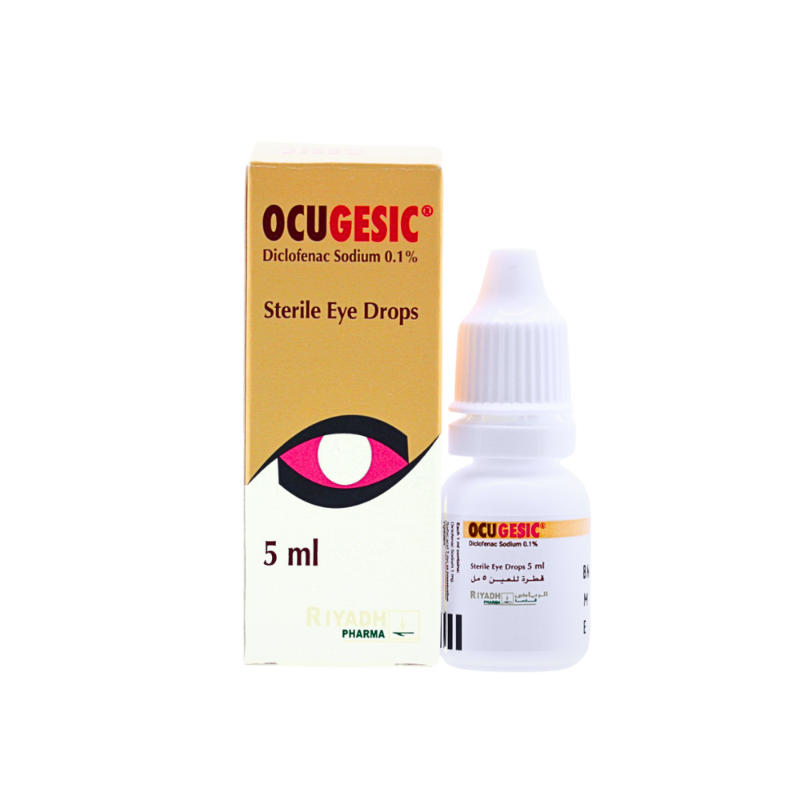
OCUGESIC 0.1% EYE DROPS 5ML
- Sku : I-004491
Key features
OCUGESIC 0.1% Eye Drops (Ocugesic) are an ophthalmic solution containing diclofenac sodium 0.1% as the active ingredient. They are a nonsteroidal anti-inflammatory drug that inhibits cyclooxygenase (COX) enzymes, reducing prostaglandin synthesis in ocular tissues to decrease inflammation, pain and prostaglandin-mediated miosis. Indicated for treatment of postoperative inflammation following cataract surgery and for temporary relief of pain and photophobia after corneal refractive surgery. Supplied as a 5 ml ophthalmic solution.- Brand: Ocugesic
- Active Ingredient: DICLOFENAC SODIUM 0.1%
- Strength: 0.1%
- Dosage Form: Eye drops
- Pack Size: 5 ml
- Route: Ophthalmic use
- Prescription Status: Prescription
- Therapeutic Class: Ophthalmic
- Pharmacological Group: Anti-inflammatory (Eye)
- Drug Class: Non-steroidal anti-inflammatory drug (NSAID) - Ophthalmic
- Manufacturer: RIYADH PHARMA
- Country of Origin: Saudi Arabia
- SFDA Registration No.: 1902244941
- Shelf Life: 24 months
- Storage: store below 25°c
- Target Organ: Eye
Frequently bought together
Skin And Body Care > Eye Care
Indications
Approved Uses
Treatment of postoperative inflammation following cataract surgery; and temporary relief of pain and photophobia after corneal refractive surgery.
Dosage & Administration
Dosing by Condition
Post-cataract surgery inflammation: 1 drop in the affected eye(s) 4 times daily starting 24 hours after surgery; typical duration is about 2 weeks (some protocols extend up to 4 weeks per surgeon). Corneal refractive surgery pain/photophobia: 1-2 drops within 1 hour before surgery, then 1-2 drops within 15 minutes after surgery, then 1-2 drops 4 times daily for up to 3 days.
Initial Dose
1 drop in affected eye(s) 4 times daily
Maintenance Dose
1 drop in affected eye(s) 4 times daily
Maximum Dose
Maximum dose depends on indication; common regimens are 1 drop in the affected eye(s) up to 4 times daily (do not exceed prescribed frequency).
Children's Dosage
Safety and effectiveness in pediatric patients have not been established.
Dose Adjustment Notes
No dose adjustment is generally required in renal or hepatic impairment because systemic exposure from ophthalmic diclofenac is minimal; use the shortest effective duration per indication and avoid prolonged use in patients at higher corneal-risk.
How to Take
For ophthalmic use only. Wash hands; shake only if the label instructs. Tilt head back, pull down lower eyelid, instill 1 drop into the conjunctival sac; close the eye and perform nasolacrimal occlusion (press inner corner) for 1-2 minutes. Do not touch the dropper tip to the eye/skin/any surface. If using other eye drops, separate by at least 5 minutes (ointments last). Remove contact lenses before use and reinsert after at least 15 minutes (and avoid lenses if the eye is inflamed or if advised post‑op).
Side Effects
Common Side Effects
Transient burning/stinging on instillation, ocular irritation/itching, conjunctival hyperemia (redness), lacrimation (watery eyes), blurred vision; less commonly keratitis/corneal epithelial disorders.
Side Effect Frequency
Most common: transient ocular burning/stinging on instillation; other reported ocular adverse effects include irritation, hyperemia, blurred vision, tearing, and keratitis; rare but serious: corneal epithelial breakdown/ulceration, corneal thinning/melting/perforation and delayed corneal healing.
Safety & Warnings
Contraindications
Contraindicated in hypersensitivity to diclofenac or to aspirin/other NSAIDs, including patients with aspirin/NSAID-induced asthma, urticaria, or acute rhinitis.
Warnings & Precautions
Warnings/precautions: cross-sensitivity with aspirin/NSAIDs; may delay corneal healing; use caution with bleeding disorders/anticoagulants; higher risk of corneal adverse events in complicated ocular surgery, corneal epithelial defects/denervation, diabetes, ocular surface disease, rheumatoid arthritis; if contains benzalkonium chloride, remove soft contact lenses and reinsert after ~15 minutes.
Age Restriction
Pediatric use: safety/efficacy not established; use only if prescribed by an ophthalmologist (no specific minimum age can be confirmed from the verified API data).
Driving Warning
Temporary blurred vision may occur-avoid driving until clear.
Drug Interactions
Drug Interactions
Key interactions: topical ophthalmic corticosteroids (delayed healing/increased corneal complication risk) and drugs that increase bleeding risk (e.g., anticoagulants/antiplatelets) due to NSAID effect; avoid unnecessary concomitant ophthalmic NSAIDs.
Interaction Severity
MODERATE: Concomitant topical ophthalmic corticosteroids (increased risk of delayed corneal healing/corneal complications). MODERATE: Anticoagulants/antiplatelets (theoretical additive bleeding risk, especially peri‑operative, though systemic absorption is low). CAUTION: Concurrent topical ophthalmic NSAIDs (potential additive corneal toxicity risk).
Food Interaction
No clinically relevant food interactions (not applicable for ophthalmic use).
Special Populations
Pregnancy
Consult Doctor
Breastfeeding
Caution
Children
Safety and effectiveness in pediatric patients have not been established.
Kidney Impairment
No adjustment needed.
Liver Impairment
No adjustment needed.
Storage & Patient Advice
Stopping the Medicine
Do not stop early without prescriber advice; use for the prescribed duration (especially post-operative), and stop/seek care if severe irritation, hypersensitivity, or corneal symptoms occur.
Patient Counseling
Wash hands; instill 1 drop without touching the tip; close eye and press inner corner for 1-2 minutes. Remove contact lenses and reinsert after ≥15 minutes (or avoid as directed post‑op). If using other eye drops, separate by ≥5 minutes. Temporary blurred vision may occur-avoid driving until clear. Use for the full prescribed post‑operative course. Stop and seek urgent care if severe eye pain, worsening redness, photophobia, vision changes, or signs of corneal injury occur. Discard the bottle 4 weeks after opening (or earlier if the product label specifies a different in-use period).
Monitoring Requirements
No routine systemic monitoring is required; monitor clinically for ocular adverse effects-especially corneal epithelial defects/keratitis, delayed healing, thinning/ulceration-particularly with prolonged use, frequent dosing, or in high-risk patients (e.g., dry eye, diabetes, rheumatoid arthritis, ocular surface disease).
Pharmacology
Mechanism of Action
Nonsteroidal anti-inflammatory drug that inhibits cyclooxygenase (COX) enzymes, reducing prostaglandin synthesis in ocular tissues, thereby decreasing inflammation, pain, and prostaglandin-mediated miosis.
Half-Life
Not clinically meaningful for the ophthalmic product due to very low systemic absorption; when measurable systemically, diclofenac plasma half-life is about 1-2 hours.
Metabolism
Not clinically relevant for the ophthalmic product due to minimal systemic absorption; if absorbed, diclofenac undergoes hepatic metabolism (primarily CYP2C9) with hydroxylation and subsequent conjugation (e.g., glucuronidation).
Product Information
Available Dosage Forms
Eye drops (solution).
Composition per Dose
Each 1 ml: Diclofenac sodium 1 mg (0.1%); each drop approximately 0.05 ml containing 0.05 mg diclofenac sodium
Generic Availability
Yes
OTC Alternatives
No OTC alternative
Target Organ
Eye
Reviewed by Al Mujtama Pharmacy Medical Review Team. Last reviewed 10-08-2026
Similar Products
Medications > Eye and Ear Medications
Medications > Anticonvulsants and antiepileptics
Medications > Cholesterol Medications
Medications > Painkillers and Antipyretics
Medications > Gastrointestinal Medications
Medications > Other Medicines
Medications > Psychiatric Medications
Medications > Eye and Ear Medications
Medications > Painkillers and Antipyretics
Medications > Dermatology Medications
