
Use Code: ND30 And Get 30% OFF | Get Free Delivery With No Minimum Order
-1744229570.gif "Almujtama Pharmacy logo")




Frequently bought together
Vitamins & Supplements > Vitamins and Minerals
Vitamins & Supplements > Vitamins and Minerals
Vitamins & Supplements > Vitamins and Minerals
Vitamins & Supplements > Vitamins and Minerals
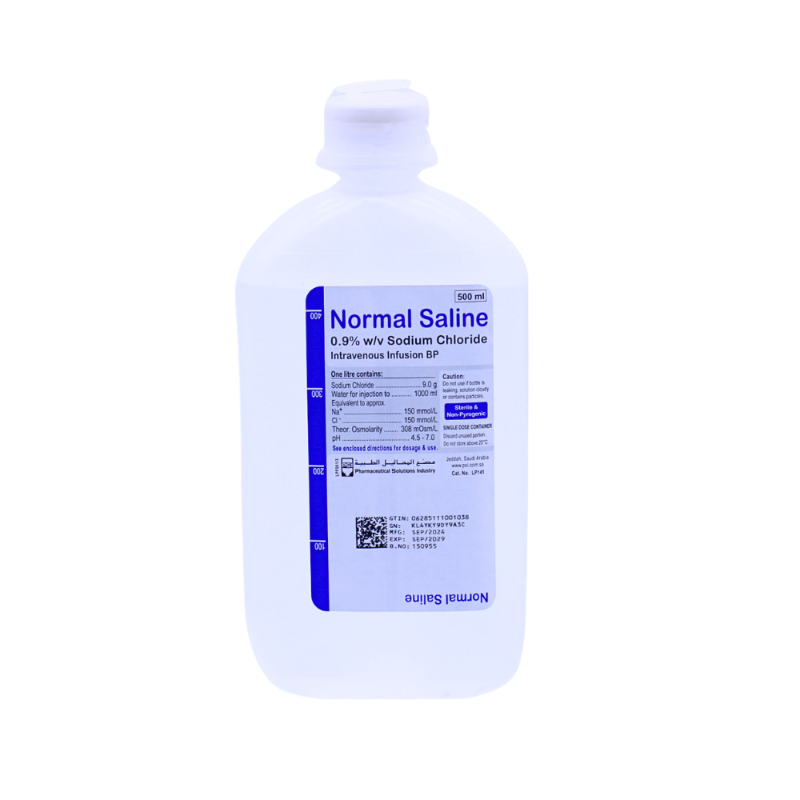
NORMAL SALINE 0.9% W/V (IV) INFUSION 500ML
- Sku : I-004411
Key features
Normal Saline I.V. Infusion Solution 0.9% is a sterile intravenous solution containing sodium chloride 0.9%. It works as an isotonic crystalloid to replace water and electrolytes, helping maintain fluid balance and osmotic pressure. It is used for parenteral replacement of extracellular fluid and sodium/chloride in dehydration or hypovolemia, and as a diluent or vehicle for IV medications. It is supplied as a 250 ml solution pack.- Brand: NORMAL SALINE
- Active Ingredient: SODIUM CHLORIDE 0.9%
- Strength: 0.9%
- Dosage Form: Solution
- Pack Size: 250 ml
- Route: Parenteral use
- Prescription Status: Prescription
- Therapeutic Class: Blood & Blood Forming Organs
- Drug Class: Isotonic crystalloid intravenous fluid (electrolyte solution: sodium chloride).
- Manufacturer: Pharmaceutical Solution Industries (PSI)
- Country of Origin: Saudi Arabia
- SFDA Registration No.: 9-149-91
- Shelf Life: 48 months
- Storage: store below 25°c
- Primary Use: Intravenous isotonic fluid used for extracellular fluid replacement, electrolyte replenishment, and as a vehicle for IV drug administration
Frequently bought together
Vitamins & Supplements > Vitamins and Minerals
Vitamins & Supplements > Vitamins and Minerals
Vitamins & Supplements > Vitamins and Minerals
Vitamins & Supplements > Vitamins and Minerals
Indications
Approved Uses
Parenteral replacement of extracellular fluid and sodium/chloride (e.g., dehydration/hypovolemia with sodium/chloride depletion) and as a vehicle/diluent for IV drug administration; may also be used for priming extracorporeal circuits (e.g., hemodialysis) per institutional protocol.
Off-Label Uses
For this IV infusion product, off-label uses may include use as a nebulization diluent and for flushing/maintaining IV line patency (institution-dependent); wound/nasal irrigation is typically performed with specifically labeled irrigation saline products rather than IV infusion bottles.
Dosage & Administration
Dosing by Condition
Dose, rate, and duration are individualized based on indication (resuscitation vs maintenance vs diluent), age/weight, hemodynamics, and labs; administer per physician order and institutional protocols rather than fixed volumes.
Initial Dose
500-1000 ml IV infused over 1-4 hours depending on clinical urgency
Maintenance Dose
1500-2500 ml per 24 hours adjusted to clinical response and fluid balance
Maximum Dose
No fixed maximum dose; volume/rate are individualized based on indication (e.g., resuscitation vs maintenance), hemodynamics, urine output, and electrolyte/acid-base monitoring.
Children's Dosage
Neonates and children: 20 ml/kg IV bolus for resuscitation, repeated as needed; maintenance calculated by weight using Holliday-Segar method (100 ml/kg for first 10 kg, 50 ml/kg for next 10 kg, 20 ml/kg thereafter per 24 hours)
Dose Adjustment Notes
Use with caution and consider lower volumes/rates in patients at risk of sodium/water retention (e.g., heart failure, significant renal impairment, cirrhosis); tailor therapy to clinical status and monitor fluid balance, electrolytes, and acid-base balance.
How to Take
For intravenous infusion (parenteral use) using aseptic technique and a sterile IV administration set; inspect for clarity/particulates and container integrity before use; do not use if cloudy, discolored, leaking, or container is damaged; administer at the prescribed rate and volume; single-use container-discard any unused portion.
How to Prepare
Ready-to-use IV solution; no reconstitution required. Inspect container/solution for leaks, particulate matter, or discoloration; use aseptic technique. If used as a diluent/vehicle for other IV medications, confirm compatibility/stability and follow the specific product’s dilution instructions.
Side Effects
Common Side Effects
Infusion site reactions (pain, irritation, erythema, phlebitis/thrombosis) and, with excessive or rapid administration, fluid overload/edema and electrolyte/acid-base disturbances such as hypernatremia and hyperchloremic metabolic acidosis.
Side Effect Frequency
Frequencies are generally not well quantified for IV 0.9% sodium chloride; report as 'frequency not known' with key risks: infusion-site reactions/phlebitis, fluid overload (including pulmonary edema), hypernatremia, hyperchloremia and hyperchloremic metabolic acidosis (especially with large volumes), and hypersensitivity reactions (rare).
Safety & Warnings
Contraindications
No absolute contraindication in most labeling; avoid/use only if clearly indicated in hypernatremia or hyperchloremia and in severe fluid-overload states (e.g., decompensated heart failure, severe renal failure/oliguria-anuria, severe edema/ascites) unless under close monitoring.
Warnings & Precautions
Monitor fluid balance, electrolytes, and acid-base status during therapy (especially large/prolonged infusions); use caution in heart failure, renal impairment, cirrhosis/ascites, hypertension, edema, and pre-eclampsia; large volumes can cause hyperchloremic metabolic acidosis; inspect solution/container integrity and use appropriate IV administration precautions.
Age Restriction
No specific age restriction; can be used in all age groups (including neonates/children) with weight- and clinical status-based dosing and monitoring.
Drug Interactions
Drug Interactions
Corticosteroids/corticotropin: additive sodium and fluid retention; Lithium: increased sodium load can increase renal lithium clearance and lower lithium levels (changes in sodium/fluid balance can alter lithium concentrations).
Interaction Severity
MODERATE: Corticosteroids/corticotropin (additive sodium and water retention). MODERATE: Lithium (changes in sodium balance can alter lithium renal clearance and serum levels-often decreased with higher sodium/IV saline, increased with sodium depletion).
Food Interaction
No clinically relevant food interactions (not applicable for IV administration).
Special Populations
Children
Neonates and children: 20 ml/kg IV bolus for resuscitation, repeated as needed; maintenance calculated by weight using Holliday-Segar method (100 ml/kg for first 10 kg, 50 ml/kg for next 10 kg, 20 ml/kg thereafter per 24 hours)
Kidney Impairment
No specific CrCl-based adjustment; use great caution in renal impairment/oliguria-anuria-reduce volume/rate and monitor for sodium retention, edema, and electrolyte/acid-base changes.
Storage & Patient Advice
Preparation Instructions
Ready-to-use IV solution; no reconstitution required. Inspect container/solution for leaks, particulate matter, or discoloration; use aseptic technique. If used as a diluent/vehicle for other IV medications, confirm compatibility/stability and follow the specific product’s dilution instructions.
Missed Dose
Not applicable-administered and titrated by healthcare professionals; if an infusion is interrupted, restart/adjust per clinical status and prescriber order.
Stopping the Medicine
Administered and discontinued by healthcare professionals; stop when the clinical indication is resolved or if signs of fluid/electrolyte overload occur, per prescriber protocol.
Overdose
Overdose/excess administration may cause fluid overload (peripheral/pulmonary edema, hypertension), hypernatremia, hyperchloremia, and hyperchloremic metabolic acidosis; manage by stopping infusion, supportive care, diuretics if appropriate, and correcting electrolytes-dialysis may be required in severe renal failure.
Patient Counseling
Administered IV by healthcare professionals; patients should promptly report infusion-site pain/redness/swelling, shortness of breath, facial/lip swelling or rash (hypersensitivity), or symptoms of fluid overload (rapid weight gain, edema, worsening breathlessness). Inform the care team of heart failure, renal impairment, liver disease/cirrhosis, hypertension, or any fluid/salt-restricted diet before infusion.
Monitoring Requirements
Monitor fluid balance (I&O, weight), vital signs/hemodynamics, and serum electrolytes (especially sodium/chloride) with acid-base status during large-volume or prolonged therapy; watch for signs of fluid overload.
Pharmacology
Mechanism of Action
Provides isotonic water and sodium/chloride to expand extracellular fluid volume and replenish electrolytes, helping maintain osmotic pressure and fluid distribution without causing major transcellular water shifts when given appropriately.
Onset of Action
Immediate upon IV administration.
Duration of Effect
Hemodynamic/volume-expanding effect is transient: only a fraction remains intravascular after infusion, with most distributing to the extracellular space within ~30-60 minutes; clinical effect persists while infusion continues and depends on ongoing losses and renal handling.
Half-Life
Not meaningfully defined/clinically applicable; sodium and chloride do not have a fixed elimination half-life and their kinetics depend on distribution and renal/homeostatic regulation (e.g., volume status, RAAS/ADH, kidney function).
Bioavailability
100% (intravenous administration)
Metabolism
Not metabolized; sodium and chloride are endogenous ions regulated by physiologic mechanisms.
Excretion
Primarily renal excretion/regulation (kidneys) of sodium and chloride; minor losses can occur via sweat and gastrointestinal secretions.
Protein Binding
Not protein-bound (not applicable).
Product Information
Available Dosage Forms
Solution for infusion (parenteral) in containers such as bottles/bags; separate products may exist as irrigation solutions, but this SFDA-registered product is an IV infusion solution in a bottle.
Composition per Dose
Each 100 mL: Sodium Chloride 0.9 g (equivalent to Na⁺ 15.4 mEq and Cl⁻ 15.4 mEq) in water for injection. Each 500 mL: Sodium Chloride 4.5 g (equivalent to Na⁺ 77 mEq and Cl⁻ 77 mEq) in water for injection
Generic Availability
Yes
OTC Alternatives
No OTC alternative
Primary Use
Intravenous isotonic fluid used for extracellular fluid replacement, electrolyte replenishment, and as a vehicle for IV drug administration
Reviewed by Al Mujtama Pharmacy Medical Review Team. Last reviewed 19-06-2026
Similar Products

Medications > Gastrointestinal Medications
Medications > Cold, Cough, and Allergy Medications
Medications > Other Medicines
Medications > Cholesterol Medications
Medications > Eye and Ear Medications
Medications > Other Medicines
Medications > Cold, Cough, and Allergy Medications

Medications > Gastrointestinal Medications
Medications > Painkillers and Antipyretics
Medications > Other Medicines
