
Get Free Delivery With No Minimum Order
-1744229570.gif "Almujtama Pharmacy logo")




Vitamins & Supplements > Vitamins and Minerals
Vitamins & Supplements > Vitamins and Minerals
Vitamins & Supplements > Vitamins and Minerals
Vitamins & Supplements > Vitamins and Minerals
Vitamins & Supplements > Vitamins and Minerals
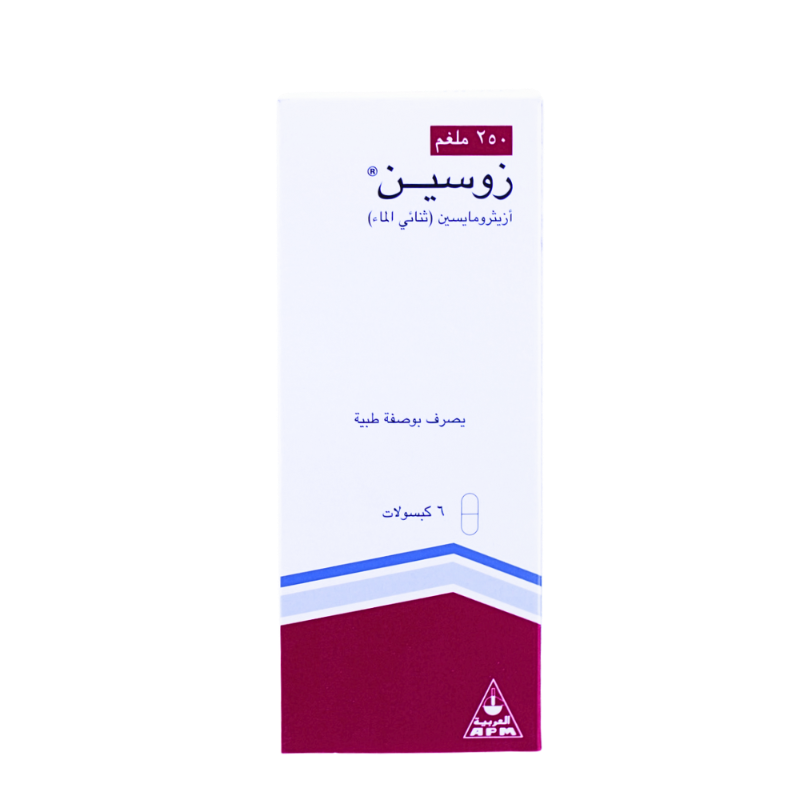
ZOCIN 250/MG CAP 6/CAP
- Sku : I-006918
Key features
ZOCIN 250 mg capsules contain the active ingredient azithromycin 250 mg per capsule. Azithromycin binds to the 50S ribosomal subunit (23S rRNA) of susceptible bacteria, inhibiting translocation and protein synthesis and exerting a primarily bacteriostatic effect. It is indicated for bacterial infections such as community-acquired pneumonia, acute bacterial sinusitis, acute bacterial exacerbations of chronic bronchitis/COPD, pharyngitis/tonsillitis, uncomplicated skin and soft-tissue infections, and urethritis/cervicitis due to Chlamydia trachomatis. Available by prescription as 250 mg capsules in a pack of 6.- Brand: ZOCIN
- Active Ingredient: AZITHROMYCIN 250mg
- Strength: 250mg
- Dosage Form: Capsule
- Pack Size: 6 Capsules
- Route: Oral use
- Prescription Status: Prescription
- Therapeutic Class: Anti-infective
- Pharmacological Group: Macrolides
- Drug Class: Macrolide Antibiotic (Azalide subclass)
- Manufacturer: The Arab Pharmaceutical Manufacturing PSC Sult
- Country of Origin: Jordan
- SFDA Registration No.: 2-347-03
- Shelf Life: 36 months
- Storage: store below 30°c
- Spectrum: Broad-spectrum.
- Antibiotic Class: Macrolide.
Vitamins & Supplements > Vitamins and Minerals
Vitamins & Supplements > Vitamins and Minerals
Vitamins & Supplements > Vitamins and Minerals
Vitamins & Supplements > Vitamins and Minerals
Vitamins & Supplements > Vitamins and Minerals
Indications
Approved Uses
Common approved uses for azithromycin include community-acquired pneumonia, acute bacterial sinusitis, acute bacterial exacerbation of chronic bronchitis/COPD, pharyngitis/tonsillitis (when appropriate), uncomplicated skin/skin-structure infections, and urethritis/cervicitis due to Chlamydia trachomatis; some labels also include chancroid and acute otitis media (pediatric).
Off-Label Uses
Examples of off-label uses include Mycobacterium avium complex (MAC) prophylaxis/treatment (often with other agents), pertussis, traveler’s diarrhea, and cat-scratch disease; other uses may be region/practice-dependent.
Dosage & Administration
Dosing by Condition
Typical adult regimens: (1) CAP/skin infections/pharyngitis-tonsillitis: 500 mg on Day 1, then 250 mg once daily on Days 2-5; (2) Acute bacterial sinusitis: 500 mg once daily for 3 days; (3) Chlamydial urethritis/cervicitis: 1 g PO single dose. Gonorrhea: azithromycin is not recommended as monotherapy; treat per current STI guidelines (ceftriaxone-based), with azithromycin only if specifically indicated by local guidance.
Initial Dose
500mg on Day 1 (for most respiratory and skin infections)
Maintenance Dose
250mg once daily on Days 2-5
Maximum Dose
Typical adult max is 500 mg/day depending on indication; 1 g single dose is used for some STI indications (e.g., chlamydia). A 2 g single dose has been used for certain indications but is not routine and is limited by GI intolerance and evolving resistance guidance.
Children's Dosage
Community-acquired pneumonia (≥6 months): 10mg/kg on Day 1 (max 500mg), then 5mg/kg once daily on Days 2-5 (max 250mg/day). Pharyngitis/tonsillitis (≥2 years): 12mg/kg once daily for 5 days (max 500mg/day). Acute otitis media (≥6 months): 30mg/kg as single dose or 10mg/kg once daily for 3 days or 10mg/kg on Day 1 then 5mg/kg on Days 2-5
Dose Adjustment Notes
No dose adjustment is generally required in mild-to-moderate renal impairment; use caution in severe renal impairment (e.g., CrCl/GFR <10 mL/min). No routine adjustment is recommended for mild-to-moderate hepatic impairment, but avoid/use extreme caution in severe hepatic disease and discontinue if hepatitis occurs.
How to Take
Swallow the capsule whole with water; for azithromycin capsules, take on an empty stomach (at least 1 hour before or 2 hours after food).
Side Effects
Common Side Effects
Diarrhea, nausea, abdominal pain, vomiting, and headache (dyspepsia/flatulence can also occur).
Side Effect Frequency
Very common (≥10%): diarrhea. Common (1-10%): nausea, abdominal pain, vomiting. Uncommon (0.1-1%): dizziness, headache, rash, vaginitis. Rare/very rare: QT prolongation/arrhythmias, hepatotoxicity/liver dysfunction, severe hypersensitivity and serious skin reactions (e.g., SJS/TEN), C. difficile-associated diarrhea.
Safety & Warnings
Contraindications
Hypersensitivity to azithromycin, erythromycin, or any macrolide/ketolide antibiotic; history of cholestatic jaundice or hepatic dysfunction associated with prior azithromycin use; known QT prolongation or history of torsades de pointes
Warnings & Precautions
Use caution/avoid in patients with known QT prolongation, electrolyte abnormalities, bradyarrhythmias, or concomitant QT‑prolonging drugs; monitor/stop if hepatic dysfunction occurs; watch for severe allergy and CDAD; may worsen myasthenia gravis; consider superinfection with prolonged use; use caution in severe renal impairment.
Age Restriction
Azithromycin is approved for pediatric use (typically ≥6 months for labeled indications), but this 250 mg capsule is generally intended for patients able to swallow capsules; use pediatric formulations (suspension) for younger children.
Driving Warning
Safe
Drug Interactions
Drug Interactions
Key interactions: aluminum/magnesium antacids (separate dosing), warfarin (monitor INR), digoxin (monitor levels/toxicity), ergot derivatives (avoid), QT‑prolonging drugs (additive risk), cyclosporine (monitor levels), nelfinavir (↑ azithromycin exposure); colchicine interaction is not a typical clinically significant azithromycin interaction unless combined with strong P‑gp/CYP3A4 inhibitors.
Interaction Severity
MAJOR: Concomitant QT-prolonging drugs (e.g., amiodarone, sotalol, certain antipsychotics) due to torsades risk; ergot derivatives (ergotamine/dihydroergotamine) due to ergotism risk. MODERATE: Warfarin (possible INR increase-monitor), digoxin (possible level increase-monitor), cyclosporine (possible level increase-monitor). MINOR: Aluminum/magnesium antacids can reduce peak levels-separate by ~2 hours.
Food Interaction
For azithromycin capsules: take on an empty stomach (≥1 hour before or ≥2 hours after meals); food has less impact on some other formulations, but this product is a capsule.
Special Populations
Pregnancy
Category B
Breastfeeding
Caution
Children
Community-acquired pneumonia (≥6 months): 10mg/kg on Day 1 (max 500mg), then 5mg/kg once daily on Days 2-5 (max 250mg/day). Pharyngitis/tonsillitis (≥2 years): 12mg/kg once daily for 5 days (max 500mg/day). Acute otitis media (≥6 months): 30mg/kg as single dose or 10mg/kg once daily for 3 days or 10mg/kg on Day 1 then 5mg/kg on Days 2-5
Elderly
Standard adult dosing; no routine dose adjustment required. Use with caution in elderly patients with underlying cardiac conditions due to QT prolongation risk.
Kidney Impairment
No adjustment needed for mild-moderate renal impairment; use with caution in severe renal impairment (CrCl <10 mL/min).
Liver Impairment
No routine dose adjustment is defined; use with caution in hepatic impairment and avoid/refrain from use in patients with prior azithromycin‑associated cholestatic jaundice/hepatic dysfunction; discontinue if liver injury signs occur.
Storage & Patient Advice
Missed Dose
Take the missed dose as soon as you remember; if it is close to the next scheduled dose, skip the missed dose and resume the regular schedule-do not double doses.
Stopping the Medicine
Complete the prescribed course; no taper is needed-stop when the course is finished unless a clinician advises earlier discontinuation due to adverse effects.
Overdose
Symptoms may include nausea, vomiting, diarrhea, abdominal pain, and reversible hearing loss; manage with supportive care, consider decontamination if early, and monitor ECG/electrolytes for QT prolongation-no specific antidote.
Patient Counseling
Finish the prescribed course; swallow capsules whole with water and take on an empty stomach (≥1 hour before or ≥2 hours after food). Avoid aluminum/magnesium antacids within ~2 hours. Seek care urgently for severe/persistent diarrhea, allergic reaction, jaundice/dark urine, or palpitations/fainting (possible arrhythmia), and report all other medicines-especially QT-prolonging drugs/warfarin/digoxin.
Monitoring Requirements
No routine labs are required for short courses in low-risk patients; monitor for hepatic injury (LFTs if symptoms/signs occur or in pre-existing liver disease) and consider ECG/QT-risk assessment in patients with risk factors or on QT-prolonging drugs.
Pharmacology
Mechanism of Action
Azithromycin binds to the 50S ribosomal subunit (23S rRNA) of susceptible bacteria, inhibiting translocation/translation and thereby inhibiting protein synthesis (primarily bacteriostatic).
Onset of Action
Peak plasma concentrations occur about 2-3 hours after an oral dose; clinical improvement in susceptible infections is often seen within 48-72 hours.
Duration of Effect
Because azithromycin concentrates in tissues and has a long terminal half-life, antibacterial activity/therapeutic tissue levels can persist for several days after the last dose.
Half-Life
Terminal elimination half-life is approximately 68 hours.
Metabolism
Limited hepatic metabolism (minor), with most drug eliminated unchanged in bile; azithromycin is not a clinically significant CYP450 inhibitor compared with erythromycin/clarithromycin.
Excretion
Primarily biliary excretion with fecal elimination (major route); renal excretion is minor (about 6% of an oral dose as unchanged drug).
Product Information
Available Dosage Forms
Capsule, Tablet, Powder for oral suspension, Intravenous injection.
Composition per Dose
Each capsule: 250mg azithromycin as azithromycin dihydrate.
OTC Alternatives
No OTC alternative - prescription required for all antibiotic treatments
Spectrum
Broad-spectrum.
Antibiotic Class
Macrolide.
Legal Disclaimer - Al Mujtama Pharmacy
The product information provided is derived from verified pharmaceutical references and is intended for general health education only. It is not a substitute for professional medical advice, diagnosis, or treatment.
Al Mujtama Pharmacy assumes no legal or medical liability for:
- Any therapeutic decision made based on the information displayed without consulting a licensed physician or pharmacist
- Any discrepancy between the information provided and the product's package insert or SFDA guidelines
- Any misuse of medication resulting from personal interpretation of the content displayed
Important notice: Drug formulations and instructions may vary between production batches. Always rely on the leaflet included inside the product packaging you have, and consult your pharmacist or physician before starting, adjusting, or discontinuing any medication.
By using this content, you acknowledge that you have read this disclaimer and agree that Al Mujtama Pharmacy bears no liability arising from reliance on this information as a substitute for direct medical consultation.
Your health is a trust - always consult your doctor first.
