
Get Free Delivery With No Minimum Order
-1744229570.gif "Almujtama Pharmacy logo")




Vitamins & Supplements > Vitamins and Minerals
Vitamins & Supplements > Vitamins and Minerals
Vitamins & Supplements > Vitamins and Minerals
Vitamins & Supplements > Vitamins and Minerals
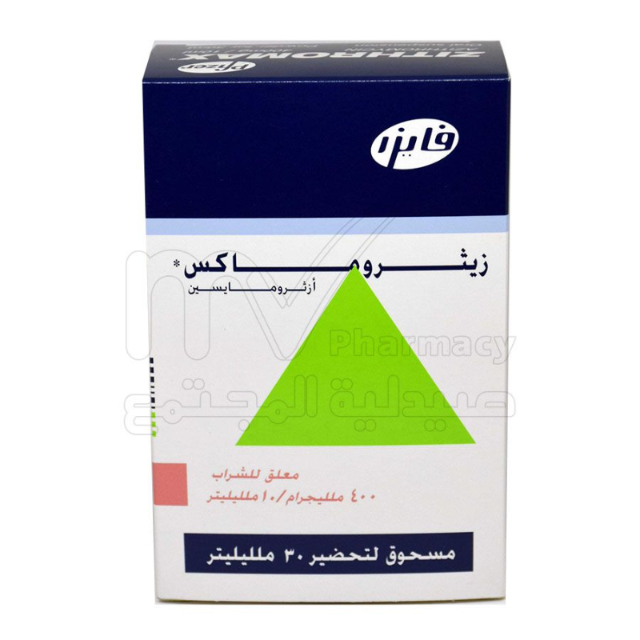
ZITHROMAX 400/MG/10/ML 30/ML SUSP
- Sku : I-006917
Key features
ZITHROMAX 40 mg/ml powder for oral suspension contains azithromycin as the active ingredient. Azithromycin binds to the 50S ribosomal subunit (23S rRNA) of susceptible bacteria, inhibiting translocation and protein synthesis to inhibit bacterial growth. It is indicated for community-acquired pneumonia; acute bacterial exacerbations of chronic bronchitis/COPD; acute bacterial sinusitis; pharyngitis/tonsillitis; uncomplicated skin and skin structure infections; uncomplicated urethritis and cervicitis due to Chlamydia trachomatis; chancroid; and pediatric acute otitis media. Available as a prescription powder for oral suspension, supplied in a 30 ml pack.- Brand: ZITHROMAX
- Active Ingredient: AZITHROMYCIN
- Strength: 40mg/ml
- Dosage Form: Powder for oral suspension
- Pack Size: 30 ml
- Route: Oral use
- Prescription Status: Prescription
- Therapeutic Class: Anti-infective
- Pharmacological Group: Macrolides
- Drug Class: Macrolide Antibiotic (Azalide subclass)
- Manufacturer: PFIZER SAUDI LIMITED
- Country of Origin: Saudi Arabia
- SFDA Registration No.: 1010222700
- Shelf Life: 24 months
- Storage: do not store above 30°c
- Spectrum: Broad-spectrum
- Antibiotic Class: Macrolide
Vitamins & Supplements > Vitamins and Minerals
Vitamins & Supplements > Vitamins and Minerals
Vitamins & Supplements > Vitamins and Minerals
Vitamins & Supplements > Vitamins and Minerals
Indications
Approved Uses
Approved (typical labeling): community-acquired pneumonia; acute bacterial exacerbation of chronic bronchitis/COPD; acute bacterial sinusitis; pharyngitis/tonsillitis (when appropriate, often as alternative therapy); uncomplicated skin and skin structure infections; uncomplicated urethritis and cervicitis due to Chlamydia trachomatis; genital ulcer disease (chancroid) due to Haemophilus ducreyi; pediatric acute otitis media.
Off-Label Uses
Common off-label uses include Mycobacterium avium complex (MAC) prophylaxis/treatment (often with other agents), pertussis treatment/post-exposure prophylaxis, certain chlamydial infections beyond labeled sites, and selected atypical respiratory infections per local guidance; COVID-19 is not recommended (lack of benefit). Typhoid fever is not a standard off-label use in guidelines where resistance is prevalent and better options exist.
Dosage & Administration
Dosing by Condition
Adults: CAP 500 mg day 1 then 250 mg daily days 2-5; acute bacterial sinusitis 500 mg daily x3 days; AECB/COPD 500 mg day 1 then 250 mg daily days 2-5 OR 500 mg daily x3 days; uncomplicated skin/skin structure 500 mg day 1 then 250 mg daily days 2-5; NGU/cervicitis (Chlamydia) 1 g once. Pediatrics (oral suspension): acute otitis media 30 mg/kg once OR 10 mg/kg daily x3 days OR 10 mg/kg day 1 then 5 mg/kg days 2-5; pharyngitis/tonsillitis 12 mg/kg daily x5 days (max 500 mg/day). Gonorrhea: azithromycin monotherapy 2 g once is not recommended in current guidelines; if used historically, it was as part of older regimens and is generally avoided due to resistance and GI intolerance.
Initial Dose
500mg on Day 1 (adults, most indications)
Maintenance Dose
250 mg once daily on Days 2 through 5.
Maximum Dose
2g as a single dose (for gonorrhea); 500mg/day for standard courses
Children's Dosage
Otitis media: 30mg/kg as single dose OR 10mg/kg/day for 3 days OR 10mg/kg on Day 1 then 5mg/kg/day for 4 days (max 500mg/day). Community-acquired pneumonia: 10mg/kg on Day 1 (max 500mg), then 5mg/kg/day Days 2-5 (max 250mg/day). Pharyngitis: 12mg/kg/day for 5 days (max 500mg/day). Not recommended in children under 6 months
Dose Adjustment Notes
Renal: no adjustment generally needed in mild-moderate impairment; use caution in severe renal impairment (e.g., CrCl/GFR <10 mL/min). Hepatic: no specific adjustment, but use caution/avoid if significant hepatic disease or prior azithromycin-associated cholestatic jaundice/hepatic dysfunction; elderly: no routine adjustment, but assess QT-risk and organ impairment.
How to Take
Reconstitute with water as directed; shake well before each dose; measure with an oral syringe/medicine spoon; may be taken with or without food; if GI upset occurs, take with food; avoid aluminum/magnesium antacids within 2 hours; complete the prescribed course.
How to Prepare
Reconstitute by adding the labeled amount of water to the bottle (often in two portions), shaking well after each addition, to a final volume of 30 mL; shake well before each dose.
Side Effects
Common Side Effects
Diarrhea, nausea, abdominal pain, vomiting; less commonly headache and dizziness.
Side Effect Frequency
Common: diarrhea/loose stools, nausea, abdominal pain, vomiting; less common: headache, dizziness, rash; rare but serious: QT prolongation/arrhythmias, hepatotoxicity/cholestatic hepatitis, severe hypersensitivity (including SJS/TEN), and hearing disturbances.
Safety & Warnings
Contraindications
Contraindicated in patients with hypersensitivity to azithromycin, erythromycin, or any macrolide/ketolide; and in those with a history of cholestatic jaundice/hepatic dysfunction associated with prior azithromycin use.
Warnings & Precautions
Warnings/precautions: QT prolongation risk (avoid/monitor in patients with known QT prolongation, electrolyte abnormalities, bradycardia, or on QT-prolonging drugs), severe hypersensitivity/SCAR (stop immediately if suspected), hepatotoxicity (stop if signs of liver injury), C. difficile-associated diarrhea, possible exacerbation of myasthenia gravis, and superinfection with prolonged use.
Age Restriction
Generally approved for pediatric use from 6 months of age and older for certain indications; not recommended in infants <6 months due to limited safety/efficacy data (except specific indications per label).
Driving Warning
Safe
Drug Interactions
Drug Interactions
Key interactions: aluminum/magnesium antacids (separate dosing to avoid reduced azithromycin peak levels), warfarin (monitor INR), digoxin (monitor levels/toxicity), cyclosporine (monitor levels), nelfinavir (increases azithromycin exposure), and other QT-prolonging drugs (additive arrhythmia risk); avoid ergot derivatives (ergotism risk).
Interaction Severity
MAJOR/AVOID: pimozide; ergotamine/dihydroergotamine (ergotism risk); other high-risk QT-prolonging agents (e.g., amiodarone, sotalol, certain antipsychotics) in susceptible patients. MODERATE: warfarin (monitor INR), digoxin (monitor levels/clinical toxicity), cyclosporine (monitor levels), nelfinavir (↑ azithromycin exposure). MINOR: aluminum/magnesium antacids (↓ Cmax-separate by 2 hours).
Food Interaction
May be taken with or without food; taking with food can improve tolerability; separate aluminum/magnesium-containing antacids by at least 2 hours.
Alcohol Interaction
Safe
Special Populations
Pregnancy
Category B (No evidence of risk in animal studies; inadequate human data)
Breastfeeding
Caution
Children
Otitis media: 30mg/kg as single dose OR 10mg/kg/day for 3 days OR 10mg/kg on Day 1 then 5mg/kg/day for 4 days (max 500mg/day). Community-acquired pneumonia: 10mg/kg on Day 1 (max 500mg), then 5mg/kg/day Days 2-5 (max 250mg/day). Pharyngitis: 12mg/kg/day for 5 days (max 500mg/day). Not recommended in children under 6 months
Elderly
Standard adult dosing - no routine dose adjustment required. Use with caution if significant renal or hepatic impairment is present
Kidney Impairment
No dose adjustment needed for mild to moderate renal impairment (e.g., GFR/CrCl >10 mL/min); use with caution in severe renal impairment (GFR/CrCl <10 mL/min).
Liver Impairment
No specific dose adjustment is recommended for mild to moderate hepatic impairment, but use with caution; avoid/use only if benefits outweigh risks in severe hepatic disease and discontinue if signs of hepatitis/cholestasis occur.
Storage & Patient Advice
Storage Conditions
Store unreconstituted powder below 30°C. After reconstitution: store at room temperature (below 30°C); do not refrigerate or freeze; discard any unused suspension after 10 days.
Preparation Instructions
Reconstitute by adding the labeled amount of water to the bottle (often in two portions), shaking well after each addition, to a final volume of 30 mL; shake well before each dose.
Missed Dose
Take the missed dose as soon as remembered; if it is close to the next scheduled dose, skip the missed dose and continue the regular schedule; do not double doses.
Stopping the Medicine
Complete the full prescribed course; no taper is required-stop when the prescribed duration is finished unless a serious adverse reaction occurs and a clinician advises stopping early.
Overdose
Symptoms may include nausea, vomiting, diarrhea/abdominal pain and reversible hearing impairment; management is supportive/symptomatic (consider activated charcoal if recent ingestion) and seek urgent medical attention-no specific antidote.
Patient Counseling
Reconstitute exactly as directed; shake well before each dose and measure with an oral syringe/spoon; take with or without food (with food if stomach upset); finish the full course; avoid aluminum/magnesium antacids within 2 hours; seek care for severe/persistent diarrhea, rash/allergic reaction, jaundice/dark urine, or palpitations/syncope (QT risk); store as directed on the label and discard after the labeled in-use period; keep at/under 30°C per SFDA storage condition.
Monitoring Requirements
No routine labs for short courses in low-risk patients; monitor for clinical response and diarrhea; check LFTs if hepatic disease or symptoms of hepatotoxicity occur; consider ECG/QT risk assessment (and ECG if high risk or on QT-prolonging drugs); monitor INR if on warfarin and digoxin levels/clinical toxicity if on digoxin.
Pharmacology
Mechanism of Action
Binds to the 50S ribosomal subunit (23S rRNA) of susceptible bacteria, inhibiting translocation/protein synthesis and thereby inhibiting bacterial growth (primarily bacteriostatic).
Onset of Action
Pharmacokinetic onset: peak plasma concentrations typically occur about 2-3 hours after an oral dose; clinical improvement in bacterial infections is usually seen within 24-72 hours if the pathogen is susceptible.
Duration of Effect
Because of extensive tissue distribution and a long terminal half-life, antibacterial activity/therapeutic tissue concentrations can persist for several days after the last dose.
Half-Life
Terminal elimination half-life: approximately 68 hours.
Bioavailability
Approximately 37% (oral azithromycin; suspension/capsules are similar).
Metabolism
Limited hepatic metabolism (e.g., N-demethylation); not a clinically significant CYP450 substrate and has minimal CYP-mediated interaction potential compared with other macrolides.
Excretion
Primarily biliary excretion with fecal elimination; renal excretion is minor (about 6% of dose as unchanged drug).
Protein Binding
Concentration-dependent protein binding, approximately 7% to 51%.
Product Information
Available Dosage Forms
For azithromycin (Zithromax/azithromycin products): powder for oral suspension (this product per verified API), oral tablets, and IV powder for solution/infusion; ophthalmic eye drops are not a Zithromax azithromycin dosage form (azithromycin ophthalmic is a different product/brand in some markets).
Composition per Dose
Each 5ml (after reconstitution): 200mg azithromycin (40mg/ml)
Generic Availability
Yes
OTC Alternatives
No OTC alternative - prescription required for all antibiotic therapy
Spectrum
Broad-spectrum
Antibiotic Class
Macrolide
Legal Disclaimer - Al Mujtama Pharmacy The product information provided is derived from verified pharmaceutical references and is intended for general health education only. It is not a substitute for professional medical advice, diagnosis, or treatment. Al Mujtama Pharmacy assumes no legal or medical liability for: Any therapeutic decision made based on the information displayed without consulting a licensed physician or pharmacist Any discrepancy between the information provided and the product's package insert or SFDA guidelines Any misuse of medication resulting from personal interpretation of the content displayed Important notice: Drug formulations and instructions may vary between production batches. Always rely on the leaflet included inside the product packaging you have, and consult your pharmacist or physician before starting, adjusting, or discontinuing any medication. By using this content, you acknowledge that you have read this disclaimer and agree that Al Mujtama Pharmacy bears no liability arising from reliance on this information as a substitute for direct medical consultation. Your health is a trust - always consult your doctor first.