
Get Free Delivery With No Minimum Order
-1744229570.gif "Almujtama Pharmacy logo")




Health Care & Wellness > Medical Devices And Accessories
Vitamins & Supplements > Omega-3 Supplements
Vitamins & Supplements > Omega-3 Supplements
Vitamins & Supplements > Omega-3 Supplements
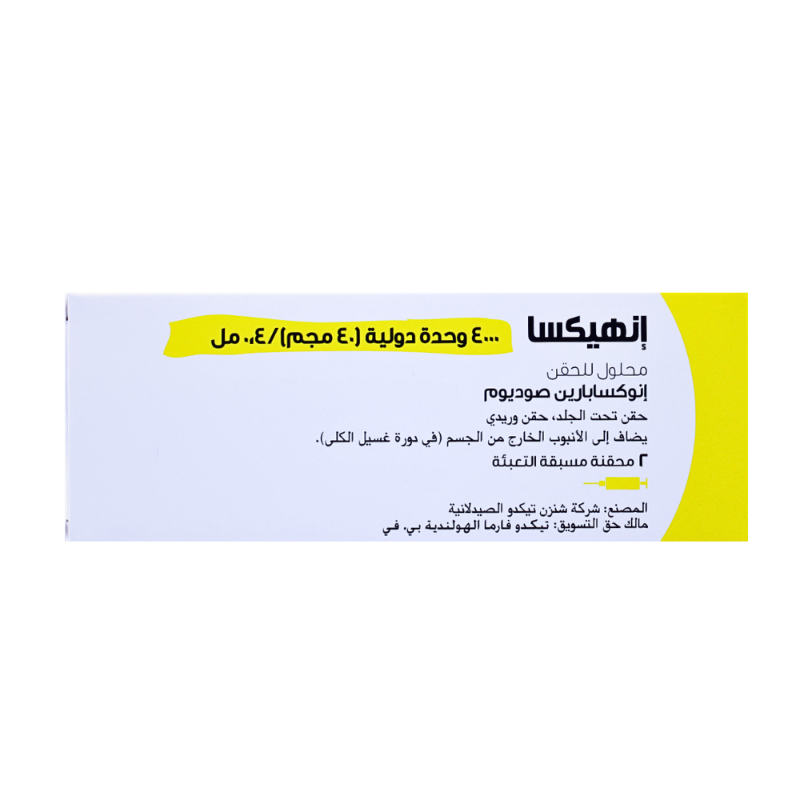
INHIXA 40/MG/0.4/ML 2/PREF.SYR
- Sku : I-029167
Key features
INHIXA 40 mg/0.4 ml is a solution for injection in a prefilled syringe containing enoxaparin sodium 40 mg. It potentiates antithrombin (ATIII) activity, preferentially inhibiting factor Xa with lesser inhibition of thrombin, thereby reducing fibrin formation and thrombus propagation. INHIXA is indicated for prevention of venous thromboembolism (DVT/PE) in surgical patients (including orthopedic and general surgery) and in acutely ill medical patients with restricted mobility, for treatment of DVT with or without pulmonary embolism, for prevention of ischemic complications in unstable angina and non-ST-elevation MI (NSTEMI), and for treatment of acute ST-elevation MI (STEMI). Supplied as a 0.4 ml solution for injection in a prefilled syringe.- Brand: INHIXA
- Active Ingredient: ENOXAPARIN SODIUM 40mg
- Strength: 40mg
- Dosage Form: Solution for injection
- Pack Size: 0.4 ml
- Route: Intravenous, Subcutaneous
- Prescription Status: Prescription
- Therapeutic Class: Antithrombotic
- Pharmacological Group: Heparin Group
- Drug Class: Low Molecular Weight Heparin (LMWH) - Antithrombotic, Heparin Group
- Manufacturer: Shenzhen Techdow Pharmaceutical Co Ltd
- Country of Origin: China
- SFDA Registration No.: 1810200218
- Shelf Life: 24 months
- Storage: Store below 30°C Don't Freez
- Cv Drug Class: Anticoagulant
Health Care & Wellness > Medical Devices And Accessories
Vitamins & Supplements > Omega-3 Supplements
Vitamins & Supplements > Omega-3 Supplements
Vitamins & Supplements > Omega-3 Supplements
Indications
Approved Uses
Prevention of venous thromboembolism (DVT/PE) in surgical patients (including orthopedic and general surgery) and in acutely ill medical patients with restricted mobility; treatment of DVT with or without pulmonary embolism; prevention of ischemic complications in unstable angina and non-ST-elevation MI (NSTEMI); treatment of acute ST-elevation MI (STEMI).
Off-Label Uses
Common off-label uses include anticoagulation in pregnancy (VTE treatment/prophylaxis and antiphospholipid syndrome-related thromboprophylaxis), peri-procedural bridging when interrupting warfarin in selected high-risk patients, and anticoagulation for extracorporeal circuits (e.g., dialysis/ECMO) where institutionally used.
Dosage & Administration
Dosing by Condition
VTE prophylaxis (general/abdominal surgery): 40 mg SC once daily (often started 2 hours pre-op or 12 hours pre/post-op per institutional protocol). VTE prophylaxis (hip replacement): 40 mg SC once daily or 30 mg SC every 12 hours. VTE prophylaxis (knee replacement): 30 mg SC every 12 hours. VTE prophylaxis (acutely ill medical patients with restricted mobility): 40 mg SC once daily. DVT/PE treatment: 1 mg/kg SC every 12 hours or 1.5 mg/kg SC once daily. Unstable angina/NSTEMI: 1 mg/kg SC every 12 hours with antiplatelet therapy. STEMI: 30 mg IV bolus then 1 mg/kg SC, followed by 1 mg/kg SC every 12 hours (age/renal adjustments apply).
Initial Dose
40 mg (0.4 mL) subcutaneously once daily (typical VTE prophylaxis dose in medical/surgical patients; indication-specific).
Maintenance Dose
40mg SC once daily (prophylaxis); 1mg/kg SC every 12 hours or 1.5mg/kg SC once daily (treatment)
Maximum Dose
Maximum dose is indication- and weight-based; for acute STEMI treated with enoxaparin 30 mg IV bolus then 1 mg/kg SC every 12 hours, cap the first two SC doses at 100 mg each (no cap thereafter).
Children's Dosage
Use and dose must be determined by a doctor; dosing is typically weight-based and considered off-label. For infants <2 months: 0.75 mg/kg SC every 12 hours. For infants ≥2 months: 0.5 mg/kg SC every 12 hours.
Dose Adjustment Notes
Severe renal impairment (CrCl <30 mL/min): reduce prophylaxis to 30 mg SC once daily (for the usual 40 mg daily prophylaxis regimen) and reduce treatment dosing to 1 mg/kg SC once daily; STEMI age ≥75 years: omit the IV bolus and use 0.75 mg/kg SC every 12 hours (with dose caps per protocol). Consider anti-Xa monitoring/individualization in extremes of body weight, pregnancy, or renal dysfunction.
How to Take
Administer by deep subcutaneous injection into the anterolateral or posterolateral abdominal wall; alternate left/right sites; do not expel the air bubble from the prefilled syringe; insert the full needle length vertically into a skin fold; do not rub the site after injection. Intravenous administration is reserved for specific acute coronary syndrome regimens (e.g., STEMI IV bolus per protocol) and is not used for routine prophylaxis.
How to Prepare
Ready-to-use pre-filled syringe (0.4 mL containing 40 mg enoxaparin sodium); no reconstitution required-administer SC (or IV bolus only for specific indications per protocol).
Side Effects
Common Side Effects
Bleeding; injection-site reactions (pain, bruising/hematoma); thrombocytopenia (including rare HIT); anemia; transient elevations in liver aminotransferases (AST/ALT).
Side Effect Frequency
Very common: bleeding/hemorrhage and injection-site hematoma; transaminase (AST/ALT) elevations are also very common. Common: thrombocytopenia (including mild), anemia, injection-site pain/irritation, nausea. Uncommon/rare but clinically critical: HIT, major hemorrhage, skin necrosis, hyperkalemia, hypersensitivity, spinal/epidural hematoma.
Safety & Warnings
Contraindications
Contraindications: active major bleeding; history of immune-mediated HIT within the past ~100 days or with circulating antibodies; hypersensitivity to enoxaparin/heparin or pork products (and to benzyl alcohol if a multidose formulation contains it).
Warnings & Precautions
Key warnings/precautions: bleeding risk; boxed warning for spinal/epidural hematoma with neuraxial anesthesia/spinal puncture (monitor neurologic signs); renal impairment (dose adjust if CrCl <30); monitor platelets for HIT; caution with recent surgery/ulcer/hemorrhagic risk; risk of hyperkalemia; not interchangeable unit-for-unit with other heparins/LMWHs; caution in extremes of body weight and in elderly.
Age Restriction
Pediatric use: safety and efficacy have not been established; may be used in children only under specialist direction with weight-based dosing/monitoring.
Driving Warning
Safe
Drug Interactions
Drug Interactions
Major interactions: other anticoagulants (warfarin, DOACs, UFH), antiplatelets (aspirin, clopidogrel, ticagrelor), NSAIDs, thrombolytics, and other agents increasing bleeding risk; avoid/monitor closely.
Interaction Severity
MAJOR: Concomitant anticoagulants (e.g., warfarin/DOACs/heparins), antiplatelet agents (e.g., aspirin, clopidogrel, ticagrelor, prasugrel), thrombolytics, and NSAIDs-additive bleeding risk; avoid or use only with clear indication and close monitoring. MODERATE: Agents increasing GI bleeding risk (e.g., systemic corticosteroids, SSRIs/SNRIs) may further increase bleeding risk. (No clinically reliable ‘minor’ interaction such as vitamin C is routinely cited.)
Food Interaction
No restriction
Special Populations
Pregnancy
Consult Doctor
Children
Use and dose must be determined by a doctor; dosing is typically weight-based and considered off-label. For infants <2 months: 0.75 mg/kg SC every 12 hours. For infants ≥2 months: 0.5 mg/kg SC every 12 hours.
Elderly
Patients ≥75 years with STEMI: omit initial IV bolus, use 0.75mg/kg SC every 12h (max 75mg for first two doses); for other indications, standard adult dosing applies but monitor renal function closely as renal clearance is reduced in elderly patients
Kidney Impairment
CrCl <30 mL/min: prophylaxis 30 mg subcutaneously once daily; treatment 1 mg/kg subcutaneously once daily (indication-specific).
Storage & Patient Advice
Storage Conditions
Store below 30°C. Do not freeze. Keep in original packaging. No reconstitution required.
Preparation Instructions
Ready-to-use pre-filled syringe (0.4 mL containing 40 mg enoxaparin sodium); no reconstitution required-administer SC (or IV bolus only for specific indications per protocol).
Missed Dose
Take/administer the missed dose as soon as remembered unless it is close to the next scheduled dose; if close, skip the missed dose and resume the regular schedule-do not double doses.
Stopping the Medicine
No taper is required; stop when clinically indicated, but ensure alternative anticoagulation/transition if ongoing thrombosis risk (e.g., bridging to oral anticoagulant).
Overdose
Primary toxicity is bleeding; manage with supportive care and consider protamine sulfate IV (approx. neutralizes anti-IIa and ~60% anti-Xa): if ≤8 h since last dose give 1 mg protamine per 1 mg enoxaparin; if >8 h give 0.5 mg per 1 mg; a second 0.5 mg/mg dose may be given if aPTT remains prolonged/bleeding persists.
Patient Counseling
Teach correct SC abdominal injection technique (rotate sites, do not expel air bubble, do not rub); warn to report any signs of bleeding/bruising or black/tarry stools, hematuria, prolonged bleeding, or coughing/vomiting blood; seek urgent care for neurologic symptoms after spinal/epidural anesthesia (back pain, numbness/weakness); avoid starting NSAIDs/antiplatelets unless instructed; inform all healthcare providers/dentists; store below 30°C and do not freeze (per SFDA storage).
Monitoring Requirements
Monitor for bleeding; CBC including hemoglobin/hematocrit and platelet count (baseline and periodically, especially early therapy to detect HIT); renal function (SCr/CrCl) at baseline and during therapy; consider anti-factor Xa levels in special populations (severe renal impairment, pregnancy, extremes of body weight, pediatrics) or if bleeding/thrombosis occurs; consider serum potassium in at-risk patients (risk of heparin-induced hyperkalemia).
Pharmacology
Mechanism of Action
Potentiates antithrombin (ATIII) activity, leading to preferential inhibition of factor Xa and lesser inhibition of thrombin (factor IIa), reducing fibrin formation and thrombus propagation.
Onset of Action
After subcutaneous administration, peak anti-Xa activity occurs approximately 3-5 hours post-dose.
Duration of Effect
Anti-Xa activity persists about 12 hours after a SC dose (supporting q12h regimens) and can provide ~24-hour coverage with once-daily prophylaxis regimens in appropriate patients.
Half-Life
Elimination half-life ~4.5 hours after a single SC dose; ~7 hours after repeated dosing (e.g., once- or twice-daily regimens).
Bioavailability
Approximately 90-100% bioavailability after subcutaneous administration (commonly cited ~92%).
Metabolism
Primarily hepatic metabolism via desulfation and depolymerization to lower-molecular weight fragments with reduced biologic activity (overall limited/partial metabolism).
Excretion
Primarily renal elimination of enoxaparin fragments/metabolites; clearance is reduced in renal impairment, increasing exposure.
Protein Binding
Binds to antithrombin (ATIII); overall plasma protein binding is lower than unfractionated heparin but not ‘unknown’.
Product Information
Available Dosage Forms
Solution for injection in a pre-filled syringe, Solution for injection in a multiple-dose vial.
Composition per Dose
Each 0.4ml pre-filled syringe: 40mg enoxaparin sodium (equivalent to approximately 4,000 IU anti-Xa activity)
Generic Availability
Yes
OTC Alternatives
No OTC alternative
Cv Drug Class
Anticoagulant
Legal Disclaimer - Al Mujtama Pharmacy The product information provided is derived from verified pharmaceutical references and is intended for general health education only. It is not a substitute for professional medical advice, diagnosis, or treatment. Al Mujtama Pharmacy assumes no legal or medical liability for: Any therapeutic decision made based on the information displayed without consulting a licensed physician or pharmacist Any discrepancy between the information provided and the product's package insert or SFDA guidelines Any misuse of medication resulting from personal interpretation of the content displayed Important notice: Drug formulations and instructions may vary between production batches. Always rely on the leaflet included inside the product packaging you have, and consult your pharmacist or physician before starting, adjusting, or discontinuing any medication. By using this content, you acknowledge that you have read this disclaimer and agree that Al Mujtama Pharmacy bears no liability arising from reliance on this information as a substitute for direct medical consultation. Your health is a trust - always consult your doctor first.