
Get Free Delivery With No Minimum Order
-1744229570.gif "Almujtama Pharmacy logo")




Health Care & Wellness > Medical Devices And Accessories
Health Care & Wellness > Medical Devices And Accessories
Vitamins & Supplements > Omega-3 Supplements
Vitamins & Supplements > Omega-3 Supplements
Vitamins & Supplements > Omega-3 Supplements
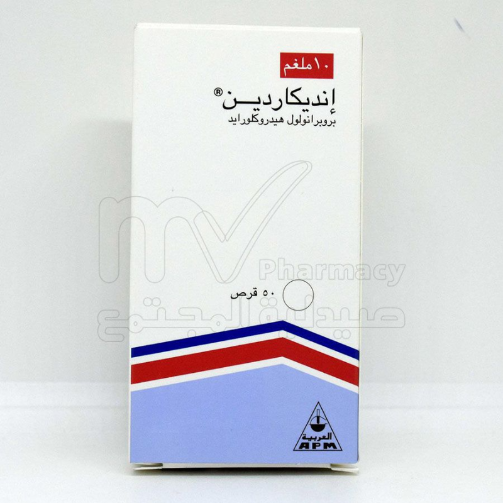
INDICARDIN 10MG 50TAB
- Sku : I-022971
Key features
INDICARDIN 10MG 50TAB is a prescription tablet formulation containing propranolol 10 mg per tablet. It is a non‑selective beta‑adrenergic receptor antagonist (β1 and β2) that reduces heart rate and contractility, lowers cardiac output and blood pressure, and suppresses renin release. INDICARDIN is indicated for hypertension, angina pectoris, certain cardiac arrhythmias (including rate control in atrial fibrillation and supraventricular tachyarrhythmias), secondary prevention after myocardial infarction, migraine prophylaxis, essential tremor, hypertrophic obstructive cardiomyopathy, and as adjunctive therapy in pheochromocytoma. Available as 10 mg tablets in a pack of 50; prescription only.- Brand: INDICARDIN
- Active Ingredient: PROPRANOLOL
- Strength: 10mg
- Dosage Form: Tablet
- Pack Size: 50 Tablets
- Route: Oral use
- Prescription Status: Prescription
- Therapeutic Class: Cardiovascular
- Pharmacological Group: Beta-Blockers
- Drug Class: Non-selective Beta-Adrenergic Blocker (Beta-Blocker)
- Manufacturer: APM
- Country of Origin: Jordan
- SFDA Registration No.: 94-119-00
- Shelf Life: 60 months
- Storage: store below 30°c
- Cv Drug Class: Beta-Blocker
Health Care & Wellness > Medical Devices And Accessories
Health Care & Wellness > Medical Devices And Accessories
Vitamins & Supplements > Omega-3 Supplements
Vitamins & Supplements > Omega-3 Supplements
Vitamins & Supplements > Omega-3 Supplements
Indications
Approved Uses
Hypertension; angina pectoris; cardiac arrhythmias (e.g., rate control in atrial fibrillation/supraventricular tachyarrhythmias); secondary prevention after myocardial infarction; migraine prophylaxis; essential tremor; hypertrophic obstructive cardiomyopathy (hypertrophic subaortic stenosis); pheochromocytoma (adjunct to alpha-blockade).
Off-Label Uses
Common off-label uses include performance anxiety (situational), portal hypertension/variceal bleed prophylaxis, thyrotoxicosis symptom control (adjunct), antipsychotic-induced akathisia, and PTSD-related hyperarousal/nightmares (evidence variable).
Dosage & Administration
Dosing by Condition
Immediate-release oral propranolol typical adult dosing: Hypertension: 40 mg twice daily initially; usual 80-160 mg/day (divided), may increase up to 320 mg/day. Angina: 40 mg 2-3 times daily initially; usual 120-240 mg/day (divided), max ~320 mg/day. Arrhythmias (rate control/SVT): 10-40 mg 3-4 times daily. Migraine prophylaxis: 40 mg twice daily initially; usual 80-160 mg/day (divided). Essential tremor: 40 mg twice daily initially; usual 80-160 mg/day (divided; some patients require higher). Post-MI: commonly 40 mg four times daily for 2-3 days then 80 mg twice daily (or equivalent total daily dose per local protocol).
Initial Dose
40 mg twice daily for hypertension and most indications; 10 mg three times daily for anxiety or elderly patients
Maintenance Dose
80-160 mg/day in divided doses for hypertension; dose varies by indication
Maximum Dose
Hypertension: 320mg/day. Angina: 320mg/day. Essential Tremor: 320mg/day. Migraine Prophylaxis: 240mg/day.
Children's Dosage
Arrhythmias: 0.25-0.5 mg/kg three to four times daily (oral); Hypertension: 0.5-1 mg/kg/day in divided doses, max 4 mg/kg/day. Use under specialist supervision only.
Dose Adjustment Notes
Titrate gradually to effect and tolerability (often every 3-7 days or weekly); use caution and consider lower doses in hepatic impairment; no routine renal dose adjustment, but use caution in severe renal impairment and in the elderly.
How to Take
Swallow tablet with water; may be taken with or without food, but take consistently with respect to meals (food can increase propranolol bioavailability).
Side Effects
Common Side Effects
Fatigue/tiredness, dizziness, bradycardia, hypotension, cold extremities, gastrointestinal upset (nausea/diarrhea), and sleep disturbance/vivid dreams (sometimes nightmares).
Side Effect Frequency
Common (1-10%): fatigue, dizziness, bradycardia, cold extremities, sleep disturbances/nightmares, gastrointestinal upset (nausea, diarrhea/constipation). Uncommon (<1%): hypotension, bronchospasm (especially in asthma/COPD), rash/psoriasiform reactions, depression/sexual dysfunction, AV block/heart failure exacerbation, thrombocytopenia, alopecia.
Safety & Warnings
Contraindications
Contraindicated in bronchial asthma/bronchospasm; cardiogenic shock; overt/uncontrolled heart failure; severe bradycardia; sick sinus syndrome (unless paced); second- or third-degree AV block (unless paced); hypersensitivity to propranolol (and generally avoid in severe peripheral arterial circulatory disorders).
Warnings & Precautions
Key warnings/precautions: avoid abrupt discontinuation (taper); caution/avoid in asthma or significant bronchospastic disease; may mask hypoglycemia and hyperthyroidism signs; caution in diabetes, peripheral vascular disease/Raynaud’s, conduction disease (1st-degree AV block), and heart failure (monitor); perioperative management should be coordinated with anesthesia; hepatic impairment may increase exposure.
Age Restriction
No fixed minimum age in labeling; pediatric use is indication-specific and should be specialist/physician-directed (notably, use for anxiety/performance anxiety is generally not established/approved in children).
Driving Warning
May Cause Drowsiness
Drug Interactions
Drug Interactions
Clinically important interactions include: verapamil/diltiazem (additive bradycardia/AV block/hypotension); digoxin (bradycardia/AV block); clonidine (severe rebound hypertension if clonidine stopped first); insulin/oral hypoglycemics (masks hypoglycemia); other antihypertensives (additive hypotension); NSAIDs (may blunt antihypertensive effect); CYP inhibitors like cimetidine (↑ propranolol) and inducers like rifampin (↓ propranolol); antiarrhythmics (additive negative inotropy/conduction effects); caution with fingolimod (marked bradycardia).
Food Interaction
Food can increase propranolol bioavailability; take consistently with respect to meals (with food may reduce GI upset for some patients).
Special Populations
Pregnancy
Consult Doctor
Children
Arrhythmias: 0.25-0.5 mg/kg three to four times daily (oral); Hypertension: 0.5-1 mg/kg/day in divided doses, max 4 mg/kg/day. Use under specialist supervision only.
Elderly
Start at lower doses (e.g., 10 mg twice daily), titrate slowly, monitor heart rate and blood pressure closely due to increased sensitivity and risk of bradycardia and hypotension
Kidney Impairment
No routine renal dose adjustment is typically required; use caution and monitor in severe renal impairment.
Storage & Patient Advice
Stopping the Medicine
Do not stop abruptly; taper gradually over at least 1-2 weeks (often longer, e.g., up to a few weeks) under medical supervision, especially in ischemic heart disease.
Overdose
Overdose may cause severe bradycardia, hypotension, AV block, cardiogenic shock, bronchospasm, hypoglycemia, seizures, and cardiac arrest; management is emergency supportive care with early decontamination when appropriate, IV fluids/vasopressors, atropine, and IV glucagon as a key antidotal therapy (plus pacing/high-dose insulin therapy per toxicology protocols when refractory).
Patient Counseling
Take exactly as prescribed and at consistent times (and consistently with meals); do not stop abruptly-taper to avoid rebound angina/arrhythmia/MI risk; may cause dizziness/fatigue-use caution driving; check pulse/BP as advised and seek care for very slow pulse, fainting, wheeze/shortness of breath, or swelling; in diabetes, it can mask hypoglycemia warning signs-monitor glucose; inform clinicians before surgery/anesthesia; limit alcohol if it worsens dizziness/hypotension.
Monitoring Requirements
Monitor blood pressure and heart rate (and symptoms of bradycardia/hypotension); consider ECG when used for arrhythmias or in conduction disease; monitor blood glucose more closely in diabetes; monitor for bronchospasm in asthma/COPD risk; assess hepatic function if clinically indicated in hepatic impairment.
Pharmacology
Mechanism of Action
Non-selective beta-adrenergic receptor antagonist (β1 and β2) that decreases heart rate and contractility, reduces cardiac output and blood pressure, and suppresses renin release.
Onset of Action
Onset for immediate-release oral propranolol is typically within 30-60 minutes (peak effect ~1-2 hours); full antihypertensive benefit may take about 1-2 weeks.
Half-Life
Approximately 3-6 hours (commonly cited ~4 hours; may be prolonged up to ~8 hours depending on formulation and patient factors).
Excretion
Primarily renal excretion of metabolites: >90% recovered in urine mainly as metabolites; <1% excreted unchanged (with a smaller fraction via feces/bile).
Product Information
Available Dosage Forms
Tablet, modified-release capsule, oral solution, intravenous injection
Composition per Dose
Each tablet: 10 mg propranolol hydrochloride
Generic Availability
Yes
OTC Alternatives
No OTC alternative
Cv Drug Class
Beta-Blocker
Legal Disclaimer - Al Mujtama Pharmacy
The product information provided is derived from verified pharmaceutical references and is intended for general health education only. It is not a substitute for professional medical advice, diagnosis, or treatment.
Al Mujtama Pharmacy assumes no legal or medical liability for:
- Any therapeutic decision made based on the information displayed without consulting a licensed physician or pharmacist
- Any discrepancy between the information provided and the product's package insert or SFDA guidelines
- Any misuse of medication resulting from personal interpretation of the content displayed
Important notice: Drug formulations and instructions may vary between production batches. Always rely on the leaflet included inside the product packaging you have, and consult your pharmacist or physician before starting, adjusting, or discontinuing any medication.
By using this content, you acknowledge that you have read this disclaimer and agree that Al Mujtama Pharmacy bears no liability arising from reliance on this information as a substitute for direct medical consultation.
Your health is a trust - always consult your doctor first.
