
Get Free Delivery With No Minimum Order
-1744229570.gif "Almujtama Pharmacy logo")




Health Care & Wellness > Medical Devices And Accessories
Vitamins & Supplements > Omega-3 Supplements
Vitamins & Supplements > Omega-3 Supplements
Health Care & Wellness > Medical Devices And Accessories
Vitamins & Supplements > Omega-3 Supplements
Vitamins & Supplements > Omega-3 Supplements
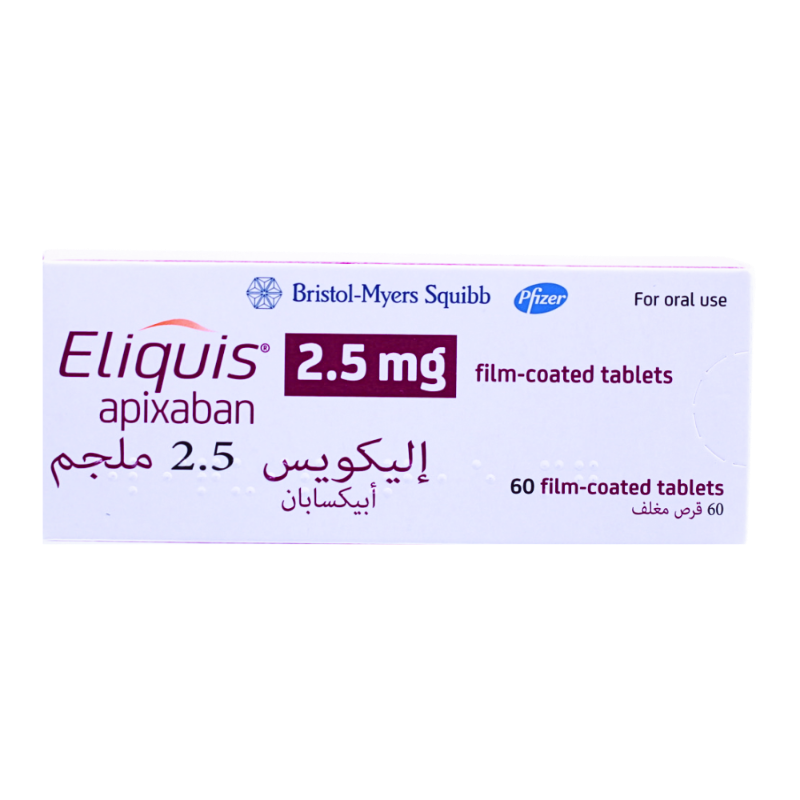
ELIQUIS 2.5MG 60 TAB
- Sku : I-025231
Key features
ELIQUIS 2.5MG 60 TAB is a film-coated tablet containing the active ingredient apixaban 2.5 mg. It is a selective, reversible direct Factor Xa inhibitor that reduces thrombin generation and clot formation without requiring antithrombin. It is used to reduce the risk of stroke and systemic embolism in nonvalvular atrial fibrillation, for prophylaxis of deep vein thrombosis following hip or knee replacement, for treatment of deep vein thrombosis and pulmonary embolism, and to reduce the risk of recurrent DVT and PE after initial therapy. Available by prescription as film-coated tablets in a pack of 60.- Brand: ELIQUIS
- Active Ingredient: APIXABAN 2.5mg
- Strength: 2.5mg
- Dosage Form: Film-coated tablet
- Pack Size: 60 Tablets
- Route: Oral use
- Prescription Status: Prescription
- Therapeutic Class: Antithrombotic
- Pharmacological Group: Direct Oral Anticoagulants
- Drug Class: Direct Factor Xa Inhibitor (Direct Oral Anticoagulant, DOAC)
- Manufacturer: Pfizer Manufacturing Deutschland GmbH
- Country of Origin: Germany
- SFDA Registration No.: 1509258216
- Shelf Life: 36 months
- Storage: store below 30°c
- Cv Drug Class: Anticoagulant
Health Care & Wellness > Medical Devices And Accessories
Vitamins & Supplements > Omega-3 Supplements
Vitamins & Supplements > Omega-3 Supplements
Health Care & Wellness > Medical Devices And Accessories
Vitamins & Supplements > Omega-3 Supplements
Vitamins & Supplements > Omega-3 Supplements
Indications
Approved Uses
To reduce the risk of stroke and systemic embolism in patients with nonvalvular atrial fibrillation, Prophylaxis of deep vein thrombosis (DVT) following hip or knee replacement surgery, Treatment of DVT and pulmonary embolism (PE), To reduce the risk of recurrent DVT and PE after initial therapy.
Dosage & Administration
Dosing by Condition
Nonvalvular AF (stroke/systemic embolism prevention): 5 mg PO twice daily; reduce to 2.5 mg PO twice daily if ≥2 of age ≥80 years, weight ≤60 kg, SCr ≥1.5 mg/dL. DVT/PE treatment: 10 mg PO twice daily for 7 days, then 5 mg PO twice daily. Prevention of recurrent DVT/PE: 2.5 mg PO twice daily after at least 6 months of treatment. Post-hip replacement prophylaxis: 2.5 mg PO twice daily for 35 days. Post-knee replacement prophylaxis: 2.5 mg PO twice daily for 12 days. Start prophylaxis 12-24 hours after surgery once hemostasis achieved.
Initial Dose
2.5 mg twice daily (for DVT/PE secondary prevention and surgical prophylaxis); 10 mg twice daily for 7 days (for acute DVT/PE treatment)
Maintenance Dose
2.5 mg twice daily (prophylaxis of DVT post hip/knee surgery, reduction in risk of recurrent DVT/PE); 5 mg twice daily (NVAF, treatment of DVT/PE after initial 7 days)
Maximum Dose
Maximum labeled regimen is 10 mg twice daily (20 mg/day) for the initial 7 days of acute DVT/PE treatment, then 5 mg twice daily.
Children's Dosage
Approved for pediatric patients from birth and older for treatment of VTE and reduction in risk of recurrent VTE after at least 5 days of initial anticoagulant
Dose Adjustment Notes
NVAF: use 2.5 mg twice daily if the patient has ≥2 of age ≥80 years, body weight ≤60 kg, or serum creatinine ≥1.5 mg/dL; avoid/contraindicated with strong dual CYP3A4/P-gp inducers; with strong dual CYP3A4/P-gp inhibitors, reduce apixaban dose by 50% (and avoid if already on 2.5 mg BID). Renal impairment: no dose adjustment solely for renal function except the NVAF criteria; patients with CrCl <15 mL/min or on dialysis have limited evidence-follow local labeling/specialist guidance.
How to Take
Swallow tablet whole with or without food; for patients unable to swallow, tablet may be crushed and suspended in water, 5% dextrose in water, or apple juice, or mixed with applesauce and administered immediately; can also be administered via nasogastric tube in 60 mL of water or 5% dextrose
Side Effects
Common Side Effects
Bleeding (e.g., bruising, epistaxis, gingival bleeding, hematuria), anemia, nausea
Side Effect Frequency
Very common (≥10%): bleeding (overall/any bleeding). Common (1-10%): anemia, nausea, contusion/bruising/hematoma, epistaxis, hematuria. Uncommon (0.1-1%): thrombocytopenia, hypotension, hypersensitivity reactions (including rash/pruritus). Rare (<0.1%): allergic edema/angioedema. Serious major bleeds (e.g., intracranial or gastrointestinal hemorrhage) are uncommon but clinically significant.
Safety & Warnings
Contraindications
Contraindications: (1) Active pathological bleeding. (2) Severe hypersensitivity reaction to apixaban (e.g., anaphylaxis).
Warnings & Precautions
Key warnings/precautions: increased risk of bleeding; boxed warning for thrombotic risk with premature discontinuation; spinal/epidural hematoma risk with neuraxial anesthesia/spinal puncture; avoid/adjust with strong CYP3A4/P-gp inhibitors/inducers; caution in renal/hepatic impairment and in elderly/low body weight; monitor clinically for bleeding (no routine coagulation monitoring).
Age Restriction
Adults only; safety and efficacy have not been established in patients <18 years.
Drug Interactions
Drug Interactions
Major interactions: strong dual CYP3A4/P-gp inhibitors (e.g., ketoconazole, itraconazole, ritonavir, clarithromycin) ↑ apixaban exposure/bleeding; strong dual CYP3A4/P-gp inducers (e.g., rifampin, carbamazepine, phenytoin, St John’s wort) ↓ exposure/efficacy; other anticoagulants/antiplatelets/NSAIDs ↑ bleeding risk; SSRIs/SNRIs may ↑ bleeding risk.
Interaction Severity
MAJOR: Strong dual CYP3A4/P-gp inhibitors (e.g., ketoconazole, itraconazole, ritonavir/cobicistat) ↑ apixaban exposure/bleeding; strong dual CYP3A4/P-gp inducers (e.g., rifampin, carbamazepine, phenytoin, St John’s wort) ↓ exposure/efficacy-avoid. Additive bleeding risk with other anticoagulants/antithrombotics (antiplatelets, NSAIDs) is clinically significant. MODERATE: SSRIs/SNRIs and other agents affecting hemostasis may increase bleeding risk.
Food Interaction
No restriction.
Special Populations
Pregnancy
Consult Doctor
Children
Approved for pediatric patients from birth and older for treatment of VTE and reduction in risk of recurrent VTE after at least 5 days of initial anticoagulant
Elderly
Dose reduction to 2.5 mg twice daily in AF patients aged ≥80 years if also meeting one additional criterion (weight ≤60 kg or serum creatinine ≥1.5 mg/dL); otherwise standard adult dosing; monitor renal function periodically
Kidney Impairment
NVAF: 5 mg twice daily; reduce to 2.5 mg twice daily if any 2 of: age ≥80 years, weight ≤60 kg, serum creatinine ≥1.5 mg/dL. ESRD on dialysis: US label allows 5 mg BID (reduce to 2.5 mg BID if age ≥80 or weight ≤60), but evidence is limited. VTE treatment/prophylaxis: no routine renal dose adjustment; use caution in severe impairment and avoid if CrCl <15 mL/min due to limited data.
Liver Impairment
Child-Pugh A: no dose adjustment. Child-Pugh B: use with caution (limited data). Child-Pugh C or hepatic disease associated with coagulopathy/clinically relevant bleeding risk: not recommended/avoid.
Storage & Patient Advice
Missed Dose
If a dose is missed, take it as soon as possible on the same day and then continue with twice-daily dosing; do not take a double dose to make up for a missed dose.
Stopping the Medicine
Do not stop apixaban without clinician guidance; if discontinuation is necessary, transition to an alternative anticoagulant to reduce thrombotic risk.
Overdose
Overdose increases bleeding risk; stop apixaban, provide supportive/local hemostatic measures, consider activated charcoal if recent ingestion, and use andexanet alfa (or 4-factor PCC where andexanet is unavailable) for life-threatening/uncontrolled bleeding; hemodialysis is ineffective.
Patient Counseling
Take exactly as prescribed twice daily with or without food; do not stop without medical advice; inform all healthcare providers/dentists; watch for and promptly report signs of bleeding; avoid unnecessary NSAIDs/antiplatelets and limit alcohol; missed dose: take same day ASAP without doubling; store below 30°C.
Monitoring Requirements
No routine coagulation monitoring (e.g., INR) is required; monitor clinically for bleeding and periodically assess renal function, hepatic function as appropriate, and CBC/hemoglobin/hematocrit. Anti-Factor Xa (apixaban-calibrated) levels may be considered only in special situations (e.g., overdose, urgent surgery, extremes of body size, suspected accumulation).
Pharmacology
Mechanism of Action
Selective, reversible, direct Factor Xa inhibitor that reduces thrombin generation and clot formation (does not require antithrombin).
Onset of Action
Peak effect ~3-4 hours after an oral dose.
Duration of Effect
Approximately 12 hours per dose (supports twice-daily dosing); anticoagulant activity declines over ~24-48 hours after the last dose depending on renal/hepatic function.
Half-Life
Approximately 12 hours.
Bioavailability
Approximately 50%.
Metabolism
Metabolized primarily by CYP3A4/5, with minor contributions from other CYP enzymes; also subject to P-gp/BCRP transport.
Excretion
Elimination via multiple pathways: renal excretion ~27% of total clearance; the remainder via biliary/fecal and intestinal excretion and metabolism.
Protein Binding
Approximately 87%.
Product Information
Available Dosage Forms
Film-coated tablet (oral)
Composition per Dose
Each film-coated tablet: 2.5 mg apixaban
Generic Availability
No
OTC Alternatives
No OTC alternative
Cv Drug Class
Anticoagulant
Legal Disclaimer - Al Mujtama Pharmacy
The product information provided is derived from verified pharmaceutical references and is intended for general health education only. It is not a substitute for professional medical advice, diagnosis, or treatment.
Al Mujtama Pharmacy assumes no legal or medical liability for:
- Any therapeutic decision made based on the information displayed without consulting a licensed physician or pharmacist
- Any discrepancy between the information provided and the product's package insert or SFDA guidelines
- Any misuse of medication resulting from personal interpretation of the content displayed
Important notice: Drug formulations and instructions may vary between production batches. Always rely on the leaflet included inside the product packaging you have, and consult your pharmacist or physician before starting, adjusting, or discontinuing any medication.
By using this content, you acknowledge that you have read this disclaimer and agree that Al Mujtama Pharmacy bears no liability arising from reliance on this information as a substitute for direct medical consultation.
Your health is a trust - always consult your doctor first.
