
Get Free Delivery With No Minimum Order
-1744229570.gif "Almujtama Pharmacy logo")




Vitamins & Supplements > Vitamins and Minerals
Vitamins & Supplements > Vitamins and Minerals
Vitamins & Supplements > Vitamins and Minerals
Vitamins & Supplements > Vitamins and Minerals
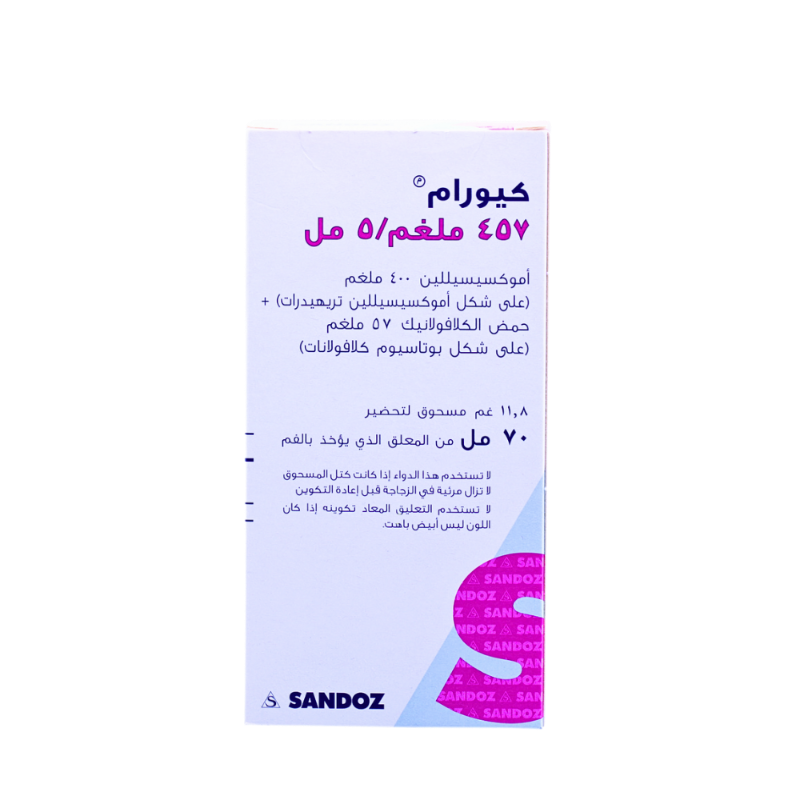
CURAM 457/MG/5/ML 70/ML SUSP
- Sku : I-006947
Key features
CURAM 457 mg/5 mL powder for oral suspension is a prescription antibacterial product containing amoxicillin 400 mg and clavulanic acid 57 mg per 5 mL. Amoxicillin inhibits bacterial cell‑wall synthesis by binding penicillin‑binding proteins, while clavulanic acid inhibits many beta‑lactamases, protecting amoxicillin and extending its antibacterial spectrum. It is indicated for treatment of susceptible bacterial infections including acute otitis media, acute bacterial sinusitis, lower respiratory tract infections (such as community‑acquired pneumonia and acute exacerbations of chronic bronchitis), urinary tract infections, skin and soft tissue infections (including dental infections), and bone and joint infections when pathogens are susceptible. Available by prescription as a reconstitutable powder for oral suspension in a 70 mL bottle.- Brand: CURAM
- Active Ingredient: AMOXICILLIN 400mg/ml, CLAVULANIC ACID 57mg/ml
- Strength: 400,57mg/ml
- Dosage Form: Powder for oral suspension
- Pack Size: 70 ml
- Route: Oral use
- Prescription Status: Prescription
- Therapeutic Class: Anti-infective
- Pharmacological Group: Penicillin + Beta-lactamase Inhibitor
- Drug Class: Aminopenicillin + Beta-lactamase Inhibitor Combination
- Manufacturer: SANDOZ
- Country of Origin: Austria
- SFDA Registration No.: 0909258198
- Shelf Life: 36 months
- Storage: store below 30°c
- Spectrum: Broad-spectrum
- Antibiotic Class: Penicillin
Vitamins & Supplements > Vitamins and Minerals
Vitamins & Supplements > Vitamins and Minerals
Vitamins & Supplements > Vitamins and Minerals
Vitamins & Supplements > Vitamins and Minerals
Indications
Approved Uses
Treatment of susceptible bacterial infections such as: acute otitis media, acute bacterial sinusitis, lower respiratory tract infections (e.g., community-acquired pneumonia, acute exacerbation of chronic bronchitis), urinary tract infections, skin and soft tissue infections (including dental infections); may also be used for bone and joint infections when pathogens are susceptible.
Off-Label Uses
Bite-wound prophylaxis/treatment (animal or human) and selected polymicrobial skin/soft-tissue infections when susceptible; other uses (e.g., chronic rhinosinusitis) may be considered case-by-case based on culture/local guidance.
Dosage & Administration
Dosing by Condition
Pediatrics (using amoxicillin component): AOM/acute bacterial sinusitis: 45 mg/kg/day divided q12h (standard) or 80-90 mg/kg/day divided q12h (high-dose) for ~5-10 days; other susceptible infections commonly 25-45 mg/kg/day divided q12h (severity/site dependent). Adults: commonly 500/125 mg q8h or 875/125 mg q12h for ~5-14 days depending on indication/severity/local guidance.
Initial Dose
Children: 45mg/kg/day of amoxicillin component in 2 divided doses (using 400/57mg per 5ml suspension). Adults: 875mg/125mg every 12 hours or 500mg/125mg every 8 hours.
Maintenance Dose
For children >3 months and <40 kg with more severe infections (e.g., otitis media, sinusitis): 45 mg/kg/day (based on amoxicillin component) divided every 12 hours.
Maximum Dose
Children: up to 90 mg/kg/day (amoxicillin component) in divided doses for selected severe infections; usual pediatric maximum amoxicillin is 4 g/day. Adults: typical maximum amoxicillin 4 g/day (regimen-dependent).
Children's Dosage
Neonates and infants <3 months: 30mg/kg/day amoxicillin component in 2 divided doses. Children 3 months to 12 years (<40kg): 25-45mg/kg/day amoxicillin component in 2 divided doses (standard); up to 90mg/kg/day for high-dose regimen. Children ≥40kg: use adult dosing.
Dose Adjustment Notes
Renal impairment: dose/interval adjustment is required (especially when CrCl <30 mL/min; avoid 875/125 mg-type regimens in severe renal impairment); hepatic impairment: use with caution and monitor liver function; high-dose pediatric regimens (amoxicillin 80-90 mg/kg/day) may be used for selected indications (e.g., AOM/sinusitis with risk of resistant S. pneumoniae).
How to Take
Reconstitute with water as directed; shake well before each dose; measure with an oral syringe/medicine spoon; administer at the start of a meal (or with food) to improve GI tolerability; complete the full prescribed course.
How to Prepare
Tap bottle to loosen powder; add water in two steps (first to about half/just below the mark, shake well; then add water up to the mark/final volume 70 mL and shake vigorously); allow foam to settle and recheck the level, then shake again before dosing.
Side Effects
Common Side Effects
Diarrhea, nausea, vomiting, abdominal pain/indigestion, skin rash/urticaria, and candidiasis (e.g., oral thrush or vaginal yeast infection).
Side Effect Frequency
Very common (≥10%): diarrhea. Common (1-10%): nausea, vomiting, mucocutaneous candidiasis; rash/urticaria may occur (frequency varies by population). Uncommon (0.1-1%): indigestion, abdominal pain, headache, dizziness, elevated liver enzymes. Rare/very rare: cholestatic hepatitis/jaundice, severe cutaneous adverse reactions (SJS/TEN), anaphylaxis, C. difficile-associated diarrhea, blood dyscrasias, seizures (usually with renal impairment/high doses), interstitial nephritis/crystalluria.
Safety & Warnings
Contraindications
Hypersensitivity to amoxicillin/clavulanate or other beta-lactams (e.g., penicillins; consider cephalosporin cross-reactivity) and previous cholestatic jaundice/hepatic dysfunction associated with amoxicillin/clavulanate.
Warnings & Precautions
Screen for beta-lactam allergy and stop immediately if reaction occurs; monitor for C. difficile diarrhea; use caution/monitoring in hepatic disease and avoid if prior Augmentin-related liver injury; adjust dosing in renal impairment; consider rash risk in infectious mononucleosis; prolonged therapy may cause superinfection.
Age Restriction
Not recommended for infants <3 months for this 400/57 mg per 5 mL (7:1) suspension; use an age-appropriate formulation/dosing guidance for neonates/young infants if needed.
Drug Interactions
Drug Interactions
Key interactions: warfarin/other oral anticoagulants (↑INR/bleeding risk-monitor), methotrexate (↑toxicity), allopurinol (↑rash risk), probenecid (↑amoxicillin levels); possible reduced efficacy of oral contraceptives (counsel backup if vomiting/diarrhea or per local guidance); may reduce efficacy of live oral typhoid vaccine.
Interaction Severity
MAJOR: Warfarin/other vitamin K antagonists (↑INR/bleeding-monitor INR), Methotrexate (↓clearance-↑toxicity). MODERATE: Probenecid (↑amoxicillin levels), Allopurinol (↑rash risk), Mycophenolate (↓MPA exposure-monitor), Oral contraceptives (counsel; backup if vomiting/diarrhea). MINOR: Live oral typhoid vaccine (reduced vaccine efficacy).
Food Interaction
Take at the start of a meal (with food).
Special Populations
Children
Neonates and infants <3 months: 30mg/kg/day amoxicillin component in 2 divided doses. Children 3 months to 12 years (<40kg): 25-45mg/kg/day amoxicillin component in 2 divided doses (standard); up to 90mg/kg/day for high-dose regimen. Children ≥40kg: use adult dosing.
Kidney Impairment
CrCl >30 mL/min: no adjustment typically needed; CrCl 10-30 mL/min: extend interval (e.g., q12h); CrCl <10 mL/min: q24h; hemodialysis: dose after dialysis. Note: the 400/57 mg per 5 mL (7:1) suspension is generally not recommended when CrCl <30 mL/min-use an alternative formulation/ratio.
Storage & Patient Advice
Storage Conditions
Before reconstitution: store below 30°C (per SFDA). After reconstitution: refrigerate at 2-8°C, do not freeze, and discard after 7 days.
Preparation Instructions
Tap bottle to loosen powder; add water in two steps (first to about half/just below the mark, shake well; then add water up to the mark/final volume 70 mL and shake vigorously); allow foam to settle and recheck the level, then shake again before dosing.
Missed Dose
Take the missed dose as soon as remembered; if it is close to the next scheduled dose, skip the missed dose and continue the regular schedule; do not double doses.
Stopping the Medicine
Complete the full prescribed course; do not stop early even if symptoms improve.
Overdose
Likely GI upset (nausea/vomiting/diarrhea/abdominal pain); possible crystalluria/renal effects and, rarely, seizures especially with very high doses or renal impairment-seek urgent medical care; management is supportive, maintain hydration, consider activated charcoal if early, and hemodialysis can remove amoxicillin.
Patient Counseling
Shake well before each dose; give at the start of a meal/with food to improve tolerance and clavulanate absorption; measure doses with an oral syringe; complete the full prescribed course; if rash, hives, facial swelling, wheeze or breathing difficulty occur stop and seek urgent care (penicillin allergy); seek medical advice for severe/persistent diarrhea (possible C. difficile) and avoid antidiarrheals unless advised; tell the prescriber about prior liver problems/jaundice with co‑amoxiclav; after reconstitution store refrigerated (2-8°C), do not freeze, and discard after 7 days; keep out of reach of children.
Monitoring Requirements
No routine labs are required for short courses in otherwise healthy patients; for prolonged therapy or high-risk patients, monitor renal function, hepatic function, and CBC; monitor INR closely if used with warfarin.
Pharmacology
Mechanism of Action
Amoxicillin inhibits bacterial cell-wall synthesis by binding PBPs; clavulanic acid inhibits many beta-lactamases, protecting amoxicillin and extending spectrum.
Onset of Action
Peak concentrations occur about 1-2 hours after an oral dose; clinical improvement is typically seen within 48-72 hours if the pathogen is susceptible.
Duration of Effect
Typical dosing intervals are every 8-12 hours (q8h or q12h) depending on formulation and indication; clinical effect requires completing the prescribed course.
Half-Life
Amoxicillin: ~1.0-1.5 hours; Clavulanic acid: ~0.8-1.2 hours (normal renal function).
Bioavailability
Amoxicillin: ~75-90% (fasting); Clavulanic acid: ~60% (range ~50-70%).
Metabolism
Amoxicillin: minimal metabolism (most eliminated unchanged); Clavulanic acid: partially/extensively metabolized (hepatic/non‑renal metabolism) to inactive metabolites.
Excretion
Amoxicillin: primarily renal, ~60-70% excreted unchanged in urine; Clavulanic acid: eliminated by both renal and non‑renal routes, with ~30-50% excreted unchanged in urine and the remainder as metabolites.
Protein Binding
Amoxicillin: ~17-20%; Clavulanic acid: ~22-30% (often cited ~25%).
Product Information
Available Dosage Forms
For this SFDA-registered product: Powder for oral suspension (oral use) in a bottle (70 mL after reconstitution).
Composition per Dose
Each 5ml of reconstituted suspension contains: 400mg amoxicillin as trihydrate and 57mg clavulanic acid as potassium clavulanate.
Generic Availability
Yes
OTC Alternatives
No OTC alternative - prescription required for all amoxicillin/clavulanate products
Spectrum
Broad-spectrum
Antibiotic Class
Penicillin
Legal Disclaimer - Al Mujtama Pharmacy
The product information provided is derived from verified pharmaceutical references and is intended for general health education only. It is not a substitute for professional medical advice, diagnosis, or treatment.
Al Mujtama Pharmacy assumes no legal or medical liability for:
- Any therapeutic decision made based on the information displayed without consulting a licensed physician or pharmacist
- Any discrepancy between the information provided and the product's package insert or SFDA guidelines
- Any misuse of medication resulting from personal interpretation of the content displayed
Important notice: Drug formulations and instructions may vary between production batches. Always rely on the leaflet included inside the product packaging you have, and consult your pharmacist or physician before starting, adjusting, or discontinuing any medication.
By using this content, you acknowledge that you have read this disclaimer and agree that Al Mujtama Pharmacy bears no liability arising from reliance on this information as a substitute for direct medical consultation.
Your health is a trust - always consult your doctor first.
