
Get Free Delivery With No Minimum Order
-1744229570.gif "Almujtama Pharmacy logo")





Health Care & Wellness > Medical Devices And Accessories
Health Care & Wellness > Medical Devices And Accessories
Vitamins & Supplements > Omega-3 Supplements
Vitamins & Supplements > Omega-3 Supplements
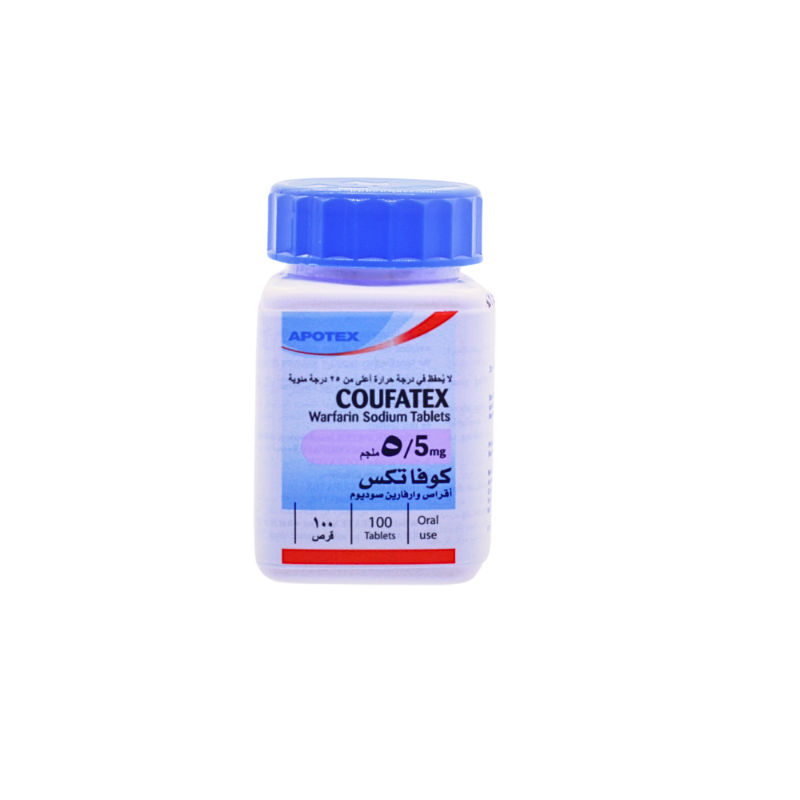
COUFATEX 5/MG TAB 100/TAB
- Sku : I-025690
Key features
COUFATEX 5 mg Tablet 100 Tablets is an oral tablet containing warfarin sodium 5 mg. It is a vitamin K antagonist that inhibits the VKORC1 enzyme, preventing regeneration of active vitamin K and thereby blocking synthesis of vitamin K-dependent clotting factors II, VII, IX and X as well as proteins C and S. It is indicated for prevention and treatment of deep vein thrombosis and pulmonary embolism, for prevention of thromboembolic complications in atrial fibrillation and following mechanical heart valve replacement, and to reduce risk of death, recurrent myocardial infarction and thromboembolic events after myocardial infarction. Available by prescription in tablet form, pack of 100 tablets.- Brand: COUFATEX
- Active Ingredient: WARFARIN SODIUM 5mg
- Strength: 5mg
- Dosage Form: Tablet
- Pack Size: 100 Tablets
- Route: Oral use
- Prescription Status: Prescription
- Therapeutic Class: Antithrombotic
- Pharmacological Group: Vitamin K Antagonists
- Drug Class: Vitamin K Antagonist (VKA) Oral Anticoagulant
- Manufacturer: APOTEX INC. (GRAY RAY)
- Country of Origin: Canada
- SFDA Registration No.: 0211234421
- Shelf Life: 24 months
- Storage: store below 25°c
- Cv Drug Class: Anticoagulant
Health Care & Wellness > Medical Devices And Accessories
Health Care & Wellness > Medical Devices And Accessories
Vitamins & Supplements > Omega-3 Supplements
Vitamins & Supplements > Omega-3 Supplements
Indications
Approved Uses
Prevention and treatment of deep vein thrombosis (DVT), prevention and treatment of pulmonary embolism (PE), prevention of thromboembolic complications in atrial fibrillation, prevention of thromboembolic complications following mechanical heart valve replacement, reduction of risk of death, recurrent myocardial infarction, and thromboembolic events after myocardial infarction
Off-Label Uses
Antiphospholipid syndrome, prevention of recurrent stroke in patients with patent foramen ovale
Dosage & Administration
Dosing by Condition
DVT/PE treatment: Initial 2-5 mg/day, titrate to INR 2.0-3.0, maintenance 2-10 mg/day. Atrial fibrillation: Initial 2-5 mg/day, titrate to INR 2.0-3.0, maintenance 2-10 mg/day. Mechanical heart valves: Initial 2-5 mg/day, titrate to INR 2.5-3.5, maintenance 2-10 mg/day. Post-MI: Initial 2-5 mg/day, titrate to INR 2.0-3.0
Initial Dose
2-5 mg once daily (individualized based on patient factors including age, weight, CYP2C9/VKORC1 genotype if available)
Maintenance Dose
2-10 mg once daily, adjusted to maintain target INR (typically 2.0-3.0 for most indications)
Maximum Dose
No fixed maximum; dose is entirely INR-guided. Doses above 10 mg/day are rarely required
Children's Dosage
Pediatric use is off-label; initial dose 0.1-0.2 mg/kg/day (max 10 mg), titrated to target INR under specialist supervision
Dose Adjustment Notes
Dose must be individualized based on INR response. Elderly, malnourished, hepatic impairment, and patients with CYP2C9 poor metabolizer status require lower doses. Titrate in small increments (0.5-1 mg) and recheck INR after each adjustment. Concurrent interacting drugs require close INR monitoring and dose adjustment
How to Take
Swallow tablet whole with a glass of water. Take at the same time each day, with or without food. Maintain consistent dietary vitamin K intake. Do not crush or chew unless directed.
Side Effects
Common Side Effects
Bleeding (minor), bruising, nausea, vomiting, abdominal pain, diarrhea, flatulence, bloating, dysgeusia
Safety & Warnings
Contraindications
Hemorrhagic tendencies or blood dyscrasias, recent or contemplated surgery of the CNS or eye, active bleeding, pregnancy (especially first and third trimester), unsupervised patients with senility, alcoholism, or psychosis, spinal puncture or regional anesthesia, hypersensitivity to warfarin, malignant hypertension, pericarditis or pericardial effusion, bacterial endocarditis
Warnings & Precautions
Requires regular INR monitoring to maintain therapeutic range. Risk of serious and fatal bleeding - any unusual bleeding should be reported immediately. Use with extreme caution in patients with recent surgery, trauma, or invasive procedures. Avoid in patients with uncontrolled hypertension. Skin necrosis and gangrene can occur, particularly in patients with protein C or S deficiency. Calciphylaxis has been reported. Dietary vitamin K intake should remain consistent. Genetic factors (CYP2C9, VKORC1 polymorphisms) significantly affect dose requirements. Bridging anticoagulation required for procedures. Patients must carry anticoagulant alert card.
Age Restriction
No absolute minimum age; use in children is off-label and requires specialist supervision
Drug Interactions
Drug Interactions
NSAIDs (increased bleeding risk), aspirin and antiplatelet agents (increased bleeding risk), antibiotics (altered gut flora affecting vitamin K synthesis - fluoroquinolones, metronidazole, fluconazole significantly increase INR), amiodarone (potent CYP2C9 inhibitor, markedly increases warfarin effect), statins (especially fluvastatin, rosuvastatin - increase INR), rifampicin (induces CYP2C9, reduces warfarin effect), carbamazepine (reduces warfarin effect), phenytoin (complex interaction, may increase or decrease INR), herbal supplements (St. John's Wort reduces effect; garlic, ginkgo, fish oil increase bleeding risk), clopidogrel (increased bleeding risk), heparin (additive anticoagulation), SSRIs (increased bleeding risk)
Interaction Severity
MAJOR: Amiodarone (potent CYP2C9 inhibition, markedly increases INR and bleeding risk); Fluconazole/azole antifungals (CYP2C9 inhibition, significantly increases INR); Rifampicin (CYP2C9/3A4 induction, markedly reduces anticoagulant effect); NSAIDs including aspirin (additive bleeding risk, GI mucosal damage); Metronidazole (CYP2C9 inhibition, significantly increases INR). MODERATE: Statins - fluvastatin, rosuvastatin (CYP2C9 inhibition, increases INR); SSRIs (antiplatelet effect increases bleeding risk); Clopidogrel (additive antiplatelet effect); Fluoroquinolones (reduced vitamin K synthesis, increases INR); Phenytoin (complex bidirectional interaction). MINOR: Paracetamol/acetaminophen at high doses (may modestly increase INR); Omeprazole (minor CYP2C19 interaction)
Food Interaction
Consistent dietary vitamin K intake is essential - large changes in consumption of vitamin K-rich foods (green leafy vegetables such as spinach, kale, broccoli) can significantly alter INR. Grapefruit juice has minimal interaction but cranberry juice may increase INR. Take at the same time each day regardless of meals.
Alcohol Interaction
Avoid
Special Populations
Pregnancy
Category X (contraindicated except in women with mechanical heart valves)
Breastfeeding
Caution
Children
Pediatric use is off-label; initial dose 0.1-0.2 mg/kg/day (max 10 mg), titrated to target INR under specialist supervision
Elderly
Start at lower doses (1-2 mg/day); elderly patients are more sensitive to warfarin due to reduced CYP2C9 activity, lower albumin, polypharmacy, and dietary variability. Monitor INR more frequently.
Kidney Impairment
No specific dose adjustment required for renal impairment; however, patients with renal impairment may have altered warfarin sensitivity and require more frequent INR monitoring and careful dose titration
Liver Impairment
Use with caution in hepatic impairment - liver disease impairs synthesis of clotting factors and warfarin metabolism, increasing sensitivity and bleeding risk. Start at lower doses and monitor INR closely. Severe hepatic impairment: use is generally contraindicated or requires extreme caution with very close monitoring.
Storage & Patient Advice
Missed Dose
Take the missed dose as soon as remembered on the same day. Do not double the dose the next day to make up for a missed dose. Inform healthcare provider if a dose is missed, as INR monitoring may be required.
Stopping the Medicine
Do not stop abruptly without medical advice - abrupt discontinuation increases risk of thromboembolic events. Taper or transition to alternative anticoagulation under medical supervision if discontinuation is required.
Overdose
Symptoms: excessive bleeding, hematuria, melena, hemoptysis, intracranial hemorrhage, prolonged INR. Management: withhold warfarin, administer vitamin K1 (phytomenadione) orally or IV depending on severity, fresh frozen plasma or prothrombin complex concentrate (PCC) for life-threatening bleeding. Seek immediate emergency medical attention. Activated charcoal may be considered if ingestion is recent.
Patient Counseling
Take warfarin exactly as prescribed at the same time every day. Never change your dose without consulting your doctor. Attend all INR blood test appointments - this test is essential to ensure your dose is correct. Report any unusual bleeding immediately: blood in urine or stools, prolonged bleeding from cuts, unusual bruising, coughing or vomiting blood, severe headache, or dizziness. Keep your diet consistent - do not suddenly increase or decrease foods high in vitamin K (spinach, kale, broccoli, cabbage). Avoid alcohol or limit intake strictly as it affects warfarin levels. Inform all healthcare providers including dentists that you are taking warfarin before any procedure. Carry your anticoagulant alert card at all times. Many common medications including over-the-counter drugs and herbal supplements interact with warfarin - always check before taking anything new. Do not stop taking warfarin without medical advice.
Monitoring Requirements
INR monitoring: daily or every other day during initiation until stable, then weekly, then monthly once stable. Liver function tests periodically. Complete blood count periodically. Signs and symptoms of bleeding at every visit.
Pharmacology
Mechanism of Action
Inhibits vitamin K epoxide reductase complex 1 (VKORC1), preventing regeneration of vitamin K1 epoxide to its active form, thereby blocking synthesis of vitamin K-dependent clotting factors II, VII, IX, and X, as well as anticoagulant proteins C and S
Onset of Action
Anticoagulant effect begins within 24 hours; full therapeutic effect (INR in target range) typically achieved in 3-5 days
Duration of Effect
2-5 days after discontinuation (dependent on synthesis of new clotting factors)
Half-Life
20-60 hours (mean approximately 40 hours); racemic mixture - S-warfarin half-life 18-35 hours, R-warfarin half-life 37-89 hours
Bioavailability
>90%
Metabolism
Hepatic via CYP2C9 (primary for S-warfarin, the more potent enantiomer), CYP3A4, and CYP1A2 (for R-warfarin); subject to significant genetic polymorphism
Excretion
Renal (major, as metabolites), fecal (8-25%)
Protein Binding
99% (primarily to albumin)
Product Information
Available Dosage Forms
Tablet
Composition per Dose
Each tablet: 5 mg warfarin sodium
Generic Availability
Yes
OTC Alternatives
No OTC alternative
Cv Drug Class
Anticoagulant
Legal Disclaimer - Al Mujtama Pharmacy
The product information provided is derived from verified pharmaceutical references and is intended for general health education only. It is not a substitute for professional medical advice, diagnosis, or treatment.
Al Mujtama Pharmacy assumes no legal or medical liability for:
- Any therapeutic decision made based on the information displayed without consulting a licensed physician or pharmacist
- Any discrepancy between the information provided and the product's package insert or SFDA guidelines
- Any misuse of medication resulting from personal interpretation of the content displayed
Important notice: Drug formulations and instructions may vary between production batches. Always rely on the leaflet included inside the product packaging you have, and consult your pharmacist or physician before starting, adjusting, or discontinuing any medication.
By using this content, you acknowledge that you have read this disclaimer and agree that Al Mujtama Pharmacy bears no liability arising from reliance on this information as a substitute for direct medical consultation.
Your health is a trust - always consult your doctor first.
