
Get Free Delivery With No Minimum Order
-1744229570.gif "Almujtama Pharmacy logo")





Vitamins & Supplements > Vitamins and Minerals

Vitamins & Supplements > Vitamins and Minerals
Vitamins & Supplements > Vitamins and Minerals
Vitamins & Supplements > Vitamins and Minerals
Vitamins & Supplements > Vitamins and Minerals
Vitamins & Supplements > Vitamins and Minerals
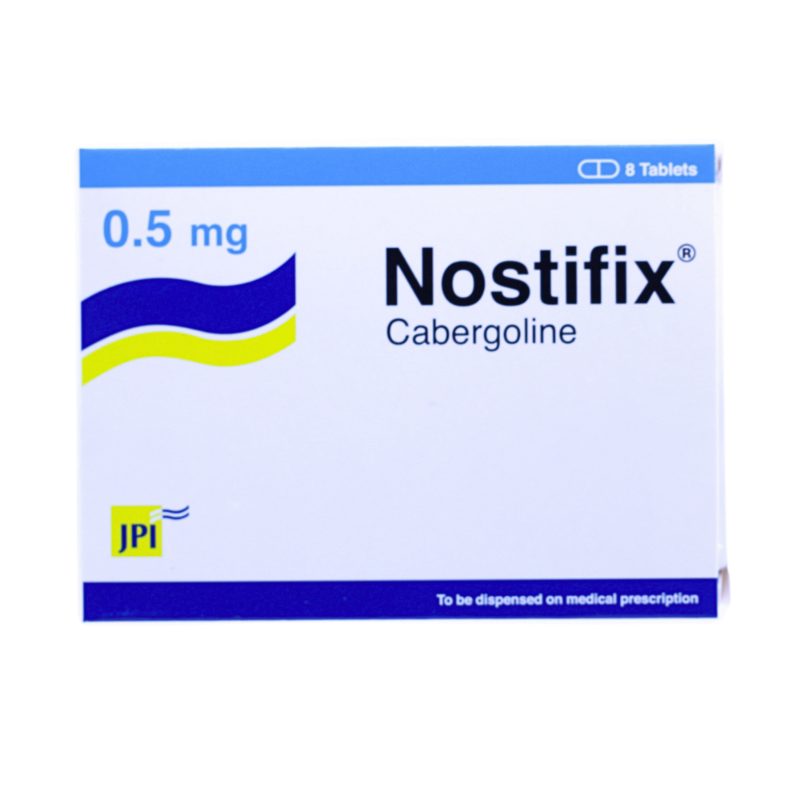
NOSTIFIX 0.5MG 8TAB
- Sku : I-022589
Key features
NOSTIFIX 0.5 mg Tablet is a prescription tablet containing cabergoline 0.5 mg. It works as a long-acting dopamine D2 receptor agonist that helps reduce prolactin secretion from the pituitary gland. It is used for the treatment of hyperprolactinemic disorders, including idiopathic hyperprolactinemia and prolactin-secreting pituitary adenomas. It is available in a pack of 8 tablets.- Brand: NOSTIFIX
- Active Ingredient: CABERGOLINE
- Strength: 0.5mg
- Dosage Form: Tablet
- Pack Size: 8 Tablets
- Route: Oral use
- Prescription Status: Prescription
- Therapeutic Class: Genitourinary
- Pharmacological Group: Uterine Drugs
- Drug Class: Dopamine D2 Receptor Agonist / Ergot Derivative / Prolactin Inhibitor
- Manufacturer: Jazeera Pharmaceutical Industries (JPI)
- Country of Origin: Saudi Arabia
- SFDA Registration No.: 0309234090
- Shelf Life: 24 months
- Storage: store below 30°c
- Hormone Type: Non-hormonal
- Method: Oral
Vitamins & Supplements > Vitamins and Minerals
Vitamins & Supplements > Vitamins and Minerals
Vitamins & Supplements > Vitamins and Minerals
Vitamins & Supplements > Vitamins and Minerals
Vitamins & Supplements > Vitamins and Minerals
Vitamins & Supplements > Vitamins and Minerals
Indications
Approved Uses
Treatment of hyperprolactinemic disorders (idiopathic hyperprolactinemia or due to prolactin‑secreting pituitary adenomas).
Off-Label Uses
Off-label: Parkinson’s disease (rarely used now), restless legs syndrome, Cushing’s disease (selected cases), and adjunctive use in infertility/ovulation restoration in hyperprolactinemic women (often considered part of hyperprolactinemia management rather than a separate indication).
Dosage & Administration
Dosing by Condition
Hyperprolactinemic disorders: start 0.25 mg twice weekly (or 0.5 mg/week total), then increase by 0.25 mg twice weekly (0.5 mg/week) at intervals of at least 4 weeks as needed; usual maintenance 0.5-1 mg/week (often 1-2 mg/week in practice); maximum commonly referenced is 1 mg twice weekly (2 mg/week) per many product labels, though higher weekly doses may be used under specialist supervision for resistant cases. Lactation inhibition/suppression: do not list as an approved regimen unless confirmed on the local SFDA label for this specific product.
Initial Dose
0.25 mg twice weekly (0.5 mg total per week), with dose increases every 4 weeks as needed based on prolactin levels
Maintenance Dose
1-2 mg per week in divided doses (twice weekly) for hyperprolactinemia
Maximum Dose
Adults-At first, 0.25 mg 2 times a week. Your doctor may increase your dose every 4 weeks as needed, according to body prolactin levels, up to 1 mg two times a week.
Children's Dosage
Safety and efficacy have not been established in patients younger than 18 years.
Dose Adjustment Notes
Titrate gradually based on serum prolactin and tolerability; dose increases should generally not occur more frequently than every 4 weeks; after prolactin is normalized and maintained for ~6 months, a supervised trial of dose reduction/discontinuation may be considered; use caution in hepatic impairment (consider lower doses/longer intervals); no routine renal dose adjustment is required but use caution in severe impairment.
Side Effects
Common Side Effects
Nausea, headache, dizziness/vertigo, constipation, abdominal pain/dyspepsia, asthenia/fatigue, somnolence/drowsiness, and orthostatic hypotension.
Safety & Warnings
Contraindications
Hypersensitivity to cabergoline, other ergot alkaloids/derivatives, or any excipients; uncontrolled hypertension; history or evidence of cardiac valvular disorders/valvulopathy; history of pulmonary, pericardial, or retroperitoneal fibrotic disorders; pregnancy-induced hypertension (e.g., pre-eclampsia/eclampsia) and postpartum hypertension (particularly when used for lactation suppression).
Warnings & Precautions
Baseline and periodic cardiovascular evaluation including echocardiography for valvulopathy risk (especially with long-term/higher doses); monitor for fibrotic reactions (pulmonary/pericardial/retroperitoneal) and discontinue if suspected; risk of orthostatic/first-dose hypotension-monitor blood pressure and counsel on dizziness/syncope; monitor for somnolence/sudden sleep onset; monitor for impulse control disorders and psychiatric symptoms; use caution in hepatic impairment; avoid use in hypertensive disorders of pregnancy/postpartum when used for lactation suppression.
Driving Warning
May Cause Drowsiness
Special Populations
Breastfeeding
Contraindicated
Children
Safety and efficacy have not been established in patients younger than 18 years.
Elderly
Start at lower dose, titrate slowly, reflecting the greater frequency of decreased hepatic, renal, or cardiac function.
Liver Impairment
Hepatic impairment: use with caution; in severe hepatic impairment (Child-Pugh C), use lower doses and titrate more slowly due to increased exposure.
Storage & Patient Advice
Stopping the Medicine
Do not discontinue without prescriber guidance; for hyperprolactinemia, consider a trial withdrawal after prolactin has been normal for ~6 months (and tumor stable if applicable), with ongoing prolactin (and clinical) monitoring for recurrence and re-initiation if needed.
Overdose
Symptoms: nausea/vomiting, abdominal discomfort, dizziness/orthostatic hypotension, syncope, confusion, hallucinations/psychosis (and other dopaminergic effects). Management: urgent medical evaluation, supportive care with blood pressure monitoring; consider activated charcoal if early; dopamine antagonists (e.g., metoclopramide) may be used to counter severe dopaminergic symptoms.
Patient Counseling
Take with food to reduce nausea; take on the same day(s) each week as prescribed; rise slowly to reduce dizziness/orthostatic hypotension and avoid alcohol/other contributors if symptomatic; avoid driving/operating machinery if drowsy or dizzy or if sudden sleep episodes occur; report shortness of breath, persistent cough, chest pain, leg swelling, or new back/abdominal pain (possible fibrotic reactions) and report palpitations or new murmur symptoms; report new or increased impulse-control behaviors (e.g., gambling, hypersexuality, compulsive shopping); keep follow-up appointments for prolactin checks and echocardiography if on long-term therapy.
Pharmacology
Mechanism of Action
Long-acting dopamine D2 receptor agonist that inhibits prolactin secretion from lactotroph cells in the anterior pituitary.
Duration of Effect
Prolactin suppression is prolonged; a single dose can have effects for about 7-14 days (sometimes longer depending on dose and patient factors).
Half-Life
63-69 hours.
Product Information
Available Dosage Forms
Tablet.
Composition per Dose
Each tablet: 0.5 mg cabergoline
Generic Availability
Yes
Hormone Type
Non-hormonal
Method
Oral
Legal Disclaimer - Al Mujtama Pharmacy
The product information provided is derived from verified pharmaceutical references and is intended for general health education only. It is not a substitute for professional medical advice, diagnosis, or treatment.
Al Mujtama Pharmacy assumes no legal or medical liability for:
- Any therapeutic decision made based on the information displayed without consulting a licensed physician or pharmacist
- Any discrepancy between the information provided and the product's package insert or SFDA guidelines
- Any misuse of medication resulting from personal interpretation of the content displayed
Important notice: Drug formulations and instructions may vary between production batches. Always rely on the leaflet included inside the product packaging you have, and consult your pharmacist or physician before starting, adjusting, or discontinuing any medication.
By using this content, you acknowledge that you have read this disclaimer and agree that Al Mujtama Pharmacy bears no liability arising from reliance on this information as a substitute for direct medical consultation.
Your health is a trust - always consult your doctor first.
