
Get Free Delivery With No Minimum Order
-1744229570.gif "Almujtama Pharmacy logo")




Vitamins & Supplements > Vitamins and Minerals
Vitamins & Supplements > Vitamins and Minerals
Vitamins & Supplements > Vitamins and Minerals
Vitamins & Supplements > Vitamins and Minerals
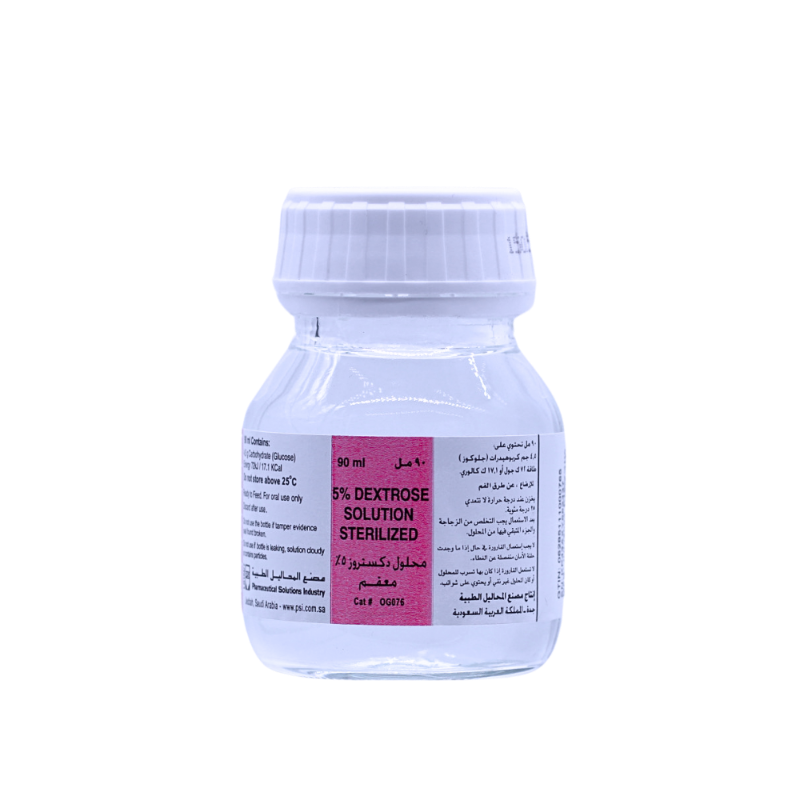
DEXTROSE 5% SOLUTION 90ML
- Sku : I-001640
Key features
Dextrose 10% In 0.225% Sodium Chloride is a prescription solution for injection containing dextrose 10% and sodium chloride 0.225%. It provides a readily metabolizable carbohydrate source for calories while supplying sodium and chloride to help maintain fluid, osmotic, and electrolyte balance. It is indicated for intravenous hydration and for maintenance or replacement of water, carbohydrates, and electrolytes when oral intake is not possible or inadequate. It is available in a 250 ml pack size.- Brand: DEXTROSE
- Active Ingredient: DEXTROSE 10%, SODIUM CHLORIDE 0.225%
- Strength: 10,0.225%
- Dosage Form: Solution for injection
- Pack Size: 250 ml
- Route: Intravenous use
- Prescription Status: Prescription
- Therapeutic Class: Blood & Blood Forming Organs
- Drug Class: Intravenous electrolyte and carbohydrate replenisher (source of water, dextrose, sodium, and chloride
- Manufacturer: Pharmaceutical Solution Industries (PSI)
- Country of Origin: Saudi Arabia
- SFDA Registration No.: 223-149-01
- Shelf Life: 48 months
- Storage: store below 25°c
- Primary Use: Intravenous fluid and caloric replacement for hydration, electrolyte replenishment, and energy supplementation
Vitamins & Supplements > Vitamins and Minerals
Vitamins & Supplements > Vitamins and Minerals
Vitamins & Supplements > Vitamins and Minerals
Vitamins & Supplements > Vitamins and Minerals
Indications
Approved Uses
Indicated as a source of water, carbohydrate calories (dextrose), and electrolytes (sodium/chloride) for intravenous hydration and maintenance/replacement of fluids and electrolytes when oral intake is not possible or inadequate.
Off-Label Uses
Common off-label uses include serving as a compatible IV diluent/vehicle for certain medications and as part of hyperkalemia management when paired with insulin (institutional protocols vary and require close glucose monitoring).
Dosage & Administration
Dosing by Condition
Dose and infusion rate are individualized based on age, weight, clinical condition, and laboratory monitoring (fluid status, electrolytes, glucose); administer per prescriber order rather than a fixed mL/day regimen.
Dose Adjustment Notes
Use with caution and consider lower rates/volumes with close monitoring in patients at risk of fluid overload or impaired clearance (e.g., heart failure, renal impairment, edema/sodium retention states); in diabetes or stress hyperglycemia, adjust infusion and/or insulin based on frequent blood glucose and electrolyte monitoring.
How to Take
For intravenous infusion only using aseptic technique; inspect solution and container for particulate matter/leaks/discoloration before use; administer at the prescribed rate (preferably via infusion pump) and avoid rapid infusion-hypertonic dextrose solutions (e.g., 10%) should be infused slowly and preferably via a large peripheral vein or central access to reduce phlebitis/extravasation risk; do not use plastic containers in series connections.
How to Prepare
Ready-to-use IV solution; no reconstitution. Inspect for particulate matter/discoloration and container integrity before use. If additives are required, use aseptic technique, verify compatibility, and mix thoroughly after addition.
Side Effects
Common Side Effects
Hyperglycemia; fluid overload/hypervolemia (including edema); electrolyte disturbances (e.g., hypokalemia and other dilutional shifts); infusion-site reactions such as pain/irritation, phlebitis/thrombosis, and extravasation; less commonly febrile response/infection related to IV access.
Side Effect Frequency
Frequency varies by patient and infusion rate; commonly reported: infusion-site reactions (phlebitis, pain/irritation, thrombosis/extravasation) and fluid/electrolyte disturbances. Hyperglycemia and fluid overload are clinically important and may be common with higher dextrose loads/rapid or large-volume infusion; electrolyte abnormalities (e.g., hypo-/hypernatremia, hypokalemia, hypophosphatemia) can occur.
Safety & Warnings
Contraindications
Contraindications: hypersensitivity to components (including corn-derived dextrose where relevant); clinically significant hyperglycemia; and conditions where sodium/chloride or fluid administration is contraindicated (e.g., severe hypernatremia/hyperchloremia or severe fluid overload states).
Warnings & Precautions
Monitor blood glucose, serum electrolytes, and fluid balance/acid-base status; use caution in diabetes, cardiac/renal impairment, and patients at risk of fluid overload; avoid rapid/excess infusion; ensure solution clarity/sterility; do not co-administer with blood products through the same line.
Age Restriction
No absolute age restriction; may be used in all age groups with heightened caution and close monitoring in neonates/infants.
Drug Interactions
Food Interaction
Not applicable (IV product); no clinically meaningful food interactions.
Special Populations
Kidney Impairment
No formal renal dose adjustment, but use caution in renal impairment-limit volume/sodium load and monitor fluid balance and electrolytes closely.
Storage & Patient Advice
Storage Conditions
Store below 25°C. Protect from freezing. Single-use only; discard unused portion.
Preparation Instructions
Ready-to-use IV solution; no reconstitution. Inspect for particulate matter/discoloration and container integrity before use. If additives are required, use aseptic technique, verify compatibility, and mix thoroughly after addition.
Missed Dose
Not applicable in the usual sense because it is administered under medical supervision; if an infusion is interrupted, the clinician should reassess fluid/glucose/electrolyte needs and restart/adjust as appropriate.
Stopping the Medicine
Discontinuation is a clinical decision; if high-rate/prolonged dextrose infusions are stopped, reduce rate and monitor glucose to avoid hypoglycemia.
Overdose
Overdose may cause hyperglycemia with glycosuria/osmotic diuresis, fluid overload (including pulmonary edema), and electrolyte/acid-base disturbances (including sodium/chloride abnormalities); management is to stop/reduce infusion, correct fluids/electrolytes, and use insulin/diuretics/supportive care as clinically indicated.
Patient Counseling
Administered intravenously by healthcare professionals; do not self-administer. Report infusion-site pain/redness/swelling or leakage (extravasation). Inform clinicians if you have diabetes, heart failure, kidney disease, or are on fluid/salt restrictions; blood glucose and electrolytes may be monitored during infusion.
Monitoring Requirements
Monitor fluid balance (intake/output, weight, signs of edema/pulmonary congestion), serum glucose, and serum electrolytes (at minimum sodium, potassium, chloride; consider magnesium/phosphate with significant dextrose loads or prolonged therapy) and acid-base status as clinically indicated; monitor renal function in at-risk patients.
Pharmacology
Mechanism of Action
Dextrose provides a readily metabolizable carbohydrate source supplying calories and contributing to osmolarity; sodium chloride supplies extracellular sodium and chloride to help maintain intravascular/extracellular volume, osmotic pressure, and electrolyte balance.
Onset of Action
Immediate (upon IV administration)
Duration of Effect
No fixed duration; clinical effects (hydration, electrolyte delivery, caloric/glucose effect) occur during infusion and depend on the administered volume/rate and patient metabolism/renal handling.
Half-Life
Not meaningfully defined/clinically applicable (no single half-life for IV dextrose or sodium chloride due to rapid utilization and tight physiologic regulation).
Bioavailability
100% (intravenous administration)
Metabolism
Dextrose is metabolized via glycolysis and subsequent oxidative pathways to CO2 and water (and stored as glycogen); sodium and chloride are not metabolized.
Excretion
Dextrose: primarily metabolized/used by tissues; only excess is excreted renally as glucose if plasma levels exceed the renal threshold. Sodium and chloride: predominantly renal excretion with homeostatic regulation.
Protein Binding
0% / negligible (dextrose not protein bound; sodium and chloride not protein bound).
Product Information
Available Dosage Forms
Solution for injection/infusion (intravenous solution) supplied in a bottle.
Composition per Dose
Each 250 mL: Dextrose 10% (25 g dextrose) + Sodium Chloride 0.225% (562.5 mg sodium chloride)
Generic Availability
Yes
OTC Alternatives
No OTC alternative
Primary Use
Intravenous fluid and caloric replacement for hydration, electrolyte replenishment, and energy supplementation
Legal Disclaimer - Al Mujtama Pharmacy
The product information provided is derived from verified pharmaceutical references and is intended for general health education only. It is not a substitute for professional medical advice, diagnosis, or treatment.
Al Mujtama Pharmacy assumes no legal or medical liability for:
- Any therapeutic decision made based on the information displayed without consulting a licensed physician or pharmacist
- Any discrepancy between the information provided and the product's package insert or SFDA guidelines
- Any misuse of medication resulting from personal interpretation of the content displayed
Important notice: Drug formulations and instructions may vary between production batches. Always rely on the leaflet included inside the product packaging you have, and consult your pharmacist or physician before starting, adjusting, or discontinuing any medication.
By using this content, you acknowledge that you have read this disclaimer and agree that Al Mujtama Pharmacy bears no liability arising from reliance on this information as a substitute for direct medical consultation.
Your health is a trust - always consult your doctor first.
