
Get Free Delivery With No Minimum Order
-1744229570.gif "Almujtama Pharmacy logo")




Vitamins & Supplements > Vitamin_D & Bone Health

Vitamins & Supplements > Vitamin_D & Bone Health
Vitamins & Supplements > Vitamins and Minerals

Vitamins & Supplements > Vitamins and Minerals
Vitamins & Supplements > Vitamin_D & Bone Health
Vitamins & Supplements > Vitamins and Minerals
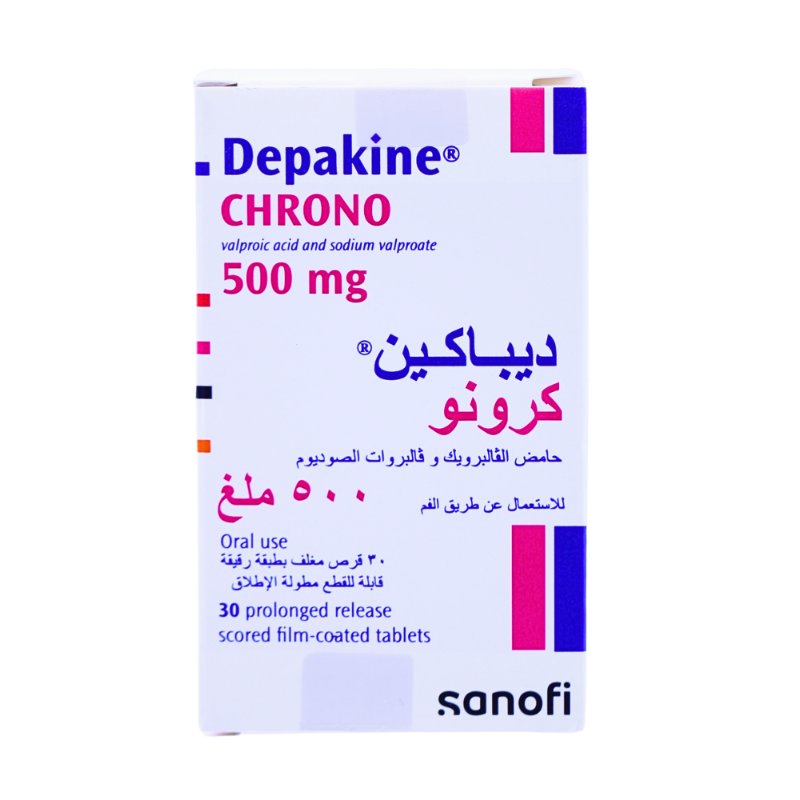
DEPAKIN CHRONO TAB
- Sku : I-001537
Key features
DEPAKIN CHRONO TAB (DEPAKINE) is a prolonged-release film-coated tablet containing valproate sodium 500 mg. It increases brain GABA availability and reduces neuronal excitability through modulation of voltage-gated sodium channels and T-type calcium channels. It is indicated for the treatment of generalized and focal epilepsies (including appropriate syndromes such as Lennox-Gastaut) and for the treatment and, where labelled, prevention of manic episodes in bipolar disorder. Available as 500 mg prolonged-release film-coated tablets in packs of 30; prescription-only.- Brand: DEPAKINE
- Active Ingredient: VALPROATE SODIUM 500mg
- Strength: 500mg
- Dosage Form: Prolonged-release film-coated tablet
- Pack Size: 30 Tablets
- Route: Oral use
- Prescription Status: Prescription
- Therapeutic Class: Anticonvulsant
- Pharmacological Group: Antiepileptics
- Drug Class: Broad-spectrum antiseizure medication (antiepileptic); mood stabilizer; fatty-acid derivative that enhances GABAergic neurotransmission.
- Manufacturer: sanofi-aventis
- Country of Origin: France
- SFDA Registration No.: 1311258585
- Shelf Life: 36 months
- Storage: store below 30°c
- Also Used For: Mood Stabilization, Migraine Prevention, Neuropathic Pain, Anxiety (off-label), Alcohol Withdrawal Seizures (off-label)
Vitamins & Supplements > Vitamin_D & Bone Health
Vitamins & Supplements > Vitamin_D & Bone Health
Vitamins & Supplements > Vitamins and Minerals
Vitamins & Supplements > Vitamins and Minerals
Vitamins & Supplements > Vitamin_D & Bone Health
Vitamins & Supplements > Vitamins and Minerals
Indications
Approved Uses
Epilepsy (generalized and focal/partial seizures, including syndromes such as Lennox-Gastaut where clinically appropriate) and treatment of manic episodes in bipolar disorder; prevention of recurrence of manic episodes may be included in some labels when valproate previously effective; migraine prophylaxis is not an approved indication for this product in many jurisdictions and should not be assumed.
Off-Label Uses
Common off-label uses include migraine prophylaxis (where not labeled), agitation/aggression/impulsivity in selected psychiatric/neurocognitive disorders, and adjunctive use in some psychotic or mood-spectrum conditions; other proposed uses (e.g., neuropathic pain) have variable evidence and are not routine.
Dosage & Administration
Dosing by Condition
Epilepsy (adults): start ~10-15 mg/kg/day, increase by ~5-10 mg/kg/week to usual 20-30 mg/kg/day; higher doses (e.g., >50-60 mg/kg/day) require close monitoring. Acute mania (adults): commonly start 750-1000 mg/day and titrate rapidly to ~1000-2000 mg/day based on response/tolerability.
Initial Dose
10-15 mg/kg/day in 1-2 divided doses for epilepsy; 750 mg/day in divided doses for bipolar mania
Maintenance Dose
20-30 mg/kg/day for epilepsy; 1000-2000 mg/day for bipolar disorder; 500-1000 mg/day for migraine prophylaxis
Maximum Dose
Up to 60 mg/kg/day in some cases, with careful monitoring.
Children's Dosage
Children ≥2 years: 20-30 mg/kg/day in 2-3 divided doses; titrate based on response and tolerability. Children under 2 years: use with extreme caution due to high risk of fatal hepatotoxicity
Dose Adjustment Notes
Titrate to clinical response and tolerability; contraindicated in significant hepatic disease and requires close monitoring in any hepatic impairment; in renal impairment, total valproate levels may be misleading (higher free fraction) so consider dose reduction and monitor free levels/clinical toxicity; use lower starting doses and slower titration in the elderly.
How to Take
Swallow the prolonged-release (chrono) tablet whole with water; do not crush or chew; take with/after food if GI upset occurs; dose is usually once daily or in 2 divided doses as prescribed.
Side Effects
Common Side Effects
Nausea, vomiting, diarrhea, abdominal pain, weight gain, tremor, somnolence, dizziness, headache, alopecia (hair loss), thrombocytopenia, increased appetite
Side Effect Frequency
Very common (>10%): nausea/GI upset, tremor, somnolence/sedation; Common (1-10%): vomiting, diarrhea, abdominal pain, weight gain/increased appetite, dizziness, headache, alopecia (often transient), thrombocytopenia, elevated liver enzymes; Uncommon/Rare (<1%): serious hepatotoxicity, pancreatitis, severe cutaneous reactions (e.g., SJS/TEN/DRESS), encephalopathy/hyperammonemia, blood dyscrasias (e.g., leukopenia/pancytopenia/agranulocytosis), renal tubular dysfunction (e.g., Fanconi).
Safety & Warnings
Contraindications
Contraindications: active liver disease/significant hepatic impairment; personal or family history of severe hepatic dysfunction (especially drug-related); known/suspected mitochondrial disorders caused by POLG mutations (e.g., Alpers-Huttenlocher) and children <2 years suspected of POLG disorder; urea cycle disorders; porphyria; hypersensitivity to valproate; pregnancy for migraine prophylaxis and (per many national risk-minimization programs) pregnancy unless no suitable alternative for epilepsy; women of childbearing potential unless conditions of a Pregnancy Prevention Programme/effective contraception are met.
Warnings & Precautions
Key warnings/precautions: monitor for hepatotoxicity (baseline and early/periodic LFTs; highest risk early and in young children/POLG); pancreatitis vigilance; strict pregnancy prevention/PPP and avoid use in pregnancy unless no suitable alternative; monitor ammonia if unexplained lethargy/vomiting/mental status change (risk of hyperammonemic encephalopathy, increased with topiramate); monitor CBC/platelets and coagulation; monitor for suicidality and severe skin reactions; avoid in urea cycle disorders and POLG-related mitochondrial disease; do not discontinue abruptly.
Age Restriction
Not contraindicated solely by age, but use is restricted/only if essential in children <2 years due to markedly higher risk of fatal hepatotoxicity; contraindicated in patients (including children) with known/suspected POLG-related mitochondrial disorders, and risk is higher with polytherapy.
Driving Warning
May Cause Drowsiness
Drug Interactions
Interaction Severity
MAJOR: Carbapenem antibiotics (e.g., meropenem/imipenem/ertapenem) markedly lower valproate concentrations-avoid. MAJOR: Lamotrigine (valproate increases lamotrigine exposure; high risk of serious rash-use much lower lamotrigine doses and monitor). MODERATE: Enzyme-inducing ASMs (phenytoin, carbamazepine, phenobarbital/primidone) and topiramate (hyperammonemia/encephalopathy risk), and antiplatelet/anticoagulant interactions (e.g., aspirin/warfarin) requiring monitoring.
Food Interaction
May be taken with food to reduce gastrointestinal adverse effects; food has no clinically significant impact on overall exposure for most patients, though it may affect the rate of absorption.
Alcohol Interaction
Avoid
Special Populations
Pregnancy
Contraindicated
Breastfeeding
Caution
Children
Children ≥2 years: 20-30 mg/kg/day in 2-3 divided doses; titrate based on response and tolerability. Children under 2 years: use with extreme caution due to high risk of fatal hepatotoxicity
Elderly
Start at lower doses and titrate slowly; elderly patients have reduced protein binding and altered metabolism leading to higher free drug levels; monitor closely for adverse effects and toxicity
Kidney Impairment
Usually no initial dose adjustment is required, but use caution and consider lower doses/monitoring because reduced protein binding in renal impairment increases the free (active) valproate fraction; interpret total levels cautiously and consider free levels if available.
Liver Impairment
Contraindicated in active liver disease or significant hepatic impairment; if mild impairment/history of liver disease, use only with extreme caution, specialist oversight, and close clinical/LFT monitoring (no reliable routine dose-reduction rule).
Storage & Patient Advice
Stopping the Medicine
Do not stop abruptly; taper gradually under medical supervision (individualized-typically over weeks) to reduce risk of seizure recurrence/status epilepticus and mood relapse.
Overdose
Overdose may cause CNS depression (lethargy to coma), hypotonia/hyporeflexia, miosis, respiratory depression, hypotension, metabolic derangements (e.g., hyperammonemia, metabolic acidosis); management is emergency supportive care (airway/ventilation, hemodynamic support), activated charcoal if appropriate, and consider hemodialysis in severe poisoning/high levels; naloxone has been used for CNS/respiratory depression in some cases but is not definitive therapy.
Patient Counseling
Swallow chrono tablets whole (do not crush/chew); take consistently (with food if stomach upset); do not stop abruptly; avoid alcohol and use caution with driving until effects known; urgently report symptoms of liver injury or pancreatitis and unusual bruising/bleeding; ensure regular blood tests as advised; check before starting new medicines (especially carbapenem antibiotics and lamotrigine); women of childbearing potential must use effective contraception and seek urgent medical advice if pregnancy occurs due to high teratogenic risk.
Monitoring Requirements
Baseline and periodic liver function tests (especially during the first 6 months), full blood count including platelets, and coagulation parameters when clinically indicated (e.g., before surgery or if bleeding/bruising); consider serum valproate concentrations (and free levels in renal impairment, pregnancy, hypoalbuminemia) and ammonia if unexplained lethargy/encephalopathy; monitor weight/metabolic effects and pregnancy status/contraception in women of childbearing potential.
Pharmacology
Mechanism of Action
Increases brain GABA availability (e.g., via inhibition of GABA metabolism) and reduces neuronal excitability through effects on voltage-gated sodium channels and T-type calcium channels.
Duration of Effect
Prolonged-release (chrono) formulation provides sustained concentrations suitable for once-daily or twice-daily dosing, with an approximate duration of effect of about 24 hours (may be closer to 12 hours in some patients depending on dose and metabolism).
Half-Life
Typical elimination half-life ~9-16 hours in adults (can be shorter with enzyme inducers and longer in neonates/elderly/hepatic dysfunction); formulation (prolonged-release) mainly affects absorption/peak-trough, not elimination half-life.
Metabolism
Extensively hepatic: mainly glucuronidation (UGT) and mitochondrial β-oxidation; minor CYP-mediated oxidation (notably CYP2C9/2C19).
Excretion
Primarily renal excretion as metabolites (mainly glucuronide conjugates and other metabolites); <3% excreted unchanged in urine.
Protein Binding
High and concentration-dependent: typically ~90% bound at low/therapeutic concentrations, decreasing as concentrations rise (often ~80-90% at higher levels).
Product Information
Composition per Dose
Each prolonged-release tablet contains 333mg of sodium valproate and 145mg of valproic acid, equivalent to 500mg of sodium valproate.
OTC Alternatives
No OTC alternative
Also Used For
Mood Stabilization, Migraine Prevention, Neuropathic Pain, Anxiety (off-label), Alcohol Withdrawal Seizures (off-label)
Legal Disclaimer - Al Mujtama Pharmacy
The product information provided is derived from verified pharmaceutical references and is intended for general health education only. It is not a substitute for professional medical advice, diagnosis, or treatment.
Al Mujtama Pharmacy assumes no legal or medical liability for:
- Any therapeutic decision made based on the information displayed without consulting a licensed physician or pharmacist
- Any discrepancy between the information provided and the product's package insert or SFDA guidelines
- Any misuse of medication resulting from personal interpretation of the content displayed
Important notice: Drug formulations and instructions may vary between production batches. Always rely on the leaflet included inside the product packaging you have, and consult your pharmacist or physician before starting, adjusting, or discontinuing any medication.
By using this content, you acknowledge that you have read this disclaimer and agree that Al Mujtama Pharmacy bears no liability arising from reliance on this information as a substitute for direct medical consultation.
Your health is a trust - always consult your doctor first.
